Septic to Sewer Conversion in Ohio
City sewer reached your street, and your septic system has served its time. We run a new lateral from your home to the municipal main, tap in, and retire the old tank properly under health department rules.
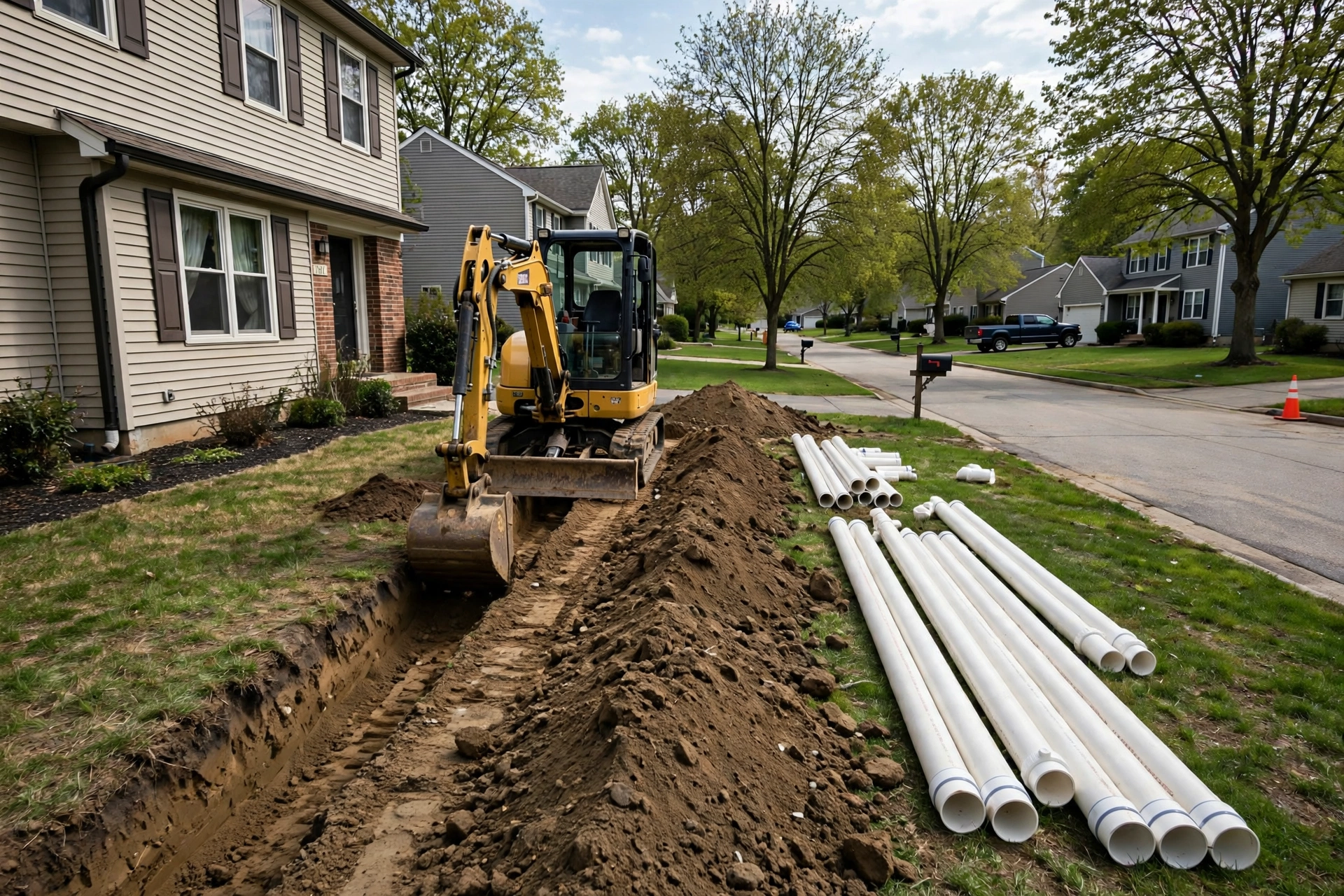
City sewer reached your street, and your septic system has served its time. We run a new lateral from your home to the municipal main, tap in, and retire the old tank properly under health department rules.
Last updated: October 13, 2026
A septic-to-sewer conversion is the process of abandoning a private septic system and connecting a home to the municipal sewer main. Nobody converts on a whim. There is always a trigger, and it is usually one of these three:
There is also the quiet reason: peace of mind. A septic system is a machine you own and maintain. Public sewer is a utility you deal with for monthly and mostly forget about. For many homeowners, especially older ones who do not want the maintenance burden, that trade is worth making the moment the main arrives.
A septic system makes you the owner, maintainer, and eventual replacer of a small wastewater plant in your yard. City sewer makes you a monthly customer while the municipality handles everything downstream. The table below compares the four factors that matter most: maintenance responsibility, monthly work structure, lifespan considerations, and environmental oversight. The U.S. EPA's homeowner guidance on septic systems describes the septic side of this comparison in detail.
| Factor | Septic | City sewer |
|---|---|---|
| Maintenance responsibility | Yours. Regular pumping, water-use discipline, and eventual drainfield replacement all fall on the homeowner. | The city's. You maintain your lateral; the municipality maintains the main and treatment. |
| Monthly work structure | No monthly bill, but periodic pumping work and a large eventual replacement work. | A monthly sewer bill, with no surprise system-replacement work hanging over you. |
| Lifespan considerations | The tank lasts decades, but the drainfield is the wear item and eventually stops absorbing. | Your lateral lasts as long as any buried pipe, and the city handles everything downstream. |
| Environmental oversight | County health district permits and inspections, with state septic rules behind them. | Municipal sewer authority plus state and federal wastewater discharge rules. |
The bottom line: septic trades a monthly bill for a maintenance burden and a large future replacement. City sewer trades the burden for a bill. Most homeowners who have lived through one drainfield failure pick the bill.
We locate your septic tank and field, confirm the city main's location and depth, and map the best route for the new lateral from your house to the street.
We pull the tap permit from the sewer authority and the abandonment permit from the county health district, and schedule the required inspections.
We trench or directionally bore the new lateral from your home to the street main, with proper slope, bedding, and cleanouts.
We connect your new lateral to the city main with an approved tap or saddle fitting, witnessed and inspected per local requirements.
We pump out the old tank and abandon it per health department rules, then restore the yard, trench, and any disturbed surfaces.
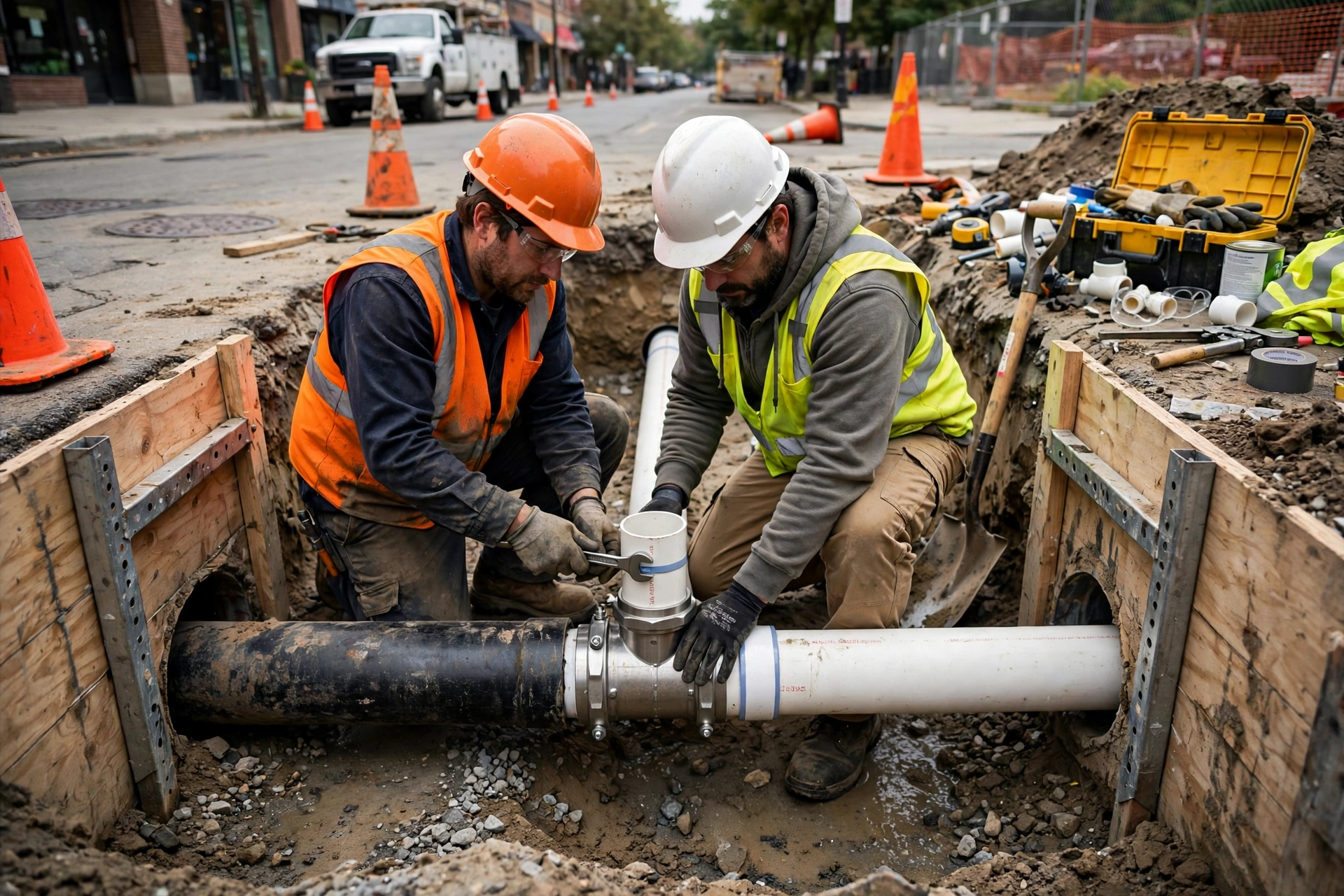
The tap: your new lateral connects to the city main with an approved fitting, inspected before backfill.
It does not stay in the ground as-is. Ohio's county health districts require proper abandonment of any septic system taken out of service, and the rules are specific for good reason: an empty tank underground can collapse under the weight of soil, vehicles, or a future structure, and leftover sludge is a contamination risk. Ohio EPA administers the statewide sewage treatment system rules that county health districts enforce locally.
The standard abandonment process goes like this. First, a licensed pumper empties the tank completely, all liquid and sludge hauled away for proper disposal. Then the tank itself is dealt with per local health district rules: typically the top is crushed or removed and the tank is filled with clean stone, gravel, or soil, compacted to prevent future settling. Some districts require full removal of the tank. The drain field lines are usually left in place once disconnected, since digging them all up would destroy the yard for no benefit.
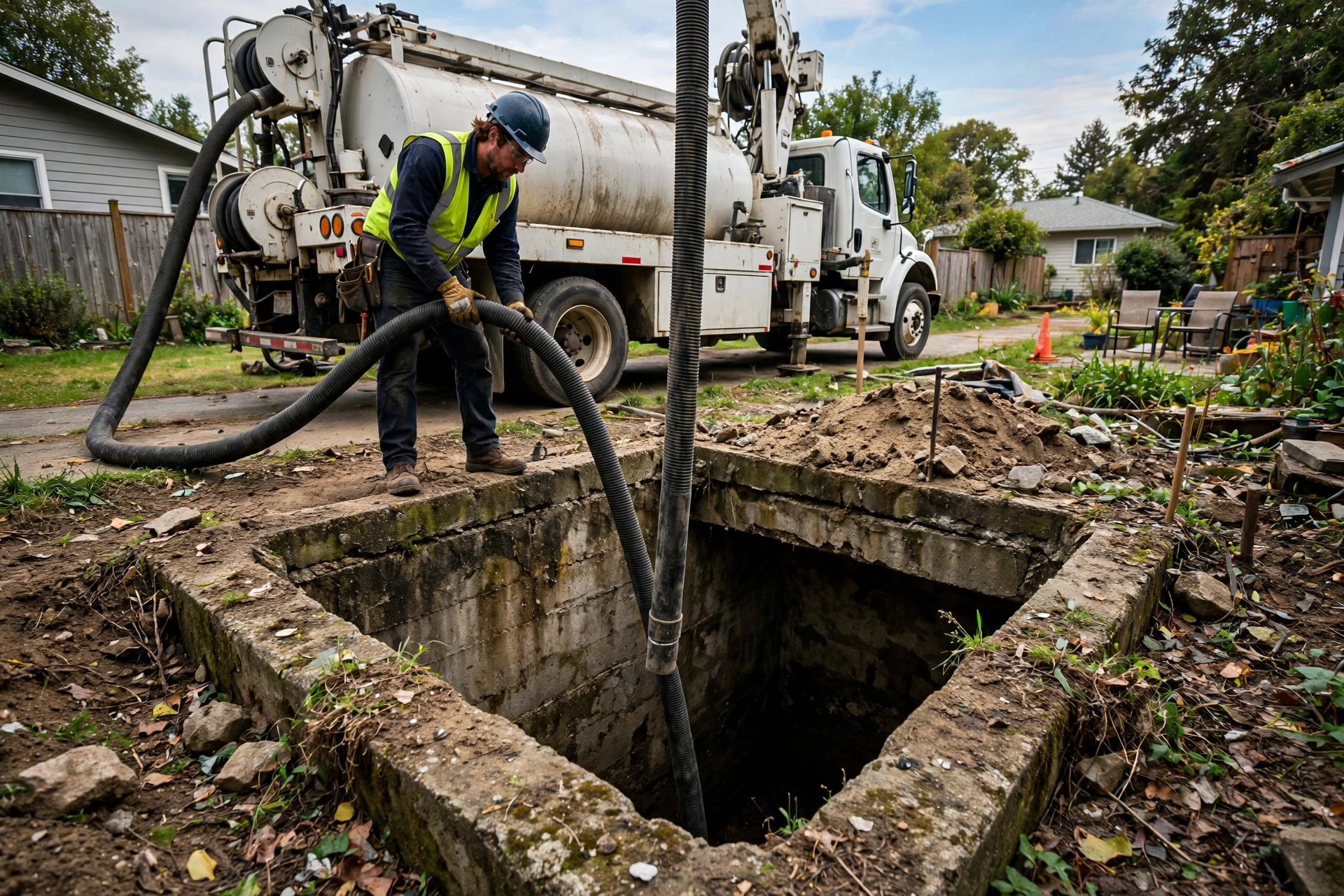
Step one of abandonment: the old tank gets pumped completely dry before it is crushed and filled per health district rules.
We handle the abandonment as part of the conversion, including the health district permit and the final inspection sign-off. You get documentation proving the system was abandoned properly, which matters when you sell: buyers and their inspectors ask for it.
A conversion touches three jurisdictions, and each has its own paperwork:
We pull all three and schedule the inspections in the right sequence, because the order matters: the tap inspection has to happen before backfill, and the abandonment sign-off has to happen before we close out the yard work. Homeowners who try to coordinate this themselves usually discover the sequencing the hard way. It is part of what you are handling us for.
One more coordination point: your plumber inside the house. The new lateral connects to your home's existing building drain, usually at the point where it currently exits toward the septic tank. If your indoor plumbing needs reconfiguration to reach the new lateral route, we flag that during the survey so there are no surprises mid-job.
Conversions vary more than almost any sewer job we do, because the distance to the main and what sits between you and it drive everything. These are the factors that set your plan:
Because the spread is so wide, a phone plan is meaningless. What we do instead: a site survey, then a written fixed plan covering our construction plus the exact municipal requirements we identified. See our Ohio sewer repair guide for the broader process picture, and call (614) 350-5706 to schedule the survey.
In many Ohio jurisdictions, yes. Cities and counties commonly require properties to connect to the public sewer within a set period after a main becomes available to the property, and some prohibit new septic permits in sewered areas. The rule and the timeline vary by municipality, so check your local ordinance or ask us and we will check it for you.
No. Ohio health districts require the old system to be properly abandoned once you connect to public sewer: pumped out, and then crushed and filled or removed per local rules. An unused tank left in the ground is a collapse and contamination hazard, and it will flag on any future property inspection.
The physical work usually takes a few days: trenching or boring the new lateral, tapping the main, and abandoning the tank. Permits and scheduling with the city and county health district add lead time on the front end, sometimes a few weeks depending on the municipality. We give you a realistic schedule after the site assessment.
Less than most homeowners expect. Where the route allows it, we use directional boring to pull the new lateral underground with only small entry and exit pits. Open trenching is still needed in some layouts, and the old tank has to be exposed for abandonment, but we restore everything we disturb.
That is common and solvable. We bore under the road to reach the main, with the proper right-of-way permits from the city or county. Road crossings add work and paperwork, but they are routine work for us, and we handle the permits and traffic coordination.
A conversion is really two projects in one: a new sewer line installation from your house to the street, and the retirement of the old system. Where the route allows, directional drilling and boring gets the new lateral in with minimal surface disruption. And once you are on city sewer, your line is your responsibility from the house to the main, which is where our camera inspection and repair services come in over the years. One call covers the whole conversion, permits to final inspection.
A site survey maps the route, identifies every municipal requirement, and gets you a written fixed plan. No guesswork.
Call (614) 350-5706