Sewer Line Repair in Greater Columbus
Our home base. From German Village clay tile to Dublin subdivision PVC, we know exactly what breaks under Central Ohio and how to fix it: camera first, one upfront price, trenchless or traditional.
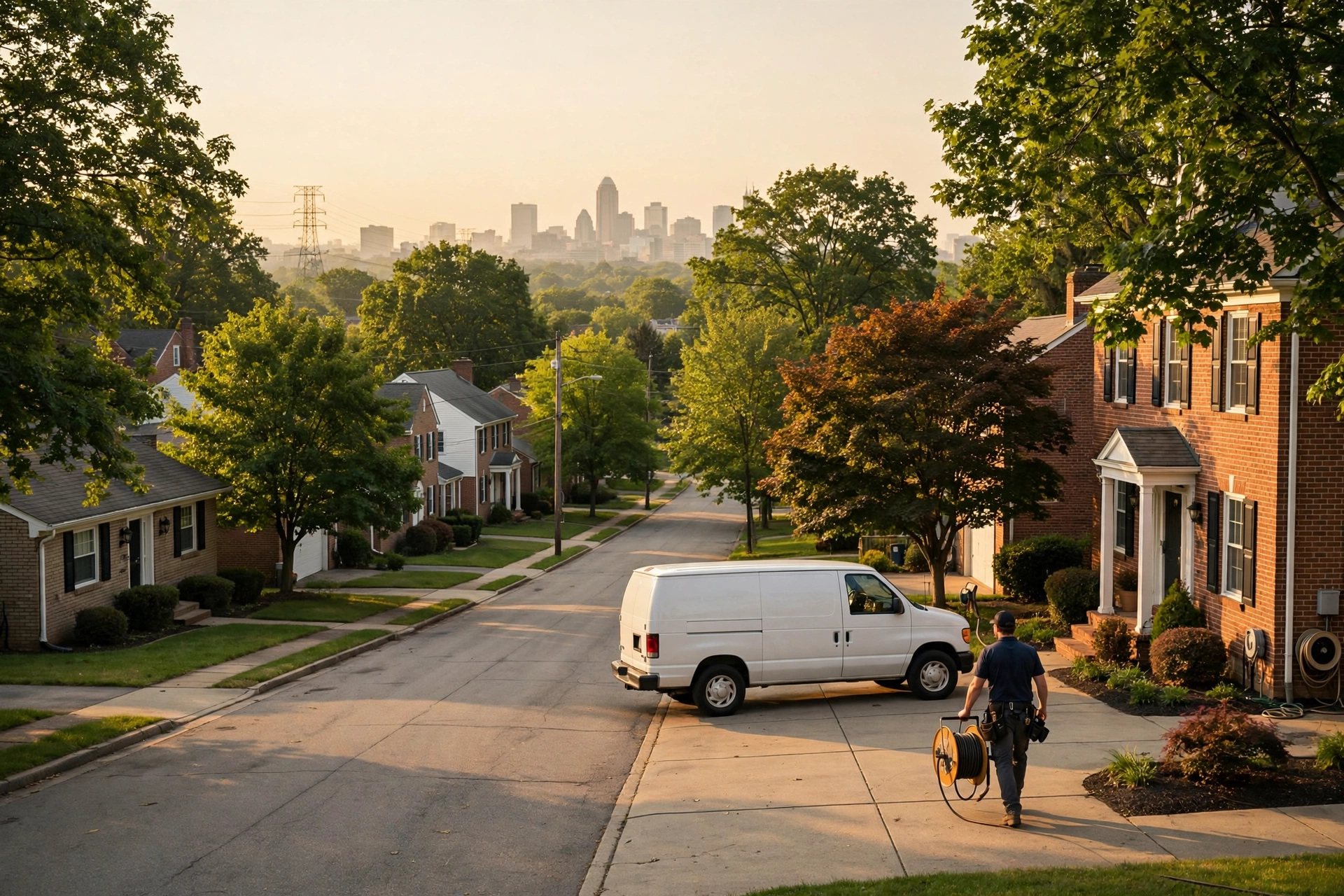
Our home base. From German Village clay tile to Dublin subdivision PVC, we know exactly what breaks under Central Ohio and how to fix it: camera first, one upfront price, trenchless or traditional.
Last updated: October 13, 2026
It's the soil under your feet and the era your house was built in. Together, they predict almost every sewer failure in Central Ohio.
Central Ohio sits on dense glacial clay. When it's wet, the clay swells; when it's dry, it shrinks. Buried sewer pipe doesn't get to move with it, so the joints take the punishment, year after year, until they separate or sag into bellies where waste collects. That's the background condition for every lateral from Marysville to Pickerington.
Then comes the housing era, which decides the material. Columbus is our headquarters city, and its older neighborhoods tell the first story: German Village, Short North, Clintonville, and Victorian Village hold homes from the early 1900s with vitrified clay tile laterals. Clay pipe has a 50 to 60 year design life, which means most of these lines are running on borrowed time, with crumbling mortar joints and root intrusion from mature street trees.
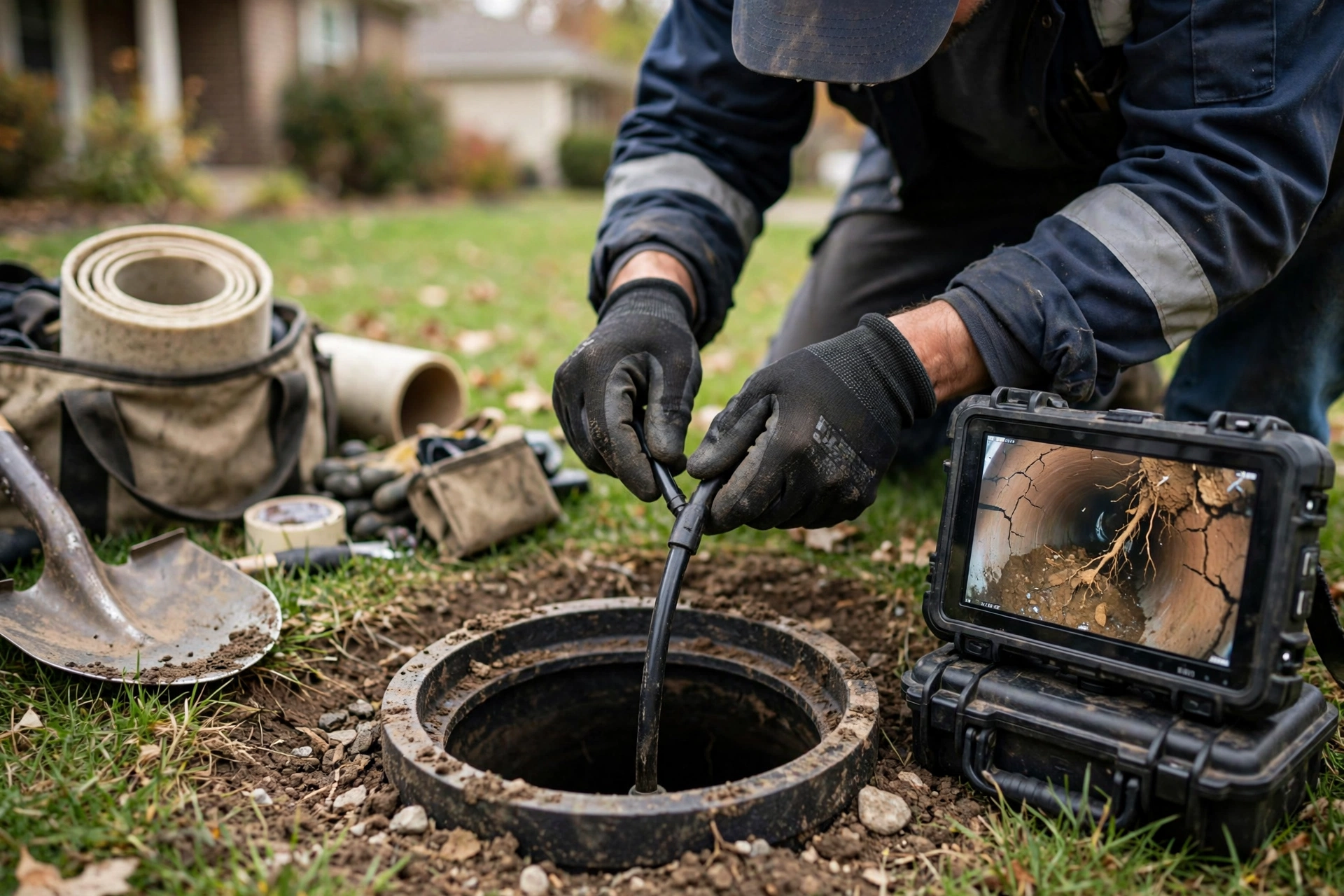
Every job starts with the camera: it shows the material, the joints, and the exact problem in about an hour.
The second story belongs to the post-war suburbs: Grove City, Reynoldsburg, Whitehall, and parts of Gahanna and Upper Arlington. Their 1950s through 1970s homes typically run cast iron laterals, and cast iron has a 50 to 75 year life. It rusts from the inside out, so it looks fine until the bottom of the pipe is paper-thin. The third story is the fast-growth wave: Dublin, Hilliard, Pickerington, and newer pockets everywhere. Their PVC lines are durable, but builder-era backfill settles in Central Ohio clay, and settling soil creates bellies and shifted joints long before the pipe itself is old.
Responsibility breaks down the same way across the region. The City of Columbus Department of Public Utilities operates the public sanitary sewer system, treatment, and storm sewers. You own the lateral from your house to the public main connection, including the part under your yard and driveway. Federal clean-water standards come from the U.S. EPA, and the Ohio EPA administers them statewide.
Cities: Columbus (German Village, Short North, Clintonville, Victorian Village), Delaware, Lancaster, Upper Arlington. Condition: Vitrified clay tile laterals with mortar-sealed joints, most of them 60 to 100+ years old. Mechanism: Mortar joints crumble, sections shift in the clay soil, and roots from mature street trees push into every damp joint. Symptoms: Recurring backups, gurgling drains, sewage smells in the yard. Service: Camera inspection first, then trenchless lining or bursting, which replaces the pipe without tearing up brick sidewalks and old-growth trees.
Cities: Grove City, Reynoldsburg, Whitehall, Gahanna, parts of Upper Arlington. Condition: Cast iron laterals from the 1950s to 1970s, now 50 to 70 years old. Mechanism: Cast iron rusts from the inside out, the bottom of the pipe thins until it flakes apart, and scale buildup narrows the bore. Symptoms: Slow drains that return after every snaking, sewer gas odors, wet spots where the line thins to nothing. Service: Hydro jetting to clear scale and roots, camera to judge remaining wall thickness, then lining or bursting if the pipe is too far gone to clean.
Cities: Dublin, Hilliard, Pickerington, Marysville, newer pockets of Grove City and Reynoldsburg. Condition: PVC laterals, often under 40 years old, in backfill that keeps settling. Mechanism: Central Ohio clay keeps moving after the builder leaves, backfill compacts unevenly, and the pipe sags into bellies or loses its slope. Tree roots then exploit the shifted joints. Symptoms: Backups after heavy rain, toilets flushing sluggishly, sewage appearing at the lowest drain in the house. Service: Camera to map the bellies and joint gaps, then root removal plus spot repair or lining of the affected section.
Cities: Newark, Delaware, Lancaster, Marysville. Condition: Older downtown housing with clay tile and early cast iron, shaded by decades-old street trees. Mechanism: Age plus roots plus clay soil movement is the triple hit: joints open, roots thicken inside them year after year, and sections offset. Symptoms: Seasonal backups, standing water where the lateral crosses the yard, frequent snaking calls. Service: Camera inspection to see exactly which joints are invaded, then lining or bursting to remove the entry points for good.
Every city below has its own page with local detail. Columbus itself anchors this region: it's our headquarters city and covered by the homepage.
Older neighborhoods near downtown carry clay tile laterals well past their design life, and mature maples keep feeding them roots. We camera first, then line or burst the pipe.
Newark sewer repair →Dublin grew fast in the 1990s and 2000s, and settling soil still pulls joints apart on some of those era's laterals. We find the belly, then fix it without tearing up the landscaping.
Dublin sewer repair →Historic neighborhoods near Ohio Wesleyan University hold clay tile laterals from the early 1900s. Tree-lined streets here make root intrusion the number-one call.
Delaware sewer repair →Post-war ranch neighborhoods are hitting the window where cast iron laterals thin out from the inside. One camera visit shows exactly how much life the pipe has left.
Grove City sewer repair →The 1960s and 70s subdivisions run on aging cast iron and clay laterals. Slow drains that come back after snaking are the classic sign of a line near its end.
Reynoldsburg sewer repair →Century-old homes downtown still run on clay tile sewers laid before most of the city was paved. Age and roots make trenchless lining a perfect fit here.
Lancaster sewer repair →Westerville blends historic homes near Otterbein with newer subdivisions, so we see everything from 1920s clay tile to construction-settled PVC. Camera first, always.
Westerville sewer repair →Hilliard's boom years filled subdivisions with PVC laterals that still suffer from settlement bellies and root joints at the seams. Quick inspection, targeted fix.
Hilliard sewer repair →Mature canopy plus 1940s-60s homes means clay tile and cast iron under some of the region's biggest shade trees. We clear roots, then eliminate their entry points.
Upper Arlington sewer repair →A mix of creekside older homes and newer subdivisions produces both root-bound clay and settling PVC laterals. We diagnose each line on its own merits.
Gahanna sewer repair →Growing subdivisions sit on Central Ohio clay that moves with the seasons, while downtown's older homes still run on clay tile. Either way, the camera tells the story.
Marysville sewer repair →Newer subdivisions mostly run PVC, but settling soil and root intrusion at connections still cause backups. We pinpoint the spot and repair just that spot.
Pickerington sewer repair →Mid-century homes carry cast iron and clay laterals nearing the end of their service life. We specialize in trenchless replacement that saves the driveway.
Whitehall sewer repair →The City of Columbus Department of Public Utilities manages the public sanitary sewer mains and treatment. You own the sewer lateral from your house to the connection at the public main, including the section under your yard and driveway, and you are responsible for maintaining it. If only your house is backing up, the lateral is the prime suspect and that's our territory. If several homes on your street back up at once, that's likely a main-line issue, call the city.
Yes, it can, just not from age. 1990s-era laterals are usually PVC, which lasts a long time, but Central Ohio's dense clay soil keeps moving long after the builder leaves. Backfill settles, bellies form, joints shift, and tree roots find the seams. We've repaired plenty of 30-year-old PVC lines with bellies you could see on camera. The camera tells you whether it's settlement, roots, or nothing at all.
It does, slowly and relentlessly. Central Ohio sits on dense glacial clay that swells when it's wet and shrinks when it's dry. That constant movement works pipe joints apart and lets sections sag into low spots called bellies, where waste and paper collect. If your drains slow down after a stretch of wet weather or a dry spell, soil movement is a likely culprit.
In most cases, yes. Columbus and the surrounding cities and townships typically require permits for sewer lateral repair and replacement, with inspection before backfill. Requirements vary by municipality, so we pull the right permit for your address and schedule the inspection as part of the job. It's included in the written price, never tacked on later.
Most trenchless jobs, lining or bursting, finish in a single day. Traditional open-trench replacement usually takes two to four days depending on line length, depth, and what's above the pipe. We give you the timeline in writing before work starts, along with the fixed price.
Also serving Columbus, Powell, Worthington, Bexley, Grandview Heights, and the greater Columbus metro. Major landmarks we work around include German Village, the Short North, the Ohio State University campus, Easton, and the Scioto Mile.
One inspection, one honest diagnosis, one upfront price, anywhere in the Columbus metro.
Call (614) 350-5706