Sewer Line Repair in Cincinnati, OH
Hillsides that shift, 130-year-old clay lines, and combined sewers in the historic districts. Cincinnati's sewer problems are its own. We camera-diagnose every job and fix it trenchless or traditional.
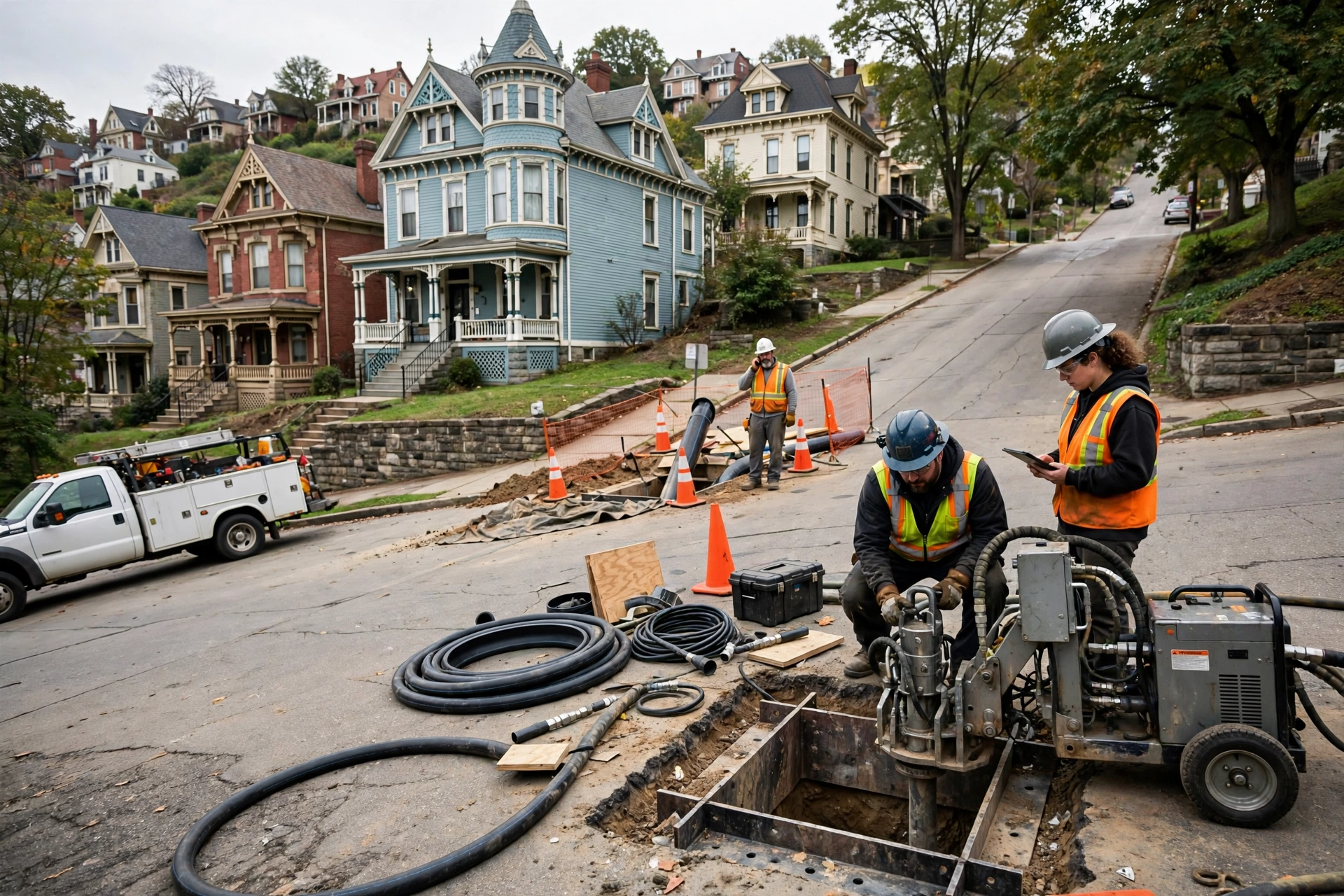
Hillsides that shift, 130-year-old clay lines, and combined sewers in the historic districts. Cincinnati's sewer problems are its own. We camera-diagnose every job and fix it trenchless or traditional.
Last updated: October 13, 2026
Cincinnati is a city of hills, and hills move. That slow, relentless movement is the number-one enemy of the rigid pipe buried beneath them.
Here's the mechanism. Rainwater soaks into a hillside, and Cincinnati gets about 42 inches of rain a year, saturating the soil. Saturated soil is heavy, and on a slope, heavy soil creeps downhill. Not in a dramatic landslide; in a slow migration measured in fractions of an inch per year. But your sewer lateral is a rigid line of clay tile or cast iron segments running through that moving soil. The pipe can't flex with the creep, so joints separate, sections offset, and eventually the line shears.
The classic symptom is a backup that recurs in the same spot after every heavy rain, in a home on or below a slope. Mt. Adams, Clifton, and the hillside streets above the river are textbook cases. A camera shows the offsets as sharp steps in the pipe where segments no longer line up. Lining can bridge minor offsets, but significant shearing usually calls for pipe bursting, which replaces the line entirely with flexible HDPE that tolerates minor ground movement far better than clay ever did.
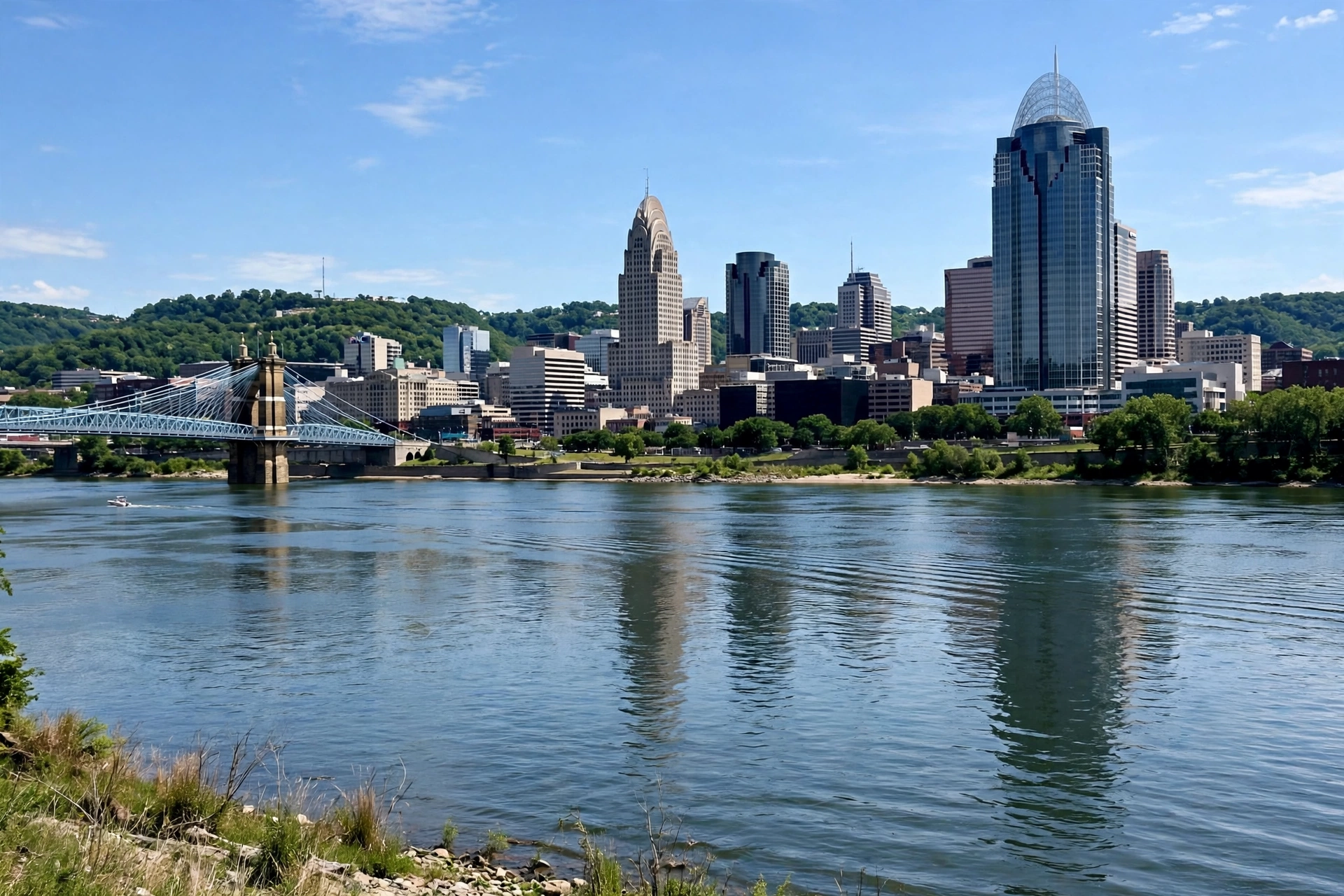
Cincinnati's hillsides and river valley each create their own sewer problems, we fix both.
The river doesn't have to reach your door to cause sewer trouble. When the Ohio River runs high, the water table along the riverfront and in the Mill Creek valley rises with it. Groundwater presses into every cracked joint and separated connection in your lateral, a process called infiltration, and suddenly your sewer line is carrying far more water than it was designed for.
The second problem arrives when the water recedes. Floodwater and high groundwater carry fine silt, and as flows normalize, that silt settles inside the pipe and hardens into a concrete-like restriction. We've camera-inspected lines after flood season that looked like they were poured half-full of cement. If you live anywhere near the river, downtown, the East End, Sayler Park, and your drains slow down in the weeks after high water, silt infiltration is the likely culprit, and hydro jetting followed by a camera check is the fix.
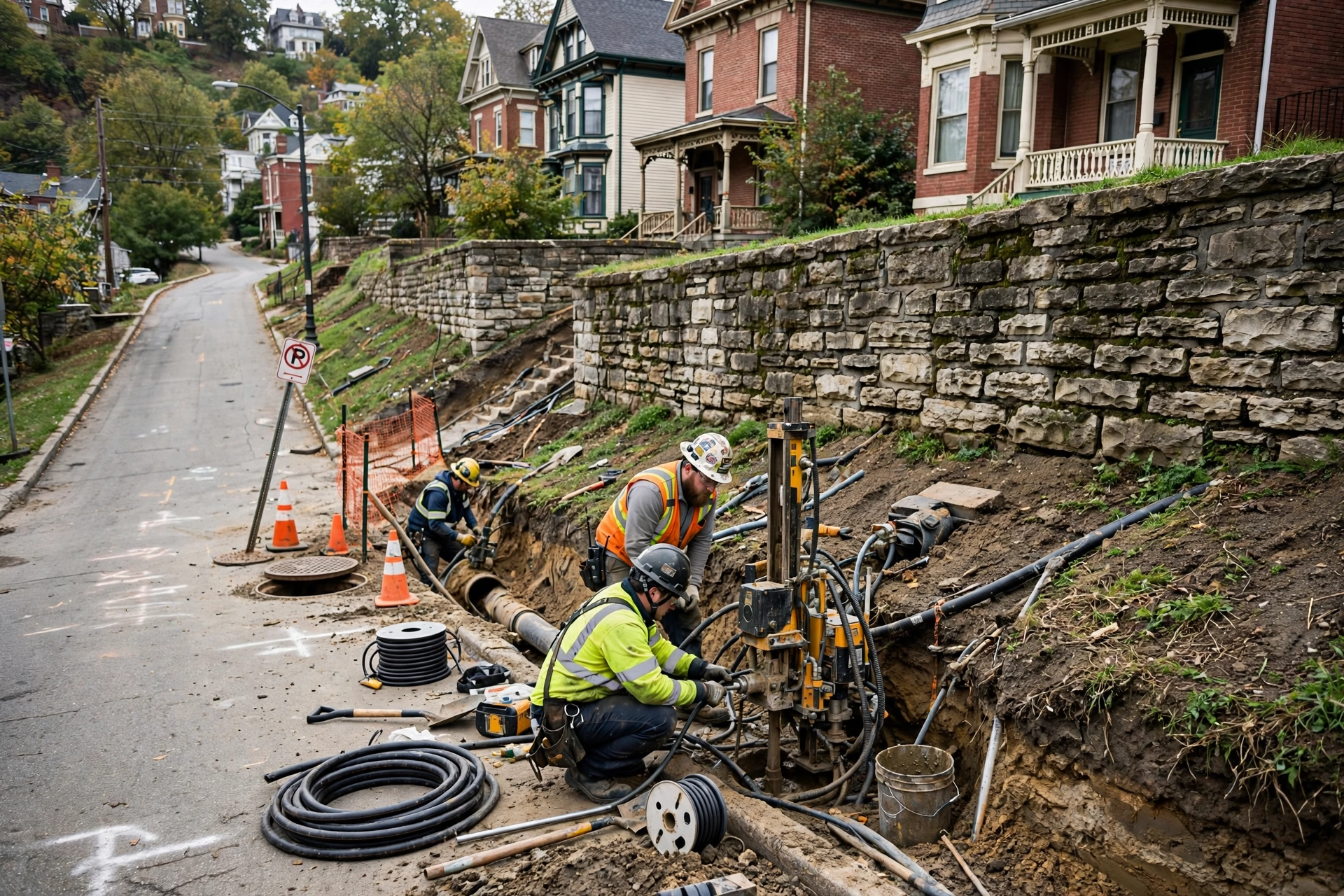
Hillside sewer work in Cincinnati: steep grades and retaining walls make trenchless the smart choice on these slopes.
In neighborhoods built before the 1950s, Over-the-Rhine, parts of Walnut Hills, the West End, one pipe carries both household sewage and street stormwater. That was standard engineering a century ago. The problem: during heavy rain, the combined flow can exceed the pipe's capacity, and the system surcharges, pressure builds and sewage looks for the nearest exit, which is often a basement floor drain in the lowest home on the block.
The Metropolitan Sewer District of Greater Cincinnati (MSD) has spent years on a federal consent decree program to reduce these overflows, but the pipes under your street are what they are today. For a homeowner, the practical defense is a backwater valve on the lateral, a one-way gate that lets sewage out but slams shut when flow tries to come back in. We install them, and in combined-sewer neighborhoods, it's the highest-value protection you can buy. Greater Cincinnati Water Works handles your drinking water; MSD handles the sewers; your lateral between the house and the main is yours, and ours to fix. The Ohio EPA sets the statewide wastewater standards that Ohio utilities like MSD operate under.
Our Cincinnati crews cover the full metro, from the riverfront historic districts to the northern suburbs. The housing, and the pipe problems, change by neighborhood: Over-the-Rhine's 130-year-old Italianate rowhouses with original clay laterals; Hyde Park and Clifton's early-1900s homes where clay tile meets mature tree roots; Mt. Adams and the hillside streets fighting soil movement; Norwood's dense post-war housing with aging cast iron; and the northern arc, Hamilton, Fairfield, Mason, Lebanon, Springboro, where 1960s–80s subdivisions are hitting the age where Orangeburg and early PVC joints start failing.
You'll find us working around Fountain Square downtown, up by the Cincinnati Zoo in Avondale, near UC Medical Center and Christ Hospital, and out by CVG airport. Wherever the lateral runs in the Cincinnati metro, the process is the same: camera first, honest diagnosis, upfront price. We cover Cincinnati's core residential ZIP codes, including 45202, 45205, 45208, 45211, and 45219.
Greater Cincinnati Water Works treats Ohio River water at two plants and reports average hardness of about 7 grains per gallon from the Richard Miller plant and 8 from the Charles M. Bolton plant (roughly 120 to 134 milligrams per liter), moderately hard. That mineral load leaves gradual scale inside older pipes, narrowing the bore and giving grease and solids a rough surface to catch on. In Cincinnati's hillside and pre-1940 neighborhoods, that scale coats century-old clay and cast iron lines that are already fighting soil movement, which is why slow drains show up earlier here.
Maintain them on the river's calendar. In Cincinnati, spring high water on the Ohio River and saturated hillsides push groundwater into cracked joints, fall sends tree roots hunting for moisture before dormancy, and winter freeze shifts soil on steep lots. A camera inspection every few years, plus the seasonal habits below, catches most problems while they are still cheap.
Cincinnati's steep hillsides move. Rainwater saturates the slope, soil creeps downhill over the years, and rigid clay or cast iron pipe can't flex with it, joints separate and sections offset. Homes in Mt. Adams, Clifton, and other hillside neighborhoods see this the most. A camera inspection shows the offsets clearly, and pipe bursting is often the fix since it replaces the line entirely.
A combined sewer carries both sewage and stormwater in one pipe, standard in neighborhoods built before the 1950s, including Over-the-Rhine and parts of Walnut Hills. During heavy rain the system can surcharge and push sewage back toward homes. If your street has combined sewers, a backwater valve on your lateral is the single best protection, and we install them.
Flooding itself rarely breaks the pipe, but it causes two real problems: river-level groundwater infiltrates cracked joints and overwhelms the line, and receding floodwater leaves silt inside the pipe that hardens into blockages. After any significant flood event near the river, a camera inspection is cheap insurance.
Often, yes. We've lined and burst century-old clay laterals all over OTR and the surrounding historic districts. Age alone doesn't disqualify a line, condition does. The camera shows whether the pipe holds enough shape for lining or needs bursting. Either way, trenchless methods mean the historic streetscape and your foundation stay undisturbed.
The Metropolitan Sewer District of Greater Cincinnati (MSD) oversees the public sewer system, and lateral work typically requires permits with inspection before backfill. We handle the permit applications and schedule inspections as part of every job, it's included in the written price.
You can't tell from inside the house, slow drains and backups look the same either way. That's exactly what the camera is for. Roots show up as fibrous masses at joints; breaks show as cracks, offsets, or collapses. The fix differs completely, roots in a sound pipe get cleared and the joints sealed by lining, while a broken pipe needs bursting or replacement, so the camera inspection comes first, always.
Hillside, historic district, or suburb, one inspection tells us exactly what's happening underground.
Call (614) 350-5706