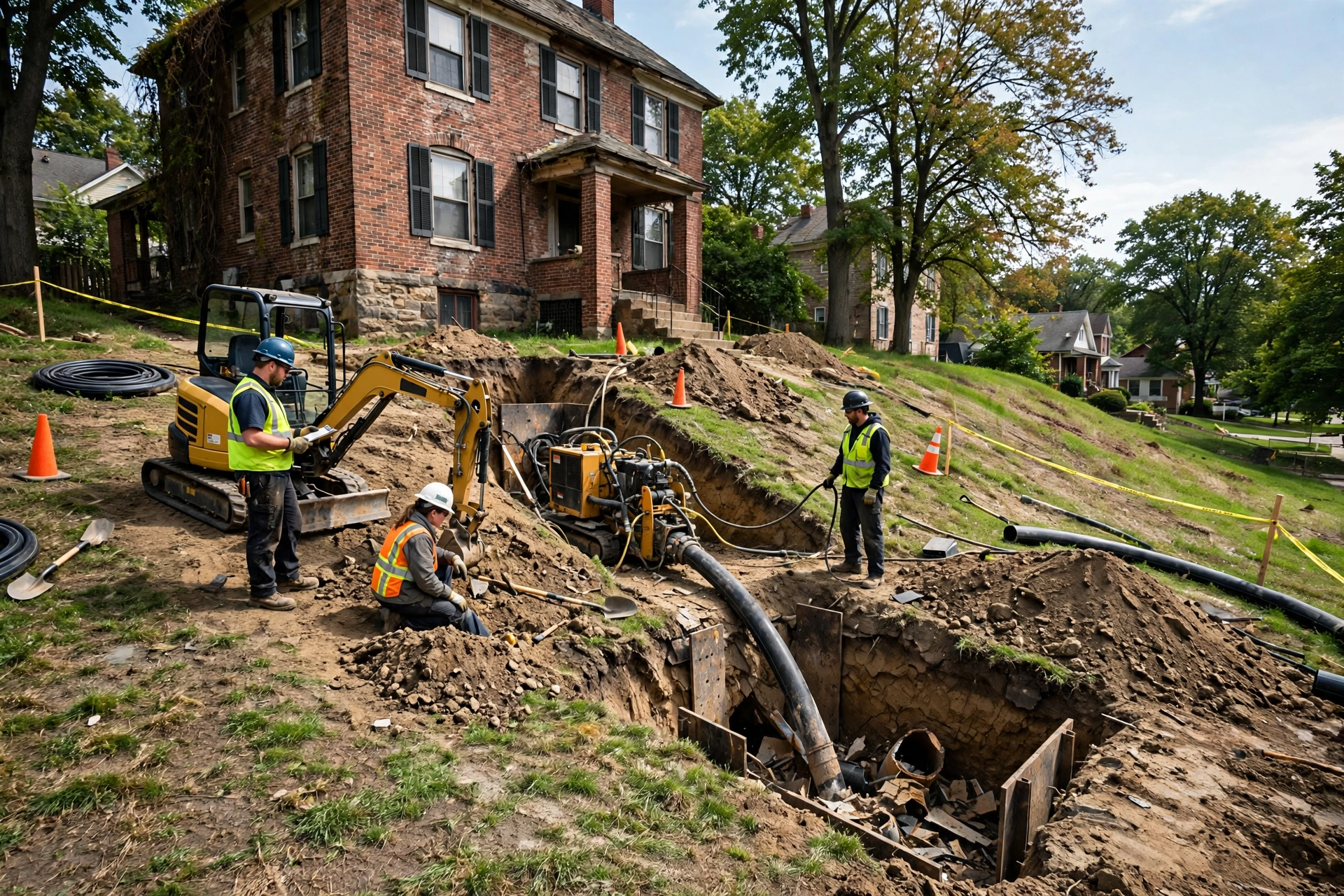
Seven hills, clay-heavy soil, combined sewers, and century-old laterals. Cincinnati is one of Ohio's toughest sewer regions. We diagnose with a camera and fix it trenchless or traditional, with one upfront price.
Last updated: October 13, 2026
Legend says Cincinnati was built on seven hills like Rome. The real number is higher, and every slope is a sewer problem waiting to happen.
The Ohio River valley carved this region into steep hillsides and narrow creek corridors. The soil in the area is clay-heavy: dense, moisture-sensitive, and prone to slow downhill creep. Sewer laterals running down these slopes get pulled and shifted over time, joints open, sections offset, and paper starts snagging where the pipe kinked. Hillside lines also tend to run deeper than flat-land lines, which makes every repair harder, and exactly why trenchless methods that avoid big excavation shine here.
The second half of the story is age. Hyde Park, Clifton, Norwood, and Over-the-Rhine hold some of Ohio's oldest housing stock, with sewer lines to match: vitrified clay tile, early cast iron, and in the oldest sections, stacked stone and brick sewers laid as far back as the 1870s. Clay pipe has a 50 to 60 year design life. These lines are a century old.
Hillside laterals run deeper and shift with the slope, trenchless repair avoids tearing up the whole yard.
The third factor is unique to Cincinnati's older core: combined sewers. Parts of the city still carry sewage and stormwater in a single pipe. When a heavy storm hits, the system can fill past capacity, and the pressure pushes flow back up through basement floor drains. If your basement floods only during storms, this is almost certainly the pattern, and a backwater valve plus a camera-checked lateral is the classic defense.
Responsibility breaks down like this: the Metropolitan Sewer District of Greater Cincinnati (MSD), established in 1968, operates the public wastewater system, roughly 3,000 miles of sanitary and combined sewers and seven treatment plants across most of Hamilton County and parts of Butler, Clermont, and Warren counties. You own the lateral from your house to the public main connection, including the part under your yard, and you are responsible for maintaining it. Federal clean-water standards come from the U.S. EPA; the Ohio EPA administers them statewide.
Cities: Cincinnati (Hyde Park, Clifton, Mount Adams, Price Hill), Norwood, Forest Park. Condition: Laterals running down steep slopes in clay-heavy soil, often deeper than flat-land lines. Mechanism: The soil creeps downhill over time, pulling pipe sections apart at the joints and creating offsets. Roots then invade the open joints, and paper snags on every offset. Symptoms: Slow drains, sewage odors near the foundation, backups that worsen after wet seasons. Service: Camera inspection maps the offsets, then trenchless lining or bursting rebuilds the line with no deep hillside excavation.
Cities: Older Cincinnati neighborhoods (Hyde Park, Clifton, Norwood, Over-the-Rhine). Condition: Combined sewers carrying sewage and stormwater in one pipe, many of them laid over a century ago. Mechanism: A heavy storm fills the system past capacity, pressure reverses in the lower laterals, and flow backs up through basement floor drains and low fixtures. Symptoms: Basement flooding only during or after heavy rain, while drains work fine in dry weather. Service: Camera inspection to check the lateral's condition, and a backwater valve to stop the reverse flow. If street-wide backups hit, call MSD at (513) 352-4900, it's likely a main-line issue.
Cities: Hamilton, Middletown, Oxford, Lebanon, Norwood. Condition: Clay tile laterals, many 60 to 100+ years old, under mature street trees. Mechanism: Mortar joints crumble, fine root hairs enter the damp joints, and roots thicken year after year until they wedge joints apart and fill the pipe. Symptoms: Recurring clogs, drains that slow a few months after every snaking, gurgling toilets. Service: Tree root removal to clear the pipe, then lining or bursting to remove the entry points for good.
Cities: Mason, Springboro, Fairfield, Lebanon, Forest Park. Condition: Mostly PVC laterals, many under 40 years old, in soil that keeps settling. Mechanism: Backfill compacts unevenly in the region's clay soil, the pipe sags into bellies or loses slope, and roots exploit every shifted joint. Symptoms: Backups after heavy rain, sluggish flushing, sewage appearing at the lowest drain. Service: Hydro jetting to clear grease and roots, camera to map the bellies, then spot repair or lining of the affected section.
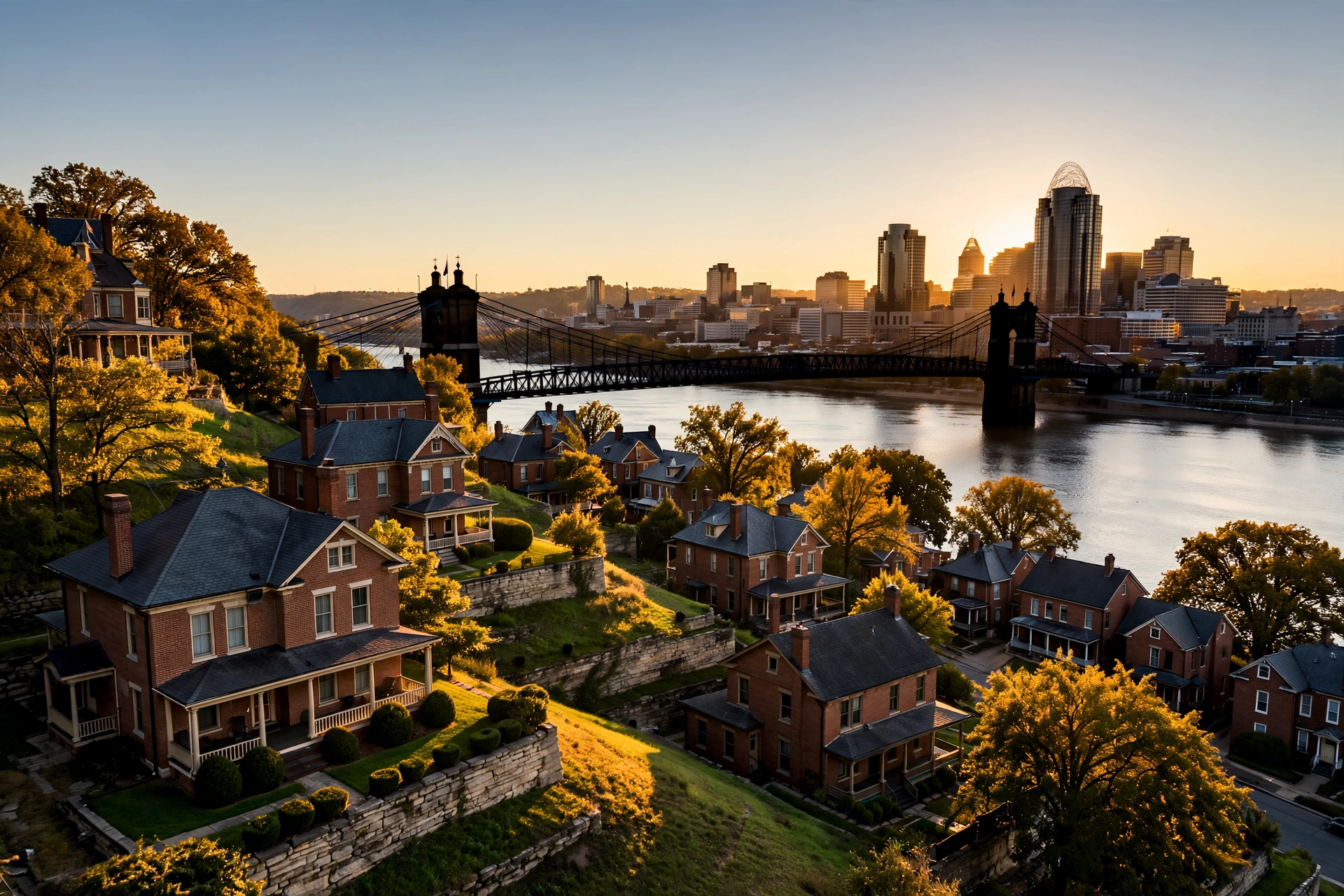
Every city below has its own page with local detail.
Seven hills, combined sewers, and laterals laid as far back as the 1870s. We handle hillside offsets, storm-driven backups, and century-old clay tile.
Cincinnati sewer repair →This river-city neighborhood runs on some of the oldest clay laterals in Butler County, and the mature street trees keep feeding them roots. Camera first, then fix.
Hamilton sewer repair →Post-war neighborhoods carry cast iron and clay laterals that are hitting their limit right about now. Slow drains that return after snaking are the tell.
Middletown sewer repair →Fairfield blends older neighborhoods with newer subdivisions, so we handle both root-choked clay and settling PVC lines. The camera decides the right fix.
Fairfield sewer repair →Newer subdivisions mostly run PVC, but builder-era settlement and tree roots at joints still cause trouble. We find the exact spot and repair just that spot.
Mason sewer repair →Rental-heavy older neighborhoods near Miami University run on aging clay tile that roots love. A camera visit before a backup saves a move-out disaster.
Oxford sewer repair →Historic homes downtown sit on clay tile laterals laid a century ago. Trenchless lining is a perfect fit for these older lines.
Lebanon sewer repair →1960s subdivisions run on cast iron and clay laterals entering their final decades. We clear, camera, and line or burst to end the cycle.
Forest Park sewer repair →Newer subdivisions run on PVC, but settling soil and root intrusion at joints still trigger backups. We repair the spot, not the whole yard.
Springboro sewer repair →Dense, century-old housing stock means clay tile laterals under mature street trees. Root intrusion here is practically a rite of passage, lining ends it.
Norwood sewer repair →MSD is the Metropolitan Sewer District of Greater Cincinnati, established in 1968. It runs the public wastewater system: roughly 3,000 miles of sanitary and combined sewers across most of Hamilton County, plus seven treatment plants. You own the sewer lateral from your house to the public main, and that's yours to maintain. Call MSD at (513) 352-4900, 24/7, when multiple homes on your street back up at once or you see sewage coming from a manhole. If only your house is affected, call a sewer contractor like us at (614) 350-5706.
Parts of Cincinnati still run on combined sewers, which carry sewage and stormwater in one pipe. During heavy storms, the system can fill past capacity, and the pressure pushes flow back up through basement floor drains and low fixtures. If your basement floods only during storms, a combined-sewer backup is likely. A backwater valve on your lateral is the classic fix for this pattern, and a camera inspection confirms whether your line is also damaged.
Yes. Cincinnati's hills mean many laterals run down slopes in clay-heavy soil that creeps downhill over time. That slow movement shifts pipe sections, opens joints, and creates offsets that snag paper and roots. Hillside lines also tend to run deeper, which makes replacement more expensive, and another reason trenchless methods that need no big excavation are a natural fit. The camera shows exactly where the slope has moved your pipe.
Most of them, yes. The clay tile laterals under older Hamilton, Middletown, Oxford, Lebanon, and Norwood homes are exactly what trenchless lining and bursting were designed for: a structurally tired pipe in the same trench line. If the pipe still has its basic shape, we can line it; if it's collapsing, we can burst it and pull in new pipe. The camera inspection decides which method fits your line.
In most cases, yes. MSD regulates connections to the public sewer system, and local municipalities typically require permits for lateral repair and replacement, with inspection before backfill. We pull the right permits for your address and coordinate inspections as part of every job. It's included in the written price, never tacked on later.
Also serving West Chester, Blue Ash, Sharonville, Milford, Loveland, and the greater Cincinnati metro. Major landmarks we work around include the Cincinnati Zoo, Fountain Square, the University of Cincinnati, Kings Island, and the Ohio River waterfront.
One inspection, one honest diagnosis, one upfront price, anywhere in the Cincinnati metro.
Call (614) 350-5706