Sewer Line Repair in Forest Park, OH
A planned community with a synchronized problem: Forest Park's 60s-era clay laterals are aging together, street by street. We camera-diagnose every job and fix it trenchless or traditional.
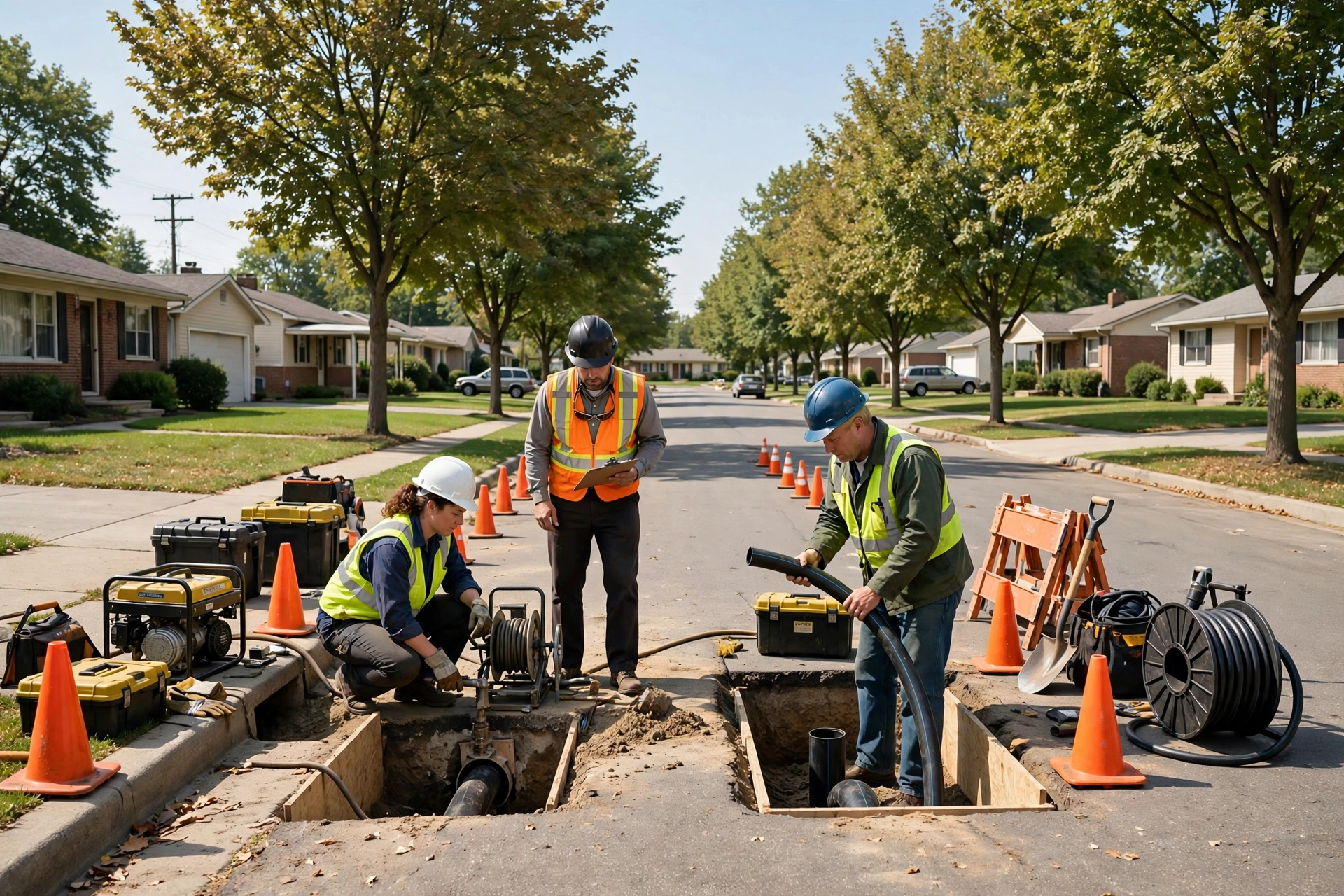
A planned community with a synchronized problem: Forest Park's 60s-era clay laterals are aging together, street by street. We camera-diagnose every job and fix it trenchless or traditional.
Last updated: October 13, 2026
Forest Park was founded in 1956 as one of America's planned communities, built from scratch with a single vision. That vision included the sewer lines, and they're all the same age.
Here's what planned means underground. The original neighborhoods went up in the late 50s and 60s with vitrified clay tile laterals and mortar joints, installed to the same spec by the same builders. Sixty-plus years later, those joints are crumbling on the same schedule. The coordinated street trees, another hallmark of the plan, grew up together too, and their root systems are now uniformly mature. So when one home on a Forest Park street has a sewer failure, it's a signal, not an isolated event: the neighbors' lines are on the same clock.
This synchronization is actually useful. If your street is starting to see sewer work, a camera inspection now catches your line while it's still a trenchless sewer repair candidate instead of a collapse. Lining seals every joint from the inside in a single pass, which is the right fix for a line that's failing at the joints but still holding its shape.
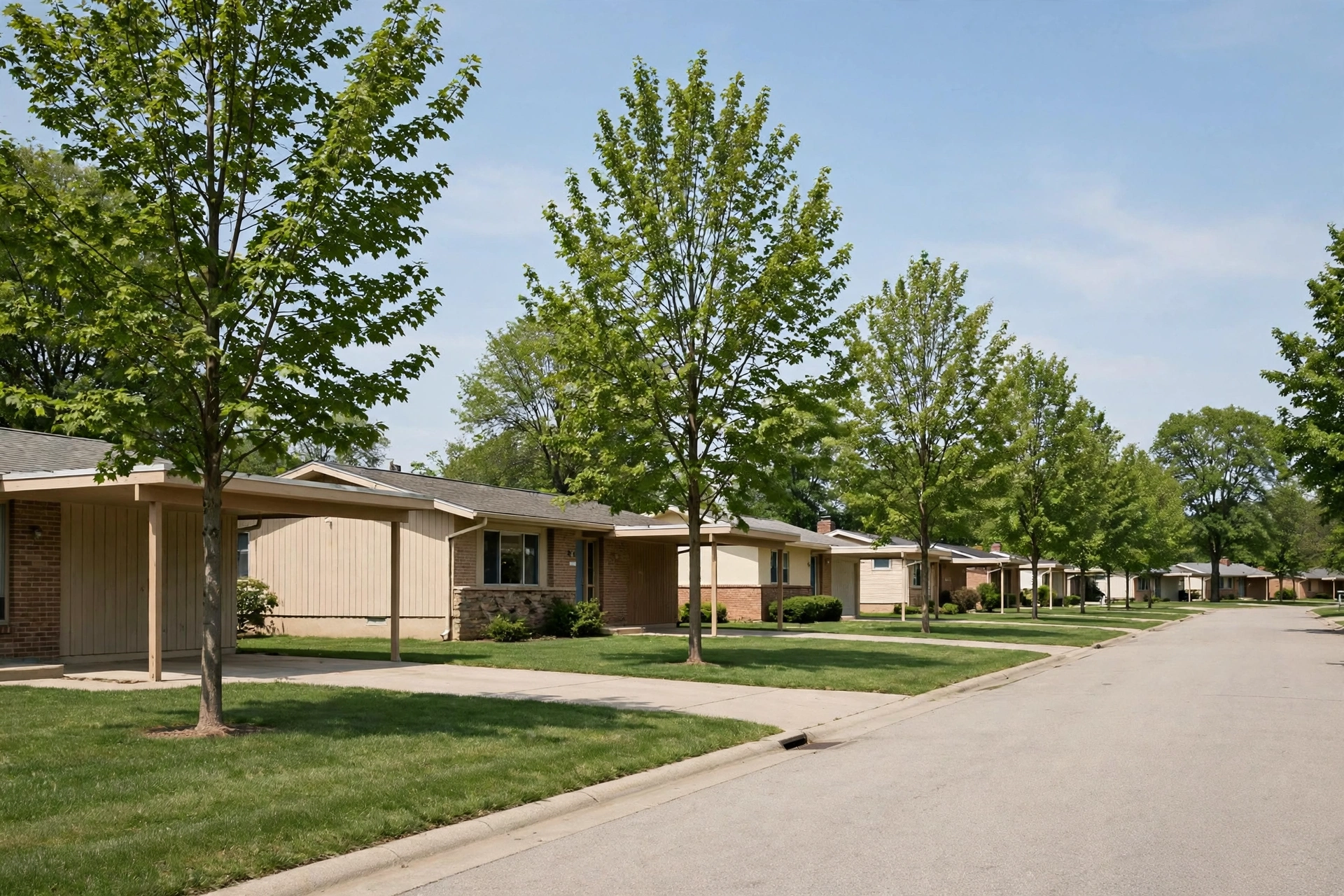
Forest Park's planned streetscapes: same-age homes, same-age clay tile laterals, same-age street trees.
The uniformity goes deeper than age. Forest Park's original development used consistent materials across whole neighborhoods, which means failure patterns repeat almost identically. Clay tile with mortar joints in the 60s tracts. Cast iron inside transitioning to clay outside in the split-levels and two-stories. And in some pockets, the thin-wall pipe products of the era that are now reaching the end of their service life.
The lots tell the same story. Forest Park's generous mid-century lots mean long laterals from house to street, and long runs have more joints, more joints mean more entry points for roots. The mature landscaping that makes the community beautiful, foundation plantings, shade trees, garden beds, also makes open-trench replacement especially destructive. Trenchless methods need only small access pits, so the landscaping you've tended for decades survives the repair.
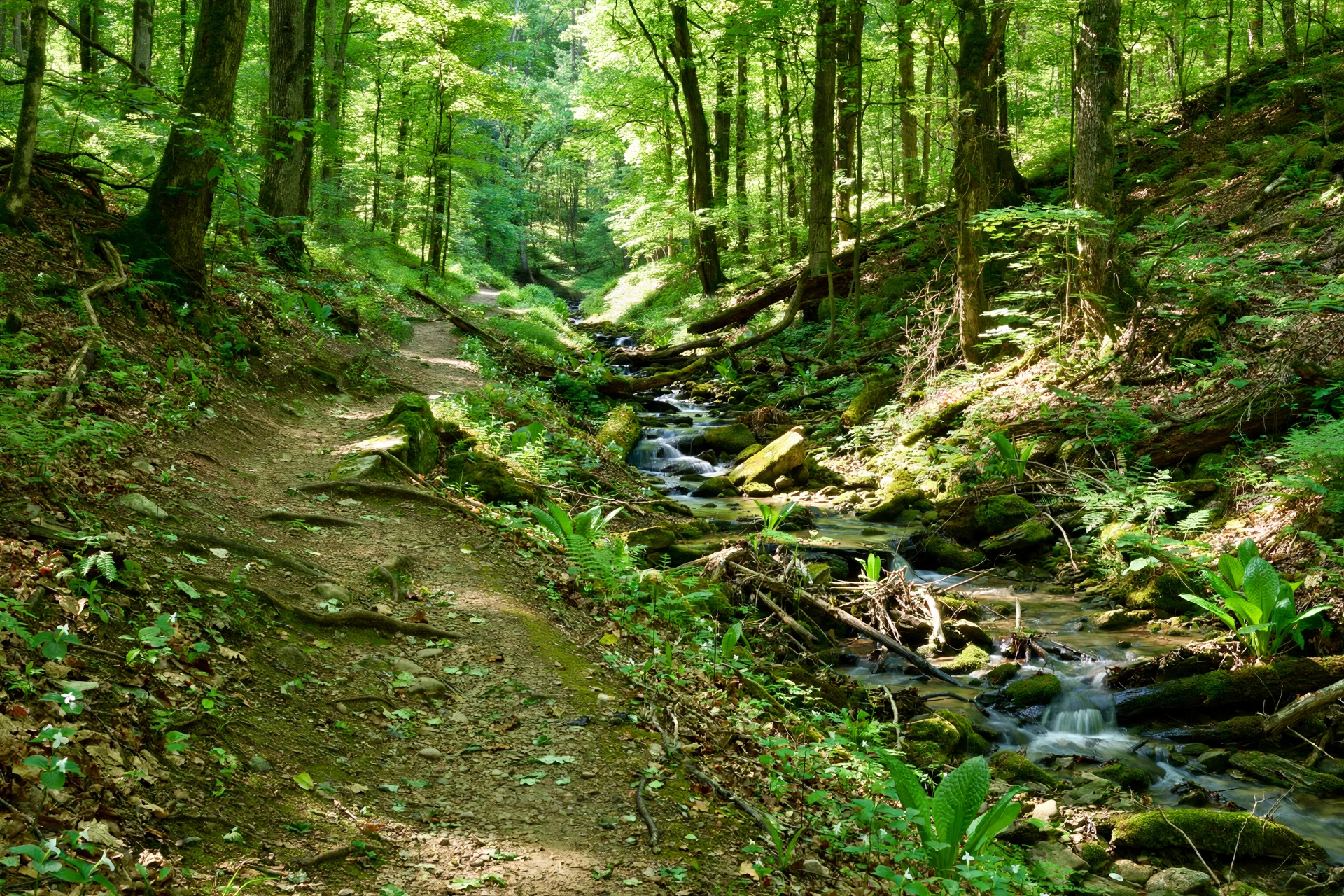
The Mill Creek valley near Forest Park: clay till soils and a high water table work on pipe joints year-round.
Forest Park sits near the Mill Creek valley, and the glacial clay till under the community holds water. After heavy rain, water perches in the soil around your lateral instead of draining through it, and hydrostatic pressure pushes into every weak mortar joint. That's infiltration, and it's why Forest Park backups so often follow big storms, then clear up, then come back with the next one.
The valley's high water table adds a second pressure. Groundwater sits close to the surface in the low areas, keeping the soil around the lateral saturated for long stretches. Saturated soil is heavy, and it settles unevenly, which offsets rigid clay sections a fraction of an inch at a time. The fix isn't a bigger sump pump or more frequent snaking, it's sealing the joints the water is entering through. Pipe lining does exactly that, and the camera inspection beforehand shows which joints are the culprits.
Our crews cover all of Forest Park: the original 60s neighborhoods with their clay tile laterals; the later additions with cast iron transitions; the streets along the Mill Creek corridor where the water table runs high; and the neighborhoods near the I-275 and SR-4 interchanges.
You'll find us working around Winton Woods, along the Mill Creek corridor, and near Mercy Health Fairfield Hospital just to the north. See our home page for the full statewide service area, but in Forest Park the process never changes: camera first, honest diagnosis, upfront plan.
We serve all of Forest Park, including ZIP codes 45240.
Two agencies split the work in Forest Park. Your drinking water bill comes through Greater Cincinnati Water Works (GCWW), which supplies the region's water. Sanitary sewer service is handled by the Metropolitan Sewer District of Greater Cincinnati (MSDGC), which provides wastewater collection and treatment across most of Hamilton County, Forest Park included. Forest Park's own Stormwater Management Utility handles stormwater separately. See MSD's list of communities served to confirm coverage.
Permits for sewer lateral work go through the City of Forest Park's building department, and we pull those permits and schedule inspections as part of every job. If you are unsure which permit your project needs, check with the city's building department before work begins.
Forest Park's water comes from Greater Cincinnati Water Works, and GCWW's own reports put average hardness at about 7 to 9 grains per gallon (roughly 120 to 159 milligrams per liter), moderately hard. Even treated surface water carries dissolved calcium and magnesium. Inside aging drain lines, those minerals deposit as scale that narrows the pipe and roughens the walls, giving grease and debris something to catch on and accelerating the blockages we clear with hydro jetting.
Forest Park receives Greater Cincinnati Water Works water wholesale, and GCWW's water quality reports put average hardness at about 7 to 8 grains per gallon (roughly 120 to 134 milligrams per liter), moderately hard. The dissolved calcium and magnesium deposit as mineral scale inside older pipes. That scale narrows the bore and gives grease and debris a rough surface to grip, turning slow drains into full blockages faster.
Forest Park's planned neighborhoods pair mature street trees with aging post-war laterals. Spring rains push groundwater into cracked joints, fall sends roots hunting for moisture, and winter freezes shallow cleanouts. One camera inspection every year or two, plus the seasonal habits below, keeps most problems small.
Most likely vitrified clay tile with mortar joints, possibly cast iron inside transitioning to clay outside. Forest Park was founded in 1956 as a planned community, and the original homes went up in the late 50s and 60s with the pipe standards of that era. After 60-plus years the mortar joints are crumbling and roots are pushing in. The camera confirms it in about an hour.
Because the whole community was built at once. Forest Park's planned development means your neighbors' homes are the same age, with the same clay tile laterals, installed by the same builders. When one line hits the end of its life, the street is on the same clock. If sewer trucks are appearing on your block, get a camera inspection before your line is next.
The City of Forest Park handles permits for sewer lateral work within city limits, with inspection typically required before backfill. We pull the permits and schedule the inspections as part of every job, it's included in the written plan, not an add-on.
They're exploiting what's already weak. The planned community planted coordinated street trees along every block, and 60 years later those root systems are mature. Fine root hairs enter damp mortar joints, thicken year after year, and wedge the joints apart. Once roots are inside, snaking only buys time. Lining or bursting the pipe removes the entry points for good.
Most trenchless jobs, lining or bursting, finish in one day. That's a real advantage in Forest Park, where the uniform lots and mature landscaping make open-trench digging especially destructive. We give you the timeline in writing before work starts, along with the fixed plan.
Also serving Fairfield, Norwood, and the greater Forest Park area. Major landmarks we work around include Winton Woods, the Mill Creek corridor, and Mercy Health Fairfield Hospital.
When the whole street is on the same pipe clock, a camera inspection now is worth a replacement later.
Call (614) 350-5706