Pipe Bursting in Ohio
When your sewer line is too damaged to line, bursting replaces it entirely without a trench. A powerful head shatters the old pipe underground while brand-new HDPE pipe follows right behind in the same path.
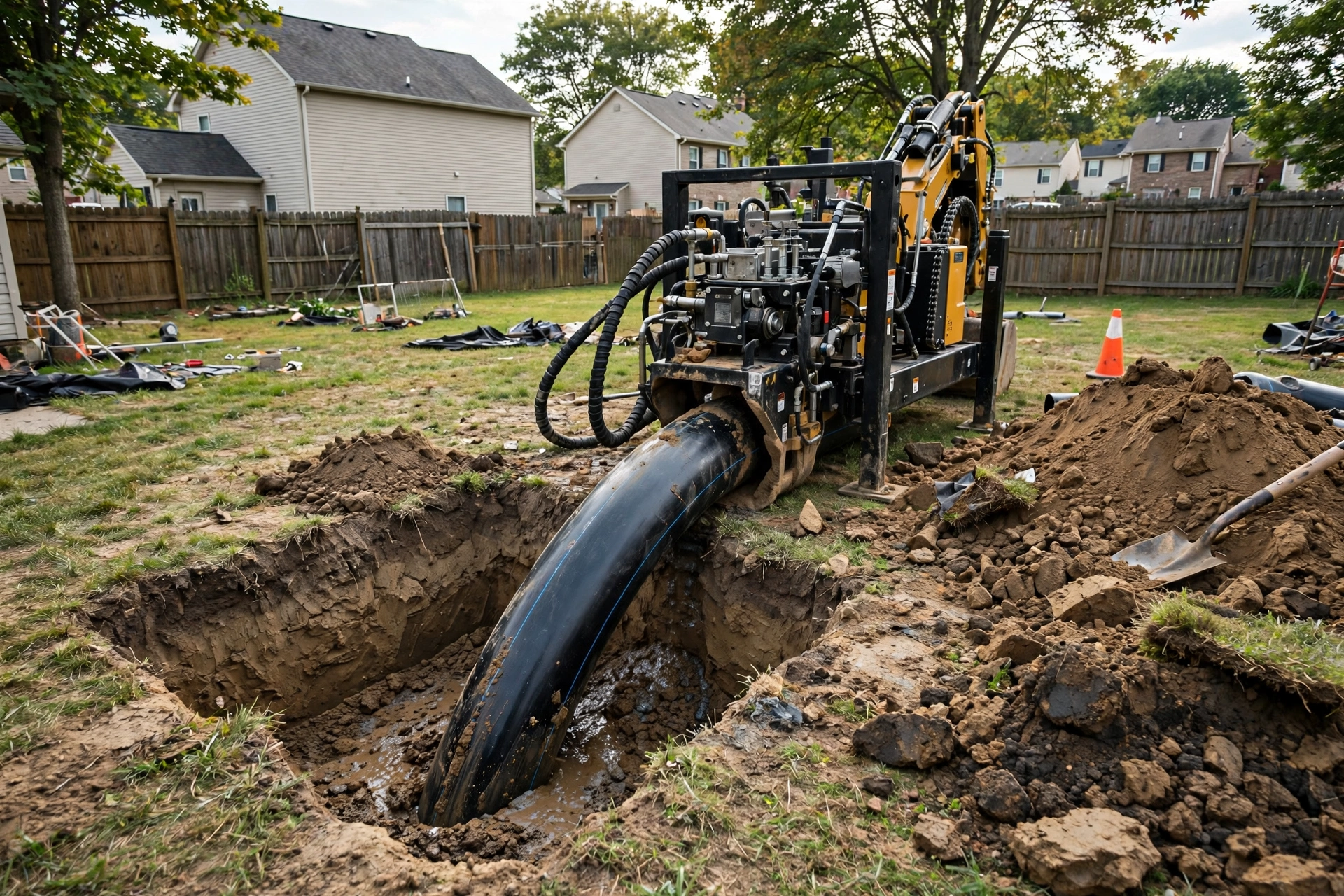
When your sewer line is too damaged to line, bursting replaces it entirely without a trench. A powerful head shatters the old pipe underground while brand-new HDPE pipe follows right behind in the same path.
Last updated: October 13, 2026
Pipe bursting is a trenchless method that replaces a sewer line without digging it up: a bursting head shatters the old pipe underground while new HDPE pipe is pulled through the same path.
Pipe bursting is for sewer lines that are past the point where lining can save them, but where you still want to avoid digging up the whole yard. If any of these describe your line, bursting is probably on the table.
Not every bad line qualifies, though. If the line runs directly under a foundation, weaves through a tangle of unlocatable utilities, or needs a completely new route, open-trench replacement is the honest recommendation. The camera inspection and utility locate decide, not a sales pitch.
Think of it as a wedge followed by a pipe. A cone-shaped bursting head, larger than the old pipe, is pulled or hammered through the damaged line. As it advances, it fractures the old pipe and pushes the fragments outward into the surrounding soil. Directly behind the head, the new HDPE pipe is attached and gets drawn into the freshly opened path in the same motion. Old pipe out, new pipe in, one continuous pull.
Camera maps the line's condition, depth, and path. We call in the Ohio utility locate so gas, electric, and water lines near the path are marked before anything moves.
A small entry pit at one end and an exit pit at the other. The bursting equipment sets up at the entry pit; the new pipe stages at the exit side.
The head travels the line, shattering the old pipe while fused HDPE pipe follows right behind. The new run is one continuous piece with no joints.
The new line is tied into your house drain at one end and the city tap or septic connection at the other, with a proper cleanout installed for future access.
A post-install camera run proves the new line is continuous and properly graded. Pits get backfilled, compacted, and patched the same day.
There are two ways to drive the head through the old pipe, and the right one depends on your soil and surroundings.
Either way, the result is the same: old pipe fragmented into the soil, new HDPE in its place, engineered for a 50-year or longer service life per industry standards. Your technician explains which method your job calls for when you review the camera footage.
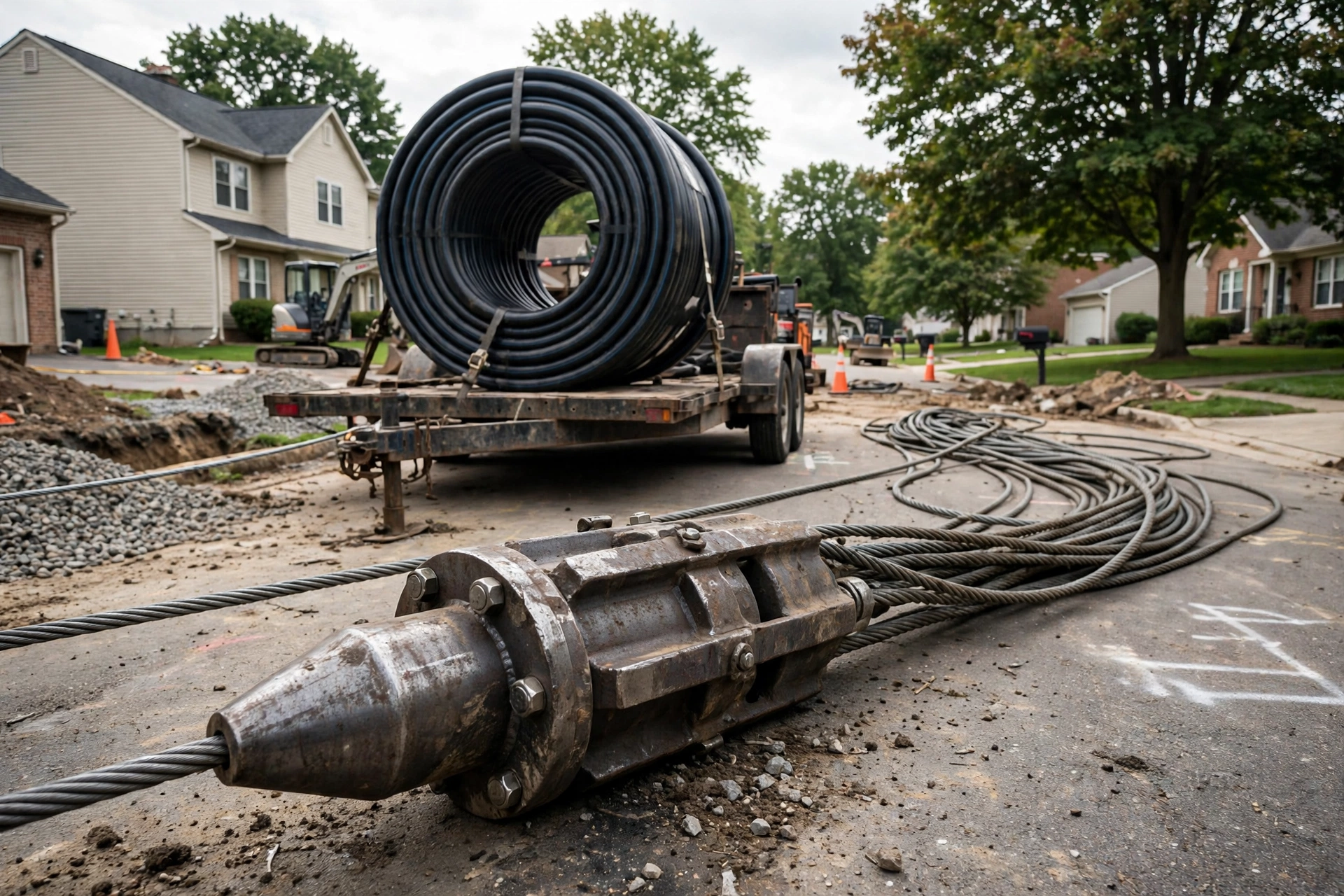
New HDPE pipe arrives in long fused sections, so the replacement run has no joints for roots to exploit.
If you are choosing between the two trenchless methods, here is the direct comparison.
| Factor | Pipe bursting | Pipe lining (CIPP) |
|---|---|---|
| End result | Brand-new HDPE pipe replaces the old line | Epoxy pipe built inside the old line |
| Diameter change | Can increase pipe size (upsizing) | Slight decrease from liner thickness |
| Pipe condition required | Handles collapsed, crushed, or deformed pipe | Pipe must roughly hold its shape |
| Bends | Gradual bends are fine; sharp 90-degree turns can stop the head | Follows the existing pipe, including bends |
| Digging required | Entry and exit pits | Often none beyond an existing cleanout |
| Best suited for | Collapsed, deformed, or undersized lines | Cracked or root-invaded lines that hold their shape |
Yes, and this is the feature no other trenchless method offers. Because the bursting head displaces soil outward as it passes, the new pipe can be a size larger than the old one. A 3-inch clay lateral can come out as a 4-inch HDPE line; a 4-inch can become 6-inch.
When does upsizing matter? Older Ohio homes were built when a 3-inch lateral was standard for a one-bath house. Add a second bathroom, a basement bath, a laundry room, or a kitchen remodel, and that old line is suddenly undersized for the fixtures feeding it. Chronic slow drains after a remodel are the classic symptom. Upsizing during bursting fixes the capacity problem permanently instead of just replacing an undersized pipe with another undersized pipe.
There are limits. Upsizing needs enough soil cover around the pipe for the displacement to happen safely, and the city tap connection has to accept the larger diameter. We check both before promising a bigger line.
Bursting is trenchless, but it's not pitless. The equipment needs a way in and a way out, which means two excavations: an entry pit where the bursting rig sets up, and an exit pit where the new pipe enters the ground.
Compared with pipe lining, which often needs no excavation at all beyond an existing cleanout, bursting disturbs more surface. Compared with an open trench, it's a fraction of the digging. If your line qualifies for lining and you want the absolute minimum disruption, lining is the gentler option; if the line is collapsed or undersized, bursting is the one that actually fixes it.
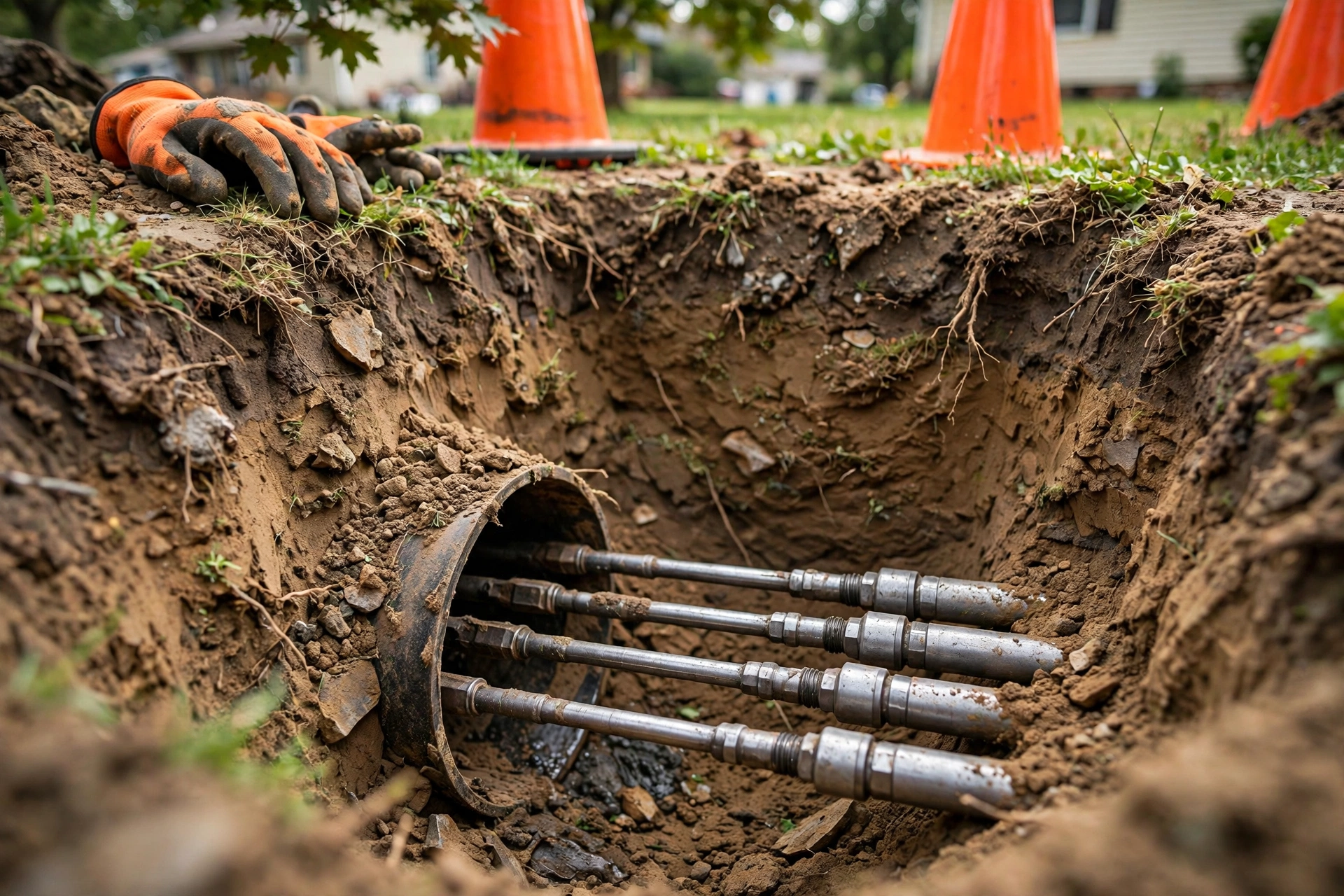
The entry pit gives the bursting rig access. Everything between the two pits stays exactly as it was.
Bursting usually costs more per foot than lining, because the equipment is heavier, the pits take labor, and the job installs an entirely new pipe. It usually costs less than open-trench excavation for the same run, because you're not paying to dig up and restore a full trench. Here's what moves your number:
State rules behind these permits come from the Ohio EPA, which administers Ohio's wastewater programs. Work that affects stormwater or nearby waterways also falls under federal discharge rules: the EPA's NPDES program covers sewer discharge permits for those projects. If your property runs on septic rather than a city connection, the U.S. EPA publishes homeowner guidance on septic and sewer systems.
Our Ohio sewer repair cost guide breaks down realistic ranges for every method. For your exact price, the process is the same as everything we do: camera inspection first, fixed written price second, work third. Call (614) 350-5706.
Much less than open-trench excavation, but more than pipe lining. Bursting needs an entry pit and an exit pit, usually dug at the ends of the run, and everything between them stays untouched. The pits get backfilled and patched the same day. Driveways, patios, and mature landscaping between the pits are left alone, which is the whole point.
Yes. Orangeburg, the tar-paper pipe common in Ohio homes from the 1950s to the 1970s, is one of the best bursting candidates. It is soft enough for the bursting head to shatter, and because Orangeburg deforms so badly it usually cannot be lined, bursting is often the only trenchless option. The camera inspection confirms how deformed it is before we commit.
High-density polyethylene, or HDPE. It is a flexible, fused plastic pipe with no bell joints to separate and no seams for roots to exploit. HDPE is the same material used for municipal water and gas lines, and it is engineered for a 50-year or longer service life underground. Sections are heat-fused into one continuous run before the pull.
Yes. Ohio's dense clay soil actually suits bursting well because the fragments of the old pipe compact outward into the soil wall as the head passes. Crews work year-round; frozen ground at the surface does not affect the pipe path several feet down. Severe storms can delay a day, and we tell you upfront if the schedule shifts.
Almost always, yes. Ohio cities and counties require permits for sewer lateral replacement, trenchless methods included, and most require an inspection before the line goes back in service. We pull the permits, call in the utility locate, and schedule the inspections as part of the job.
If your line still holds its shape, pipe lining (CIPP) is the less invasive trenchless option worth comparing first. Our trenchless sewer repair overview lays lining and bursting side by side. Every bursting job starts with a sewer camera inspection, and when the line is too far gone for any trenchless method, traditional excavation is still available, we'll tell you honestly which camp you're in.
The camera footage decides. One inspection, one fixed written price, no obligation.
Call (614) 350-5706