A brand-new epoxy pipe built inside your old sewer line, with no trench across the yard. Cured-in-place pipe lining fixes cracks, roots, and corrosion from the inside out. Here is how it works, when it qualifies, and what it lasts.
Cured-in-place pipe (CIPP) lining is a trenchless repair method that builds a new epoxy pipe inside an old sewer line, with no trench across the yard.
What Are the Signs Pipe Lining Is the Right Fix?
Lining is the right fix when your sewer line is damaged along a long run but the pipe still holds its basic shape. The camera is what confirms it, but these symptoms are the usual tip-off.
Recurring backups that snaking only pauses. A snake punches a hole through a root mass or sludge, then the same defect clogs again in a few months. When the pattern repeats, the pipe wall itself is the problem, and lining seals the wall.
Roots found on a previous cleaning. If a plumber pulled roots out of your line, they entered through joints or cracks. Cutting them buys time; lining removes the entry points permanently.
Gurgling toilets and slow drains across the house. Air and water backing up through multiple fixtures point to a main-line restriction: scale buildup, root masses, or a rough, corroded interior that a smooth liner replaces.
Sewer odor in the basement or near the foundation. Cracked or separated clay tile vents gas where it shouldn't. A continuous epoxy liner closes every crack in one pass.
A soggy strip or sunken spot in the yard. Wastewater escaping through breaks saturates the soil above the line. Lining stops the leak at its source without digging up the wet ground.
One caveat that matters: lining copies the shape of the pipe it goes into. If the camera shows the pipe is mostly intact with defects scattered along it, lining is usually the least disruptive and most economical answer. If it shows a crushed or flattened section, jump to the disqualifiers below, or read our trenchless sewer repair overview to compare lining with pipe bursting. If your home runs on a septic system rather than a city lateral, the U.S. EPA publishes homeowner guidance on septic and sewer systems explaining how the two differ.
How Does CIPP Pipe Lining Actually Work?
Cured-in-place pipe lining builds a new pipe inside the old one. A flexible tube soaked in epoxy resin goes into the damaged line, gets pressed tight against the old pipe walls, and hardens into a smooth, jointless shell. No trench, no removed pipe, no yard torn apart. Here is the job in five steps.
Inspect
A sewer camera inspection maps the full line: defects, distances, depths, pipe material, and diameter. Lining only starts when the footage shows the pipe holds its shape.
Clean
Hydro jetting and mechanical descaling strip out roots, grease, scale, and sludge. The liner has to bond to bare pipe wall, so this step is non-negotiable.
Install
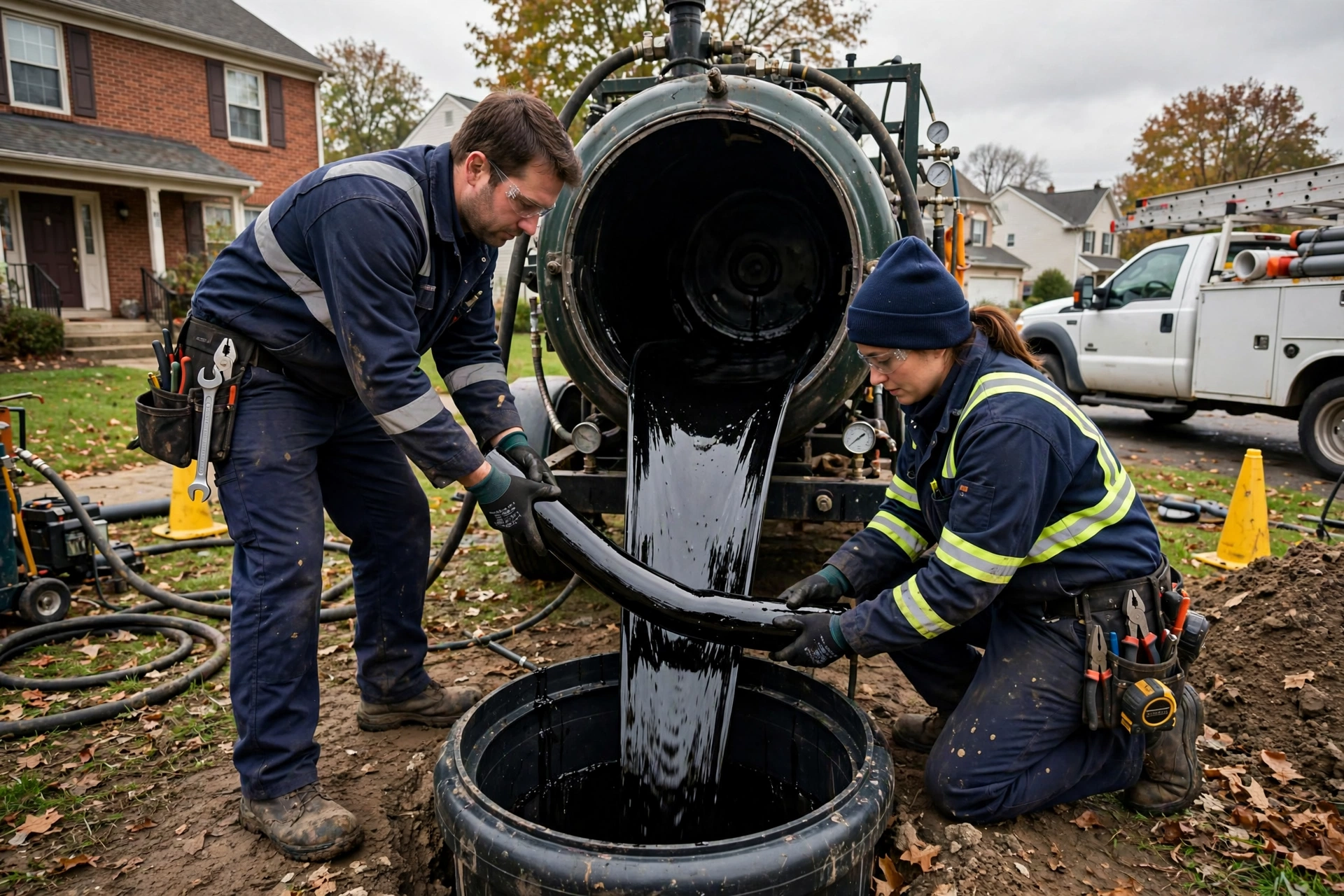
The resin-saturated liner is fed into the line through a cleanout or small access point, either inverted with air or water pressure or pulled into place, then inflated to press it against the old pipe.
Cure
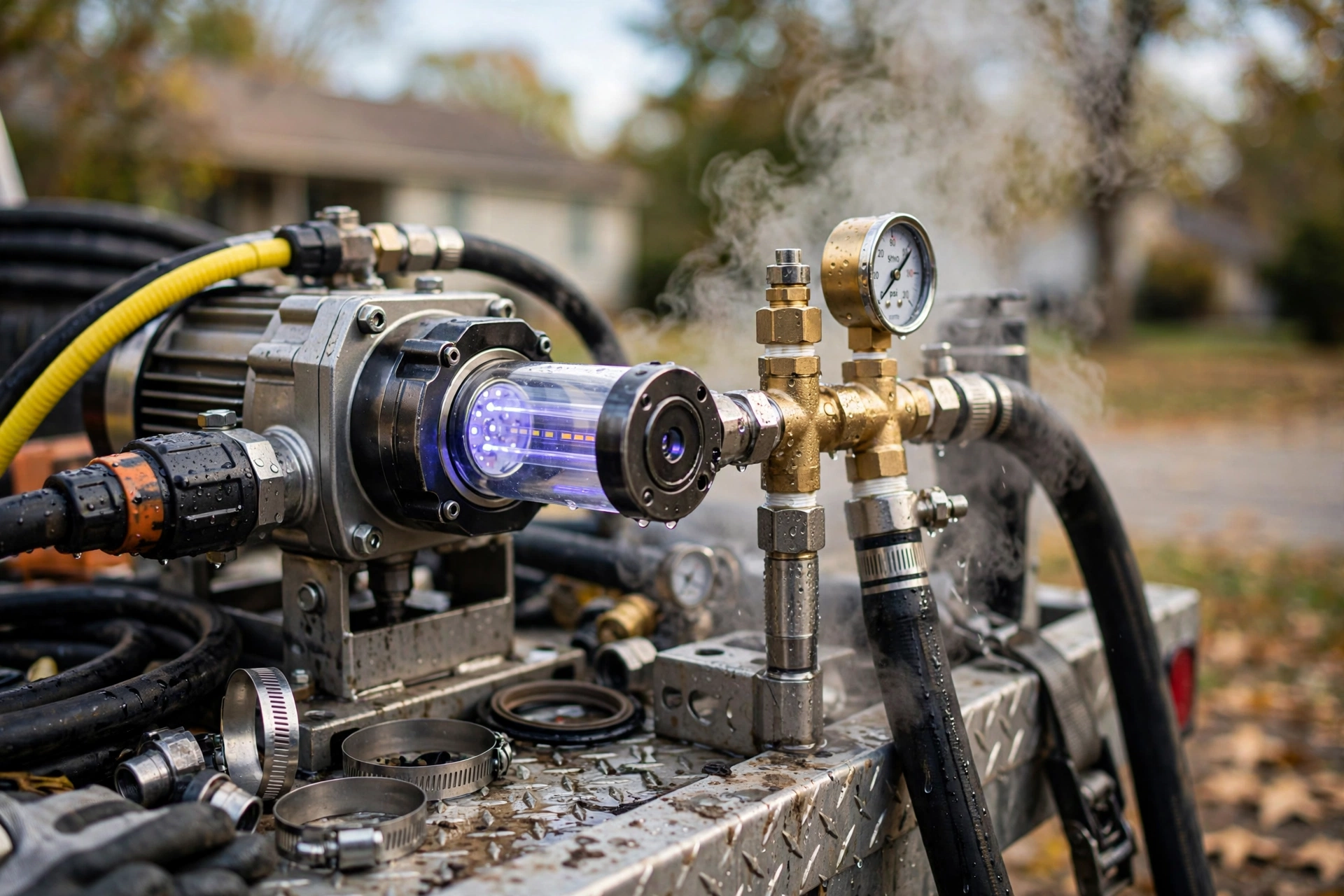
Heat or UV light hardens the resin into a solid structural pipe. Cure method depends on the liner, the diameter, and the run length, explained below.
Verify
A post-install camera run proves the liner is continuous, fully cured, and flowing properly. You watch the footage with the technician before the job is signed off.
How Is a CIPP Liner Cured?
Curing is what turns a soft resin-soaked tube into a hard structural pipe, and it uses one of three methods: hot water, steam, or UV light. All three work; the choice depends on the liner material, the diameter, and the job conditions.
Hot water cure. Hot water circulates through the inflated liner, bringing the resin up to its cure temperature evenly along the whole run. It is the most common method for residential felt liners and works reliably in Ohio winters because the temperature is controlled inside the pipe, not by the weather outside.
Steam cure. Steam does the same job faster, heating the resin quickly and shortening the cure window. It suits longer runs and larger diameters where hot water would take too long to reach full temperature.
UV cure. A train of ultraviolet lights is pulled through a glass-fiber liner, hardening the resin in minutes as it passes. UV liners cure fast and use no water, which is handy on jobs where water management is awkward. The trade-off is that UV equipment costs more, so it shows up on larger or commercial jobs.
Whichever method we use, the cure is verified before we leave: the camera shows a hard, continuous surface, and branch connections that were lined over get reopened with a robotic cutter so every fixture in the house drains exactly as before.
Cure equipment controls the resin temperature from the surface, so Ohio winter weather never decides the outcome.
Which Pipes Qualify for Lining, and Which Don't?
This is the question that decides everything, and it deserves a straight answer. Lining is a repair for a pipe that is damaged but still standing. It is not a resurrection for a pipe that has given up.
Which Pipes Usually Qualify for Lining?
Cracked clay tile. Ohio's most common older sewer pipe. Cracks from freeze-thaw soil movement and root pressure line up beautifully as long as the sections haven't shifted badly.
Root-invaded joints. Roots enter through separated joints. Clean them out, line the pipe, and the joints are gone, replaced by one continuous wall.
Corroded or scaled cast iron. Basement-era cast iron roughens and narrows with scale. Descaling plus a liner gives it a new interior.
Minor offsets and separated joints. Small shifts at joints are fine; the liner bridges them and seals the gap.
Pinhole leaks and corrosion pits in PVC or ABS. Less common, but lining handles them.
Which Pipes Don't Qualify for Lining?
Fully collapsed or flattened sections. The liner needs an open path to travel through. A crushed section has no path.
Severely deformed Orangeburg. That tar-paper pipe from the 1950s to the 1970s egg-shapes and pancakes over time. Once it's badly deformed, lining can't restore the round shape it needs.
Bellies and reverse grade. Lining follows the old pipe's shape exactly. A sag that holds wastewater will still hold wastewater after lining, just inside a newer pipe. Bellies need pipe bursting or open-trench replacement to correct the grade.
Missing sections. If part of the pipe is simply gone, there is nothing to line against.
About half the lines we camera-inspect for lining turn out to be good candidates; the rest get an honest recommendation for bursting or excavation instead. The inspection footage is yours to keep either way, so you can see exactly why we recommended what we did.
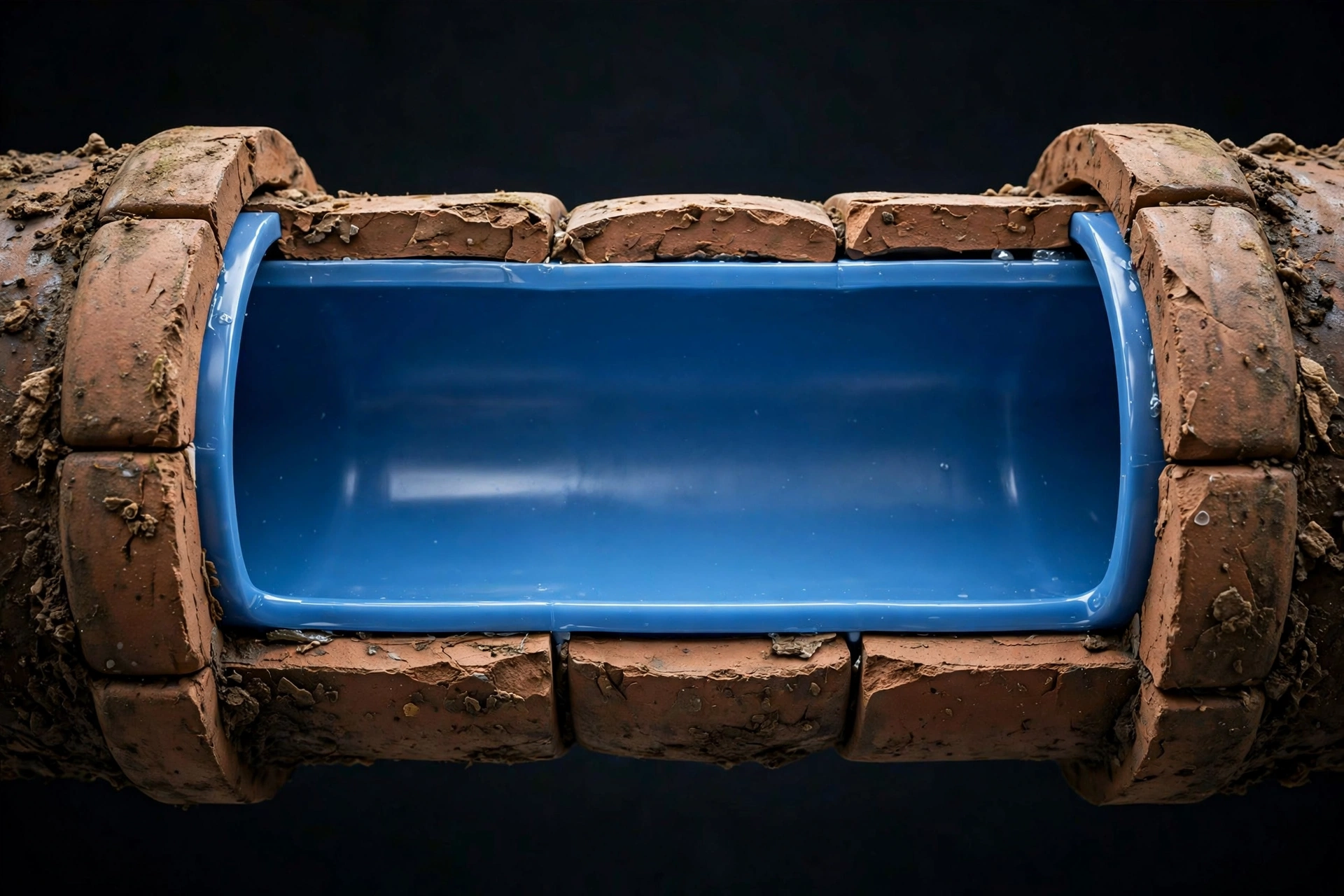
The cured liner hugs the old pipe's interior, turning cracked clay tile into a smooth, jointless channel.
Here is how lining stacks up against the other two full-line options.
Pipe lining vs. pipe bursting vs. traditional replacement
Factor
Pipe lining (CIPP)
Pipe bursting
Traditional replacement
How it works
New epoxy pipe built inside the old one
Old pipe shattered; new HDPE pulled through
Old pipe dug out; new pipe laid in a trench
Pipe condition required
Pipe must roughly hold its shape
Handles collapsed or badly deformed pipe
Works on any condition
Digging required
Often none beyond an existing cleanout
Entry and exit pits
Full open trench
Pipe diameter
Slight decrease from liner thickness
Can increase (upsizing)
Any size, set to the correct grade
Typical timeline
Often one day
Often one day; larger pulls can take two
Typically two to five working days
Best suited for
Cracked, root-invaded, or corroded lines that hold their shape
Collapsed, deformed, or undersized lines
Wrong slope, a route that must change, or shallow cheap digs
Does Lining Shrink My Pipe? How Long Does It Last?
Yes, slightly, and it almost never matters. The liner adds a few millimeters of wall thickness inside your pipe, so a 4-inch line becomes a little less than 4 inches inside. But the cured epoxy surface is dramatically slicker than rough clay tile or scaled cast iron, so wastewater moves through with less friction. In practice, flow capacity stays the same or improves, and we confirm it on the verification camera.
On lifespan: a properly installed CIPP liner is engineered for a 50-year design life, the standard design-life figure published across the CIPP industry. That number comes from the materials science: epoxy resin and felt or fiberglass composites tested for decades of underground service, not from marketing. The jointless design is the real advantage. Most sewer failures start at joints: roots slip in, soil washes out, sections shift. A liner has no joints, so those failure modes disappear along the lined run. It typically outlasts the original pipe it was installed inside.
What can shorten that life is poor prep. A liner installed over leftover roots, grease, or scale bonds badly and can wrinkle or delaminate. That is why the cleaning step gets as much time as the installation itself on our jobs, and why any lining quote that skips a thorough cleaning should make you nervous.
What Does CIPP Pipe Lining Cost in Ohio?
Straight talk: nobody can price your lining job without seeing your line on camera, and anyone who does is guessing. But you deserve to know what moves the number before you call. These are the factors that set the price of a CIPP job in Ohio:
Length of the lined run. More liner, more resin, more cure time. Longer runs to the city main cost more than short house-to-street lines.
Pipe diameter. Residential laterals are usually 3 to 6 inches. Larger diameters need thicker, more expensive liners.
Condition and prep work. A line packed with roots or heavy cast-iron scale needs serious cleaning before lining can start, and that work is part of the price.
Access. A clear outdoor cleanout is the cheapest entry. No cleanout means creating access, which adds labor.
Depth. Ohio basement laterals often run 8 to 10 feet deep. Deeper lines complicate access and curing logistics.
Permits and inspections. Ohio municipalities require permits for sewer lateral work and usually an inspection. We pull them and roll the cost into the written price. State-level rules come from the Ohio EPA, which administers Ohio's wastewater programs.
For realistic statewide ranges and a breakdown of when lining costs less than digging, read our Ohio sewer repair cost guide. The only number that actually matters is yours: call (614) 350-5706 for a camera inspection and a fixed written price.
Pipe Lining (CIPP) FAQs
A properly installed CIPP liner is engineered for a 50-year design life. The cured epoxy forms a smooth, jointless pipe inside the old one, so the separated joints and cracks that let roots and soil in are gone. It usually outlasts the original clay or cast iron pipe it rehabilitates.
Slightly, yes, and it rarely matters. The liner adds a few millimeters of wall thickness inside the pipe, so the inside diameter shrinks a little. But the cured epoxy surface is far slicker than rough old clay or scaled cast iron, so flow capacity usually stays the same or improves. We size every liner to your pipe's actual diameter and confirm the result on camera.
Yes, when the roots came through joints and cracks but the pipe still holds its shape. We cut the roots out with hydro jetting or a root-cutting head first, then the liner seals every entry point behind a seamless wall. Roots cannot grow through cured epoxy. If the roots have crushed or collapsed the pipe, lining is off the table and pipe bursting or excavation is the honest answer.
Clay tile, cast iron, PVC, ABS, and concrete pipe all take a liner well, as long as the pipe roughly holds its original shape. Orangeburg, the tar-paper pipe used from the 1950s to the 1970s, usually cannot be lined because it deforms and flattens over time. The camera inspection tells us which material you have and whether it qualifies.
Most residential CIPP jobs in Ohio finish in one day: inspect and clean in the morning, install and cure the liner, then run the verification camera before we leave. Larger or more complex lines can take a second day. You get a firm schedule in writing with your price, and we pull the required permits before work starts.