Sewer Line Repair in Greater Cleveland
Thirty cities, one shared enemy: Lake Erie winters working on old pipe. We diagnose with a camera and fix it trenchless or traditional, with one upfront price.
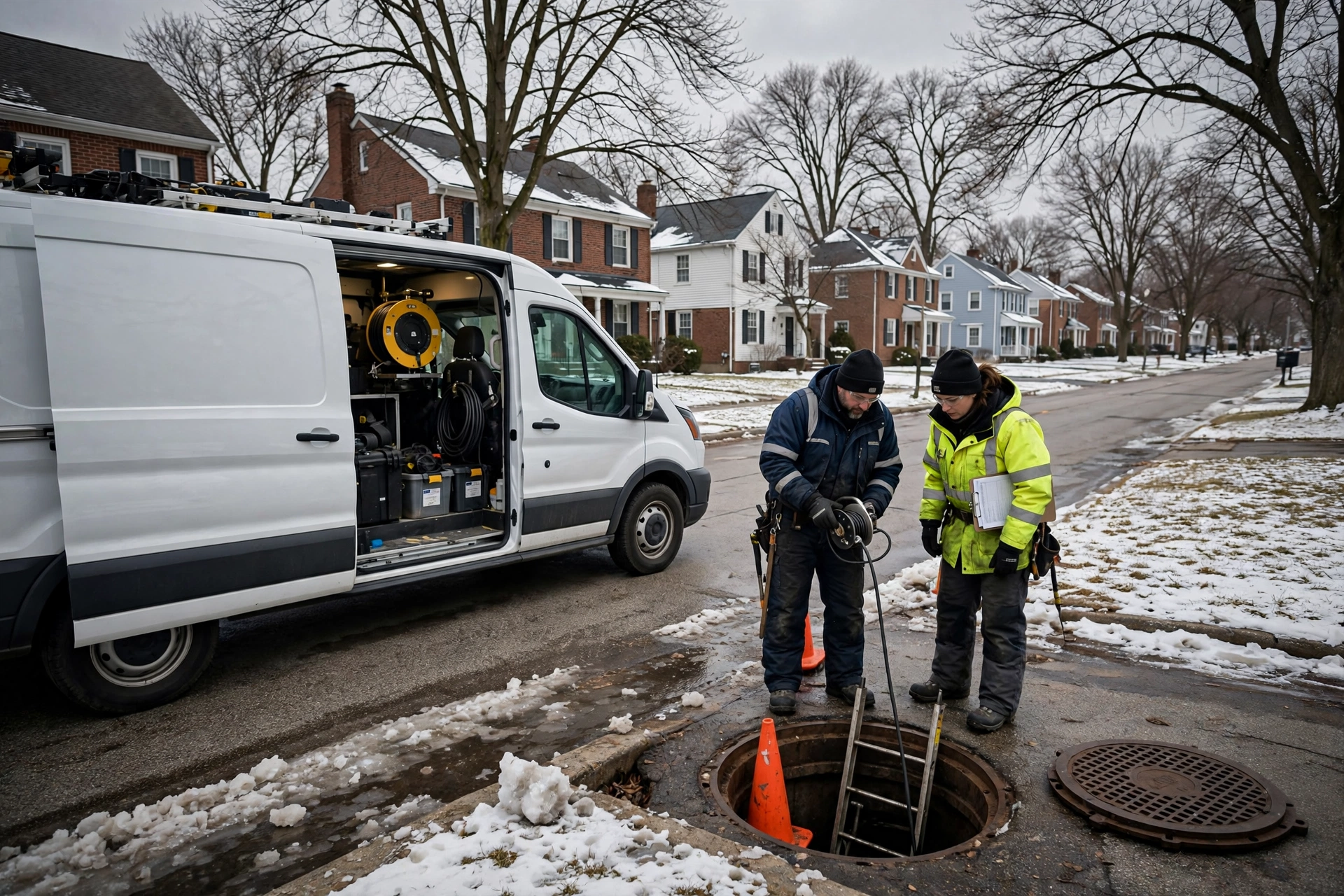
Thirty cities, one shared enemy: Lake Erie winters working on old pipe. We diagnose with a camera and fix it trenchless or traditional, with one upfront price.
Last updated: October 13, 2026
The whole metro shares three things: lake-effect winters, heavy glacial clay soil, and housing stock older than its pipe.
The winters do the most visible damage. Cleveland sits in the lake-effect snow belt, where temperatures seesaw above and below freezing for months. Meltwater seeps into hairline cracks and mortar joints, freezes, expands, and wedges the crack wider. Then it thaws, loose soil washes in, and the next freeze starts from a worse position. Failures cluster in late winter, when the ground thaws from the top down while deeper soil stays frozen.
The soil makes it worse. Northeast Ohio sits on dense glacial till, heavy clay that holds water instead of draining it. Saturated clay presses on joints, shifts as it freezes and thaws, and feeds tree roots with moisture from any small leak.
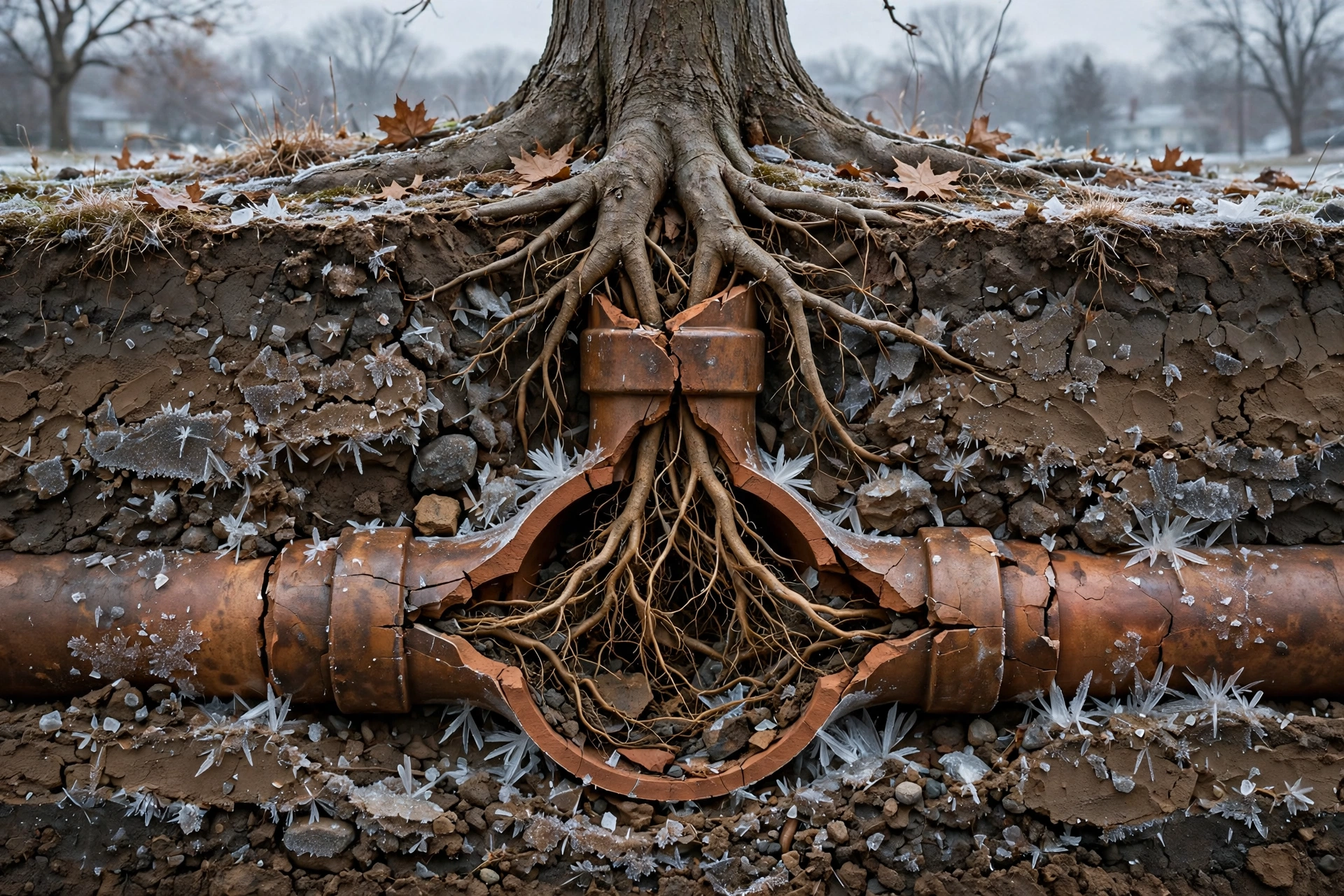
Tree roots and freeze-thaw cycles attack the same weak point: the mortar joints of old clay tile.
Read the metro from the inside out and the decades show in the ground. The inner ring, Cleveland Heights, Shaker Heights, Lakewood, and the near sides of Cleveland, was built between roughly 1890 and 1940 on vitrified clay tile with mortar-sealed joints. After 80 to 130 years the mortar has crumbled, sections have offset, and mature street trees have pushed root hairs into every damp joint. The post-war ring went up in the 1950s through the 1970s on cast iron, which rusts from the inside out and is reaching the end of its run right now. The outer suburbs are largely PVC. Whatever generation is under your house: camera first, then fix what is actually broken.
You own the lateral from your house to the public main, including the part under your yard and driveway. The Northeast Ohio Regional Sewer District (NEORSD) manages the regional system across much of Cuyahoga County and parts of surrounding counties; outlying cities like Brunswick, Medina, Lorain, and Elyria run their own utilities. Solo backup means lateral; street-wide means main. Permits run through your municipality, and we pull them as part of the job.
Cities: Cleveland Heights, Shaker Heights, Lakewood, South Euclid. Condition: clay tile with crumbled mortar joints. Mechanism: mature maples and oaks send root hairs into damp joints that thicken until they wedge joints apart. Symptom: drains that slow every spring and recover after snaking, then slow again. Fix: root removal buys time; trenchless lining or bursting closes the entry points for good.
Cities: Parma, Garfield Heights, Brook Park, Euclid, Maple Heights, Parma Heights, Mayfield Heights. Condition: 1950s to 1970s cast iron. Mechanism: corrosion thins the pipe from the inside out until it flakes and sags. Symptom: chronic slow drains, gurgling toilets, backups back within weeks of snaking. Fix: camera inspection to measure remaining wall, then trenchless replacement before a collapse forces a dig.
Cities: Avon Lake, Rocky River, Lorain, lakeshore neighborhoods. Condition: clay soil saturated near Lake Erie. Mechanism: constant moisture accelerates joint failure and groundwater infiltrates cracked lines. Symptom: backups that arrive with rain, sump pumps running constantly. Fix: camera inspection to find infiltration points, then lining to seal the line watertight.
Cities: all 30, worst where clay tile is oldest. Condition: hairline cracks and aging joints in any pipe generation. Mechanism: dozens of freeze-thaw cycles per winter wedge cracks wider until sections offset or collapse. Symptom: a lateral fine all summer that fails every February or March. Fix: fall camera inspections catch cracks while they are lining candidates; collapsed sections get pipe bursting or traditional replacement.
Every city below has its own local page. Start with yours.
The metro's core: century-old clay tile laterals, stone foundations, and the region's hardest lake-effect winters.
Sewer line repair in Cleveland →Ohio's largest suburb: post-war ranches and split-levels whose cast iron laterals are hitting end-of-life now.
Sewer line repair in Parma →Lake Erie shoreline city with a steel-town heritage: older east-side blocks still run clay tile in saturated soil.
Sewer line repair in Lorain →Lorain County seat with a Victorian-era downtown: historic-district homes still run original clay tile.
Sewer line repair in Elyria →Dense streetcar suburb where a mature tree canopy meets clay tile laterals: root intrusion is practically routine.
Sewer line repair in Lakewood →East-side lakefront suburb: 1950s colonials with cast iron, plus older lake streets where clay tile still runs.
Sewer line repair in Euclid →Lake County's largest city: sprawling subdivisions on glacial till, where offset clay joints are a frequent camera find.
Sewer line repair in Mentor →Fast-growing southwest suburb: newer subdivisions are mostly PVC, but the older core still runs clay and cast iron.
Sewer line repair in Strongsville →Hillside city of 1920s colonials and Tudors: clay tile threaded through some of the region's thirstiest tree roots.
Sewer line repair in Cleveland Heights →Former farmland turned family suburb: long laterals on big lots, new PVC beside original farmhouse clay tile.
Sewer line repair in North Ridgeville →Medina County's largest suburb: 1960s and 70s split-levels on clay-heavy soil, with cast iron aging out together.
Sewer line repair in Brunswick →Upscale west-side suburb: mature neighborhoods with original cast iron, plus estate homes with long private laterals.
Sewer line repair in Westlake →Post-war suburb west of Cleveland: bungalows and ranches whose cast iron laterals are nearing the end of their run.
Sewer line repair in North Olmsted →Big-lot suburb south of the city: long runs through glacial clay, where root-prone joints fail quietly until a backup announces them.
Sewer line repair in North Royalton →Southeast-side city of 1950s bungalows: cast iron laterals now rusting thin from the inside out.
Sewer line repair in Garfield Heights →Garden-suburb streets lined with century-old trees: clay tile joints separate where soil shifts, and roots follow the moisture.
Sewer line repair in Shaker Heights →Historic county seat wrapped in newer subdivisions: downtown's old buildings run clay tile, surrounding developments run PVC.
Sewer line repair in Medina →Lakefront city where high groundwater and clay soil team up: joints fail faster where soil never really dries out.
Sewer line repair in Avon Lake →Once French Creek Township farmland, now a booming suburb: farmhouse clay laterals beside brand-new PVC subdivisions.
Sewer line repair in Avon →East-side suburb of 1960s to 80s colonials: long clay-soil runs under big yards, where tree-lined streets feed root intrusion.
Sewer line repair in Solon →Historic Lake County downtown with 19th-century brick buildings: some of the metro's oldest laterals hide under its streets.
Sewer line repair in Willoughby →Southeast suburb of 1950s capes and ranches: cast iron aging out, with clay tile on the older blocks.
Sewer line repair in Maple Heights →1920s to 50s brick colonials near University Circle: clay tile on older streets, cast iron in post-war blocks.
Sewer line repair in South Euclid →Lakeside city of older colonials and lakefront condos: clay soil, high water table, and mature trees.
Sewer line repair in Rocky River →Small suburb ringed by Parma: modest post-war homes where cast iron laterals are reaching retirement age together.
Sewer line repair in Parma Heights →Lake County seat with a 19th-century town square: historic-district clay tile blocks from mid-century cast iron.
Sewer line repair in Painesville →East-side suburb built in the 1950s and 60s: brick ranches and split-levels with cast iron nearing replacement age.
Sewer line repair in Mayfield Heights →Hilly suburb along the Cuyahoga Valley edge: slopes and clay soil push pipe sections out of alignment.
Sewer line repair in Broadview Heights →College town built around Baldwin Wallace University, with a sandstone-quarry heritage: rentals and older homes on clay tile.
Sewer line repair in Berea →Industrial suburb by the airport: modest post-war homes with cast iron, plus commercial lines near the Ford plant corridor.
Sewer line repair in Brook Park →We cover all 30 cities across Cuyahoga, Lake, Lorain, and Medina counties.
Lining and pipe bursting that replace your lateral without tearing up the driveway or landscaping.
Trenchless options →We see exactly what is in your line and show you the footage.
How inspection works →High-pressure water that scours buildup off the pipe walls, the right prep before lining.
Jetting details →Clearing root masses from clay tile joints, with an honest read on whether the line is worth saving.
Root removal →No. NEORSD handles the regional system across much of Cuyahoga County, but outlying cities like Brunswick, Medina, Lorain, and Elyria run their own utilities. Either way, your lateral is yours to maintain.
Most likely cast iron from your foundation toward the street, sometimes transitioning to clay tile at the connection. Cast iron from the 1950s is rusting from the inside out right now, so the bottom of the pipe turns paper-thin while the top looks fine. A camera inspection shows how much wall is left and whether you are a trenchless candidate.
Most municipalities require permits for lateral repair and replacement, and many require an inspection before backfill. Rules and fees vary city to city. We pull the correct permit and schedule the inspection as part of the job.
Because no two laterals are the same. Depth, length, pipe material, soil, and what sits above the line change the job completely, and trenchless versus open-trench is the biggest swing. A camera inspection comes before any real number.
Everywhere. Lining and bursting work the same under a Parma driveway as a Cleveland sidewalk; pipe condition and access decide the method, not the zip code. If the camera shows a line intact enough to line or burst, we do it trenchless; if it has collapsed flat, we go open-trench.
One inspection, one honest diagnosis, one upfront price.
Call (614) 350-5706