Sewer Line Repair in Canton Metro
Canton, Massillon, and Alliance share Stark County's soil, winters, and early-1900s housing stock, and they share the same sewer problems. We camera-diagnose every job and fix it trenchless or traditional.
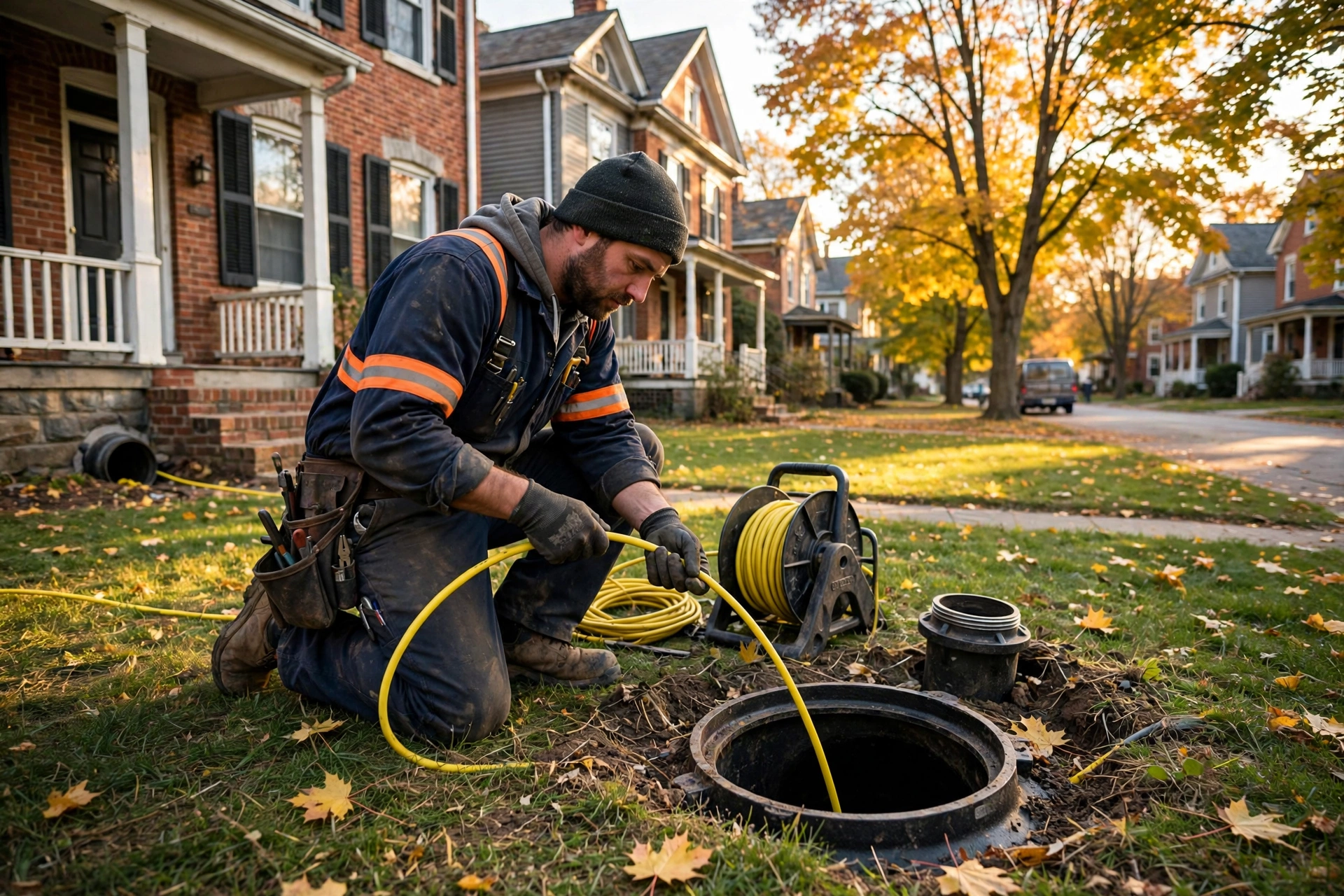
Canton, Massillon, and Alliance share Stark County's soil, winters, and early-1900s housing stock, and they share the same sewer problems. We camera-diagnose every job and fix it trenchless or traditional.
Last updated: October 13, 2026
It is not one thing, it is a stack of them. Stark County combines heavy glacial clay soil, hard freeze-thaw winters, and neighborhoods built in the early 1900s with clay tile laterals that are now a century old.
Canton sits in the rolling terrain of northeast Ohio, the county seat of Stark County and home of the Pro Football Hall of Fame. Under the historic neighborhoods, from downtown and the near-northwest side out toward the Hall of Fame corridor, the ground is thick glacial clay. That clay swells when wet and shrinks when dry, and every season's movement shifts buried pipe sections a little. Add a hard northeast Ohio winter, where temperatures swing above and below freezing for months, and the freeze-thaw cycles finish what the clay started: meltwater seeps into mortar joints and hairline cracks, freezes, expands, and wedges them wider.
The housing stock completes the picture. Canton, Massillon, and Alliance all grew fast in the early 1900s, steel, manufacturing, and rail jobs drawing workers who filled new neighborhoods with brick and wood-frame homes. The sewer lines buried under those streets are the same era: vitrified clay tile with mortar-sealed joints. A century later, the mortar has crumbled, the sections have shifted with the clay soil, and mature maples and oaks line the streets, sending roots into every damp joint. The metro's sewer problems are not mysterious. They are the predictable result of old pipe, heavy clay, hard winters, and big trees.
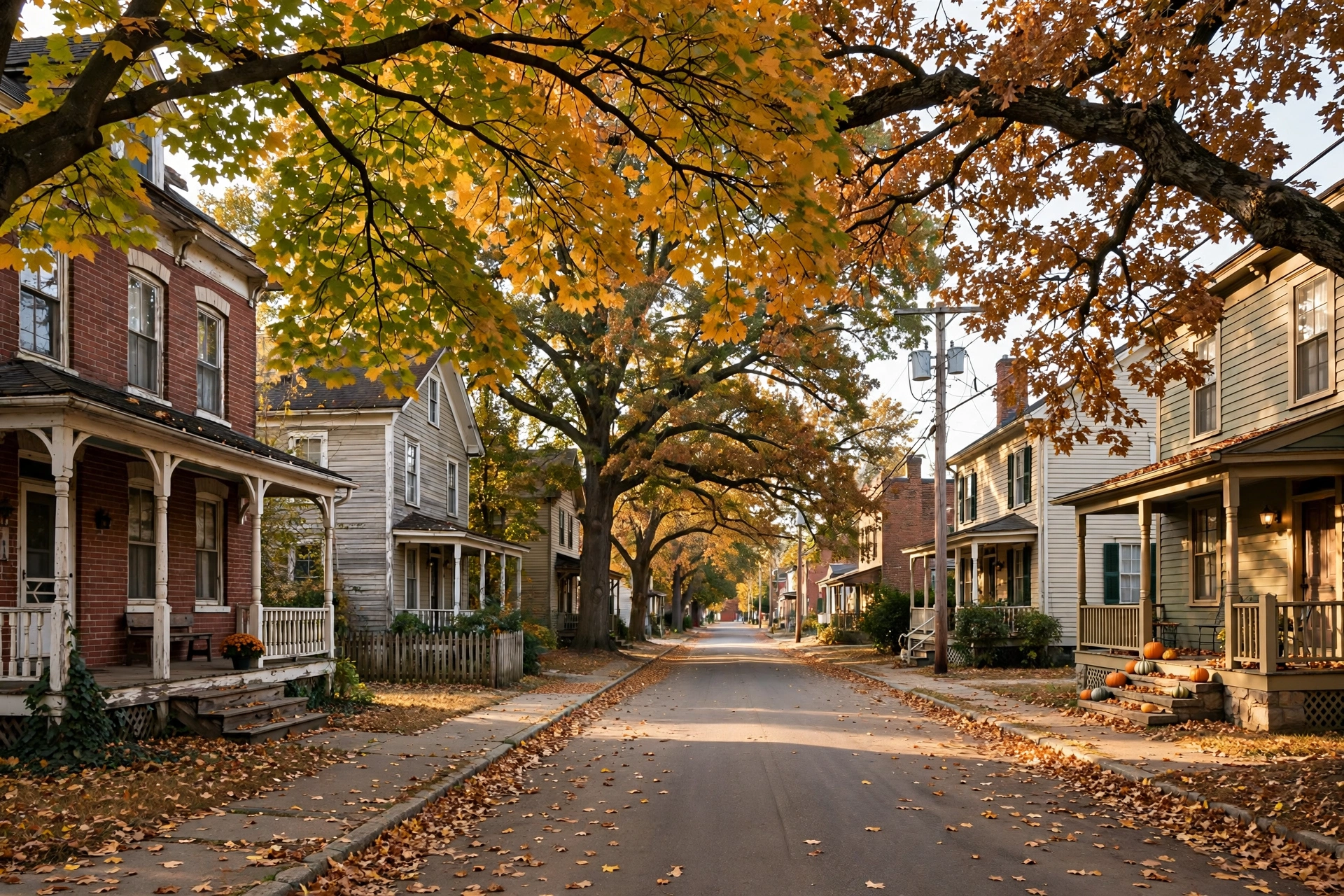
Canton's historic streets pair century-old clay laterals with some of the region's biggest, oldest street trees.
The early-1900s homes around downtown Canton, Massillon's downtown and west side, and Alliance's historic districts near the University of Mount Union run vitrified clay tile from stone or brick foundations, with mortar joints that a century of freeze-thaw cycles has crumbled. Those lines are the metro's most common failure: joint separation from clay soil heave, root intrusion through crumbled joints, and sections that offset as the soil shifts.
The post-war boom brought ranches and split-levels with cast iron laterals, and cast iron rusts from the inside out. It looks fine until the bottom of the pipe is paper-thin. Where the pipe still holds its shape, old clay and cast iron laterals are excellent candidates for trenchless lining. A camera inspection, which takes about an hour, shows exactly what you are working with. No guessing, no excavation to find out.
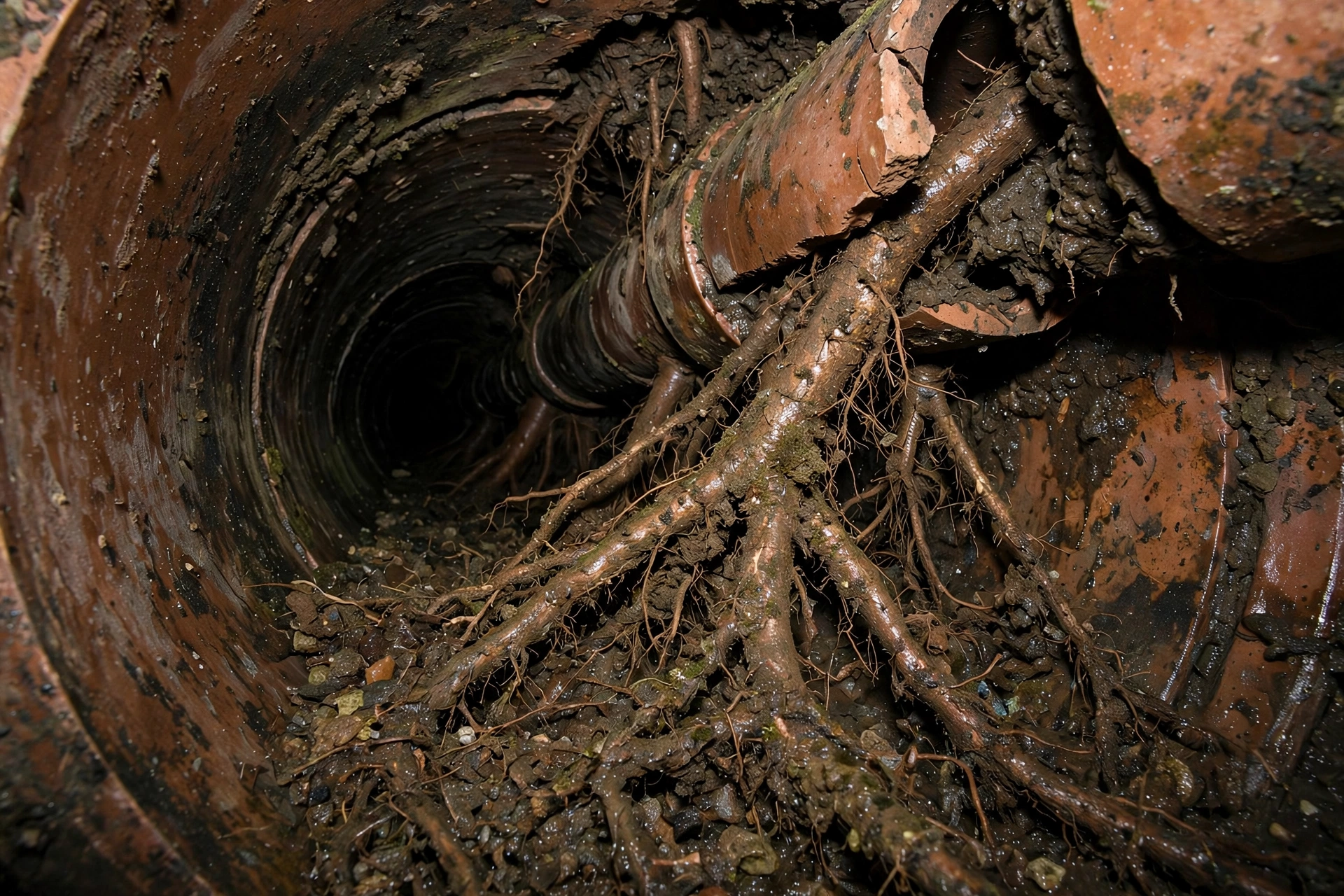
This is how Canton-metro laterals fail most often: crumbled mortar joints give tree roots a way in, and the roots wedge the joint apart year after year.
Each city runs its own system, and that matters for permits and who you call when something goes wrong. In Canton, Canton City Utilities handles water and sewer, and Canton's Water Reclamation Facility treats sanitary sewage for the greater Stark County area. In Massillon, the City of Massillon operates its own Sewer & Waste Department, and its wastewater treatment plant on the southwest side handles the city's sewage. In Alliance, the City of Alliance Water Utility handles water/sewer/trash billing, and the city's wastewater treatment plant processes sanitary sewage.
One rule holds in all three cities: you own the sewer lateral from your house to where it connects with the public main, usually at the street or sidewalk. Everything in between, including the part under your yard and driveway, is yours to maintain and repair. If sewage is backing up in multiple homes on your street at once, that is likely a main-line problem, call your city's sewer department. If it is just your house, the lateral is the prime suspect, and that is our territory.
Federal clean-water standards come from the U.S. EPA; the Ohio EPA administers them in Ohio and sets the statewide wastewater standards these city systems operate under. Each city runs its own permit process for lateral repair and replacement, with inspection typically required before backfill. We pull the permits and schedule the inspections as part of every job.
The same four failure patterns show up in Canton, Massillon, and Alliance, just in different mixes by city.
The glacial clay under Canton's rolling terrain and Alliance's historic districts swells with moisture and shrinks with drought, and every season's movement shifts buried clay tile sections. Over decades, the joints between sections separate and offset. Once a joint opens, soil washes in, roots find the damp opening, and the line slowly loses capacity. The symptom is a drain problem that gets worse a little each year, not all at once. A camera inspection shows separated joints clearly, and offset sections are exactly what trenchless repair fixes without digging up the yard.
Stark County winters deliver dozens of freeze-thaw cycles per season. Meltwater seeps into hairline cracks and mortar joints, freezes, expands with tremendous force, and wedges the crack wider. Then it thaws, loose soil washes into the opening, and the next freeze starts from a worse position. The failures cluster in late winter: February into March, when the ground thaws from the top down while deeper soil stays frozen and pressure peaks. If your drains slow down every year around the same time, that is the cycle, and a fall camera inspection catches the damage while the line is still a lining candidate instead of a collapse job.
Massillon sits in the Tuscarawas River valley, so groundwater runs high and infiltrates every cracked joint when the ground saturates, a process called infiltration that makes your lateral carry far more water than it was designed for. In the oldest blocks of Massillon and Canton, the public mains may still be combined sewers carrying both sewage and stormwater, a century-old standard practice, and during heavy rain those lines can surcharge and push sewage back toward basement floor drains. The symptom is backups that arrive with the rain, not the season. The fix depends on the cause: lining seals infiltration out of the lateral, and a backwater valve stops surcharge flow in its tracks.
The historic districts around the University of Mount Union, Canton's near-downtown blocks, and Massillon's west side combine century-old clay laterals with some of the metro's biggest street trees. Mature maples and oaks send fine root hairs into damp mortar joints all summer, and the roots thicken year after year until they wedge joints apart or fill the pipe. The symptom is drains that slow down every spring and clogs that keep coming back after snaking. Snaking only buys time against roots; hydro jetting clears the mass so the camera can see the damage, and lining or bursting the pipe removes the entry points for good.
Each city below has its own local page with neighborhood-level detail: the housing eras, the soil, the tree canopy, and the utility that runs the sewers.
The county seat and home of the Pro Football Hall of Fame, where early-1900s neighborhoods, downtown combined sewers, and heavy glacial clay stack up the most failure modes per block in the metro.
Sewer line repair in Canton, OH →The Tuscarawas River keeps groundwater high along the valley floor here, so Massillon laterals battle infiltration and root intrusion from downtown to the west side, with Paul Brown Tiger Stadium at the heart of it.
Sewer line repair in Massillon, OH →Carnation City and a college town: mature trees around the University of Mount Union and the historic neighborhoods push roots into century-old clay tile that a hundred winters have already loosened.
Sewer line repair in Alliance, OH →No. Each city runs its own utility: Canton City Utilities handles water and sewer in Canton, the City of Massillon operates its own Sewer & Waste Department, and Alliance runs water/sewer/trash billing through the city's Water Utility. One rule holds in all three, though: you own the lateral from your house to the public main, so a lateral problem is yours to fix regardless of which city you live in.
Stark County winters deliver dozens of freeze-thaw cycles per season. Meltwater and groundwater seep into cracks and mortar joints in your sewer line, freeze, expand with tremendous force, and wedge the crack a little wider. By February and March the ground is thawing from the top down while deeper soil stays frozen, water has nowhere to go, pressure peaks, and weakened clay tile lines fail. If your drains slow down every late winter, you are watching this cycle in real time.
Most likely vitrified clay tile with mortar joints, running from a stone or brick foundation out to the street. That holds for the early-1900s neighborhoods around downtown Canton, Massillon's downtown and west side, and Alliance's historic districts near the University of Mount Union. After a century, the mortar joints crumble, roots push in, and sections offset. If the pipe still holds its shape, these old clay laterals are excellent candidates for trenchless lining.
Yes, each city runs its own permit process for sewer lateral repair and replacement, and inspections are typically required before backfill. We pull the permits and coordinate the inspections as part of every job, it's baked into the written plan, not an add-on surprise.
The Tuscarawas River. Massillon sits in the river valley, so the water table runs high and groundwater infiltrates every cracked joint when the ground saturates. Canton sits on rolling terrain with heavy glacial clay that heaves seasonally and shifts pipe sections. Both cities fail on the same early-1900s clay tile, but Massillon's failures lean toward infiltration and root intrusion, while Canton's lean toward joint separation and soil heave. The camera tells us which story your street is living.
Also serving North Canton, Louisville, Hartville, Minerva, Canal Fulton, Navarre, and the greater Canton metro. Major landmarks we work around include the Pro Football Hall of Fame, the McKinley Presidential Library & Museum, Paul Brown Tiger Stadium in Massillon, the University of Mount Union and Glamorgan Castle in Alliance, and Sippo Lake Park.
One inspection, one honest diagnosis, one upfront plan, anywhere in the Canton metro.
Call (614) 350-5706