Rubber-era worker housing, century-old clay tile, and combined sewers in the Cuyahoga River valley. We camera your lateral, give you one honest diagnosis, and fix it trenchless or traditional with one upfront price.
Last updated: October 13, 2026
Akron built tires for the world, and housing for the workers who made them. A century later, those same sewer lines are still in the ground.
Akron earned the nickname "Rubber Capital of the World" when Goodyear, Firestone, and Goodrich turned it into a tire-manufacturing powerhouse in the early 1900s. The factories needed workers, and workers needed homes, so whole neighborhoods went up fast. Goodyear Heights, Firestone Park, Kenmore, and Ellet filled with modest brick and wood-frame houses between roughly 1900 and 1940. Each one got a sewer lateral, usually vitrified clay tile with mortar joints, running out to a street main. Most of those laterals have never been replaced. They have served for 90 to 120 years, and the combination of age, crumbling mortar, and aggressive tree roots is finally catching up with them.
The ground under Akron works against old pipe too. The metro sits in the Cuyahoga River valley, where glaciers left rolling hills and a patchwork of clay, silt, and sand. Water moves through that soil unevenly, and freeze-thaw cycles each winter shift the ground just enough to stress brittle clay joints. On the hillsides of Cuyahoga Falls, Hudson, and Stow, slow soil creep adds sideways pressure. None of this breaks a new PVC line, but it punishes pipe that is already a century old.
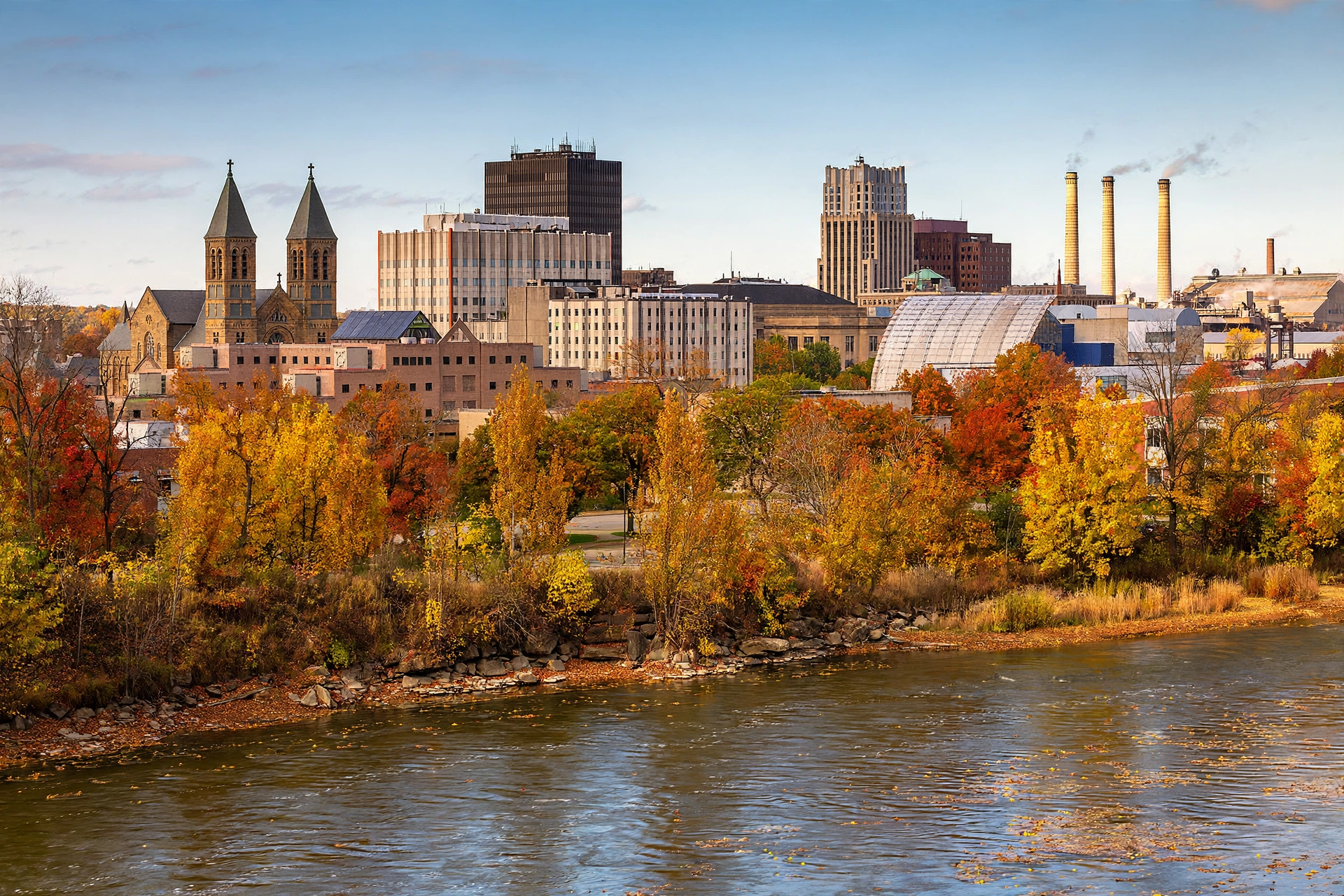
The Cuyahoga River valley and rolling glacial terrain that stress Greater Akron's aging sewer lines.
Much of the older city of Akron runs on combined sewers, single pipes that carry both sewage and stormwater. In dry weather that works fine. In heavy rain, stormwater can overwhelm the pipes, and the result can send untreated sewage toward the Cuyahoga River or back toward homes. The problem put Akron under a federal consent decree, entered in 2014, and the city answered with the Akron Waterways Renewed! program. Since then the city has invested more than $1 billion in sewer infrastructure: five combined-sewer-overflow storage basins, the Ohio Canal Interceptor Tunnel, the Northside Interceptor Tunnel, and a major upgrade of its Water Reclamation Facility. As of this year, most of the required projects are complete.
That program fixes the public system, not your lateral. You still own the pipe from your house to the public main, and combined-system backups put extra pressure on old private laterals. In Akron's older neighborhoods, the smartest defense is a camera inspection, a clear picture of what your lateral looks like, and a fix that keeps storm surges out of your basement.
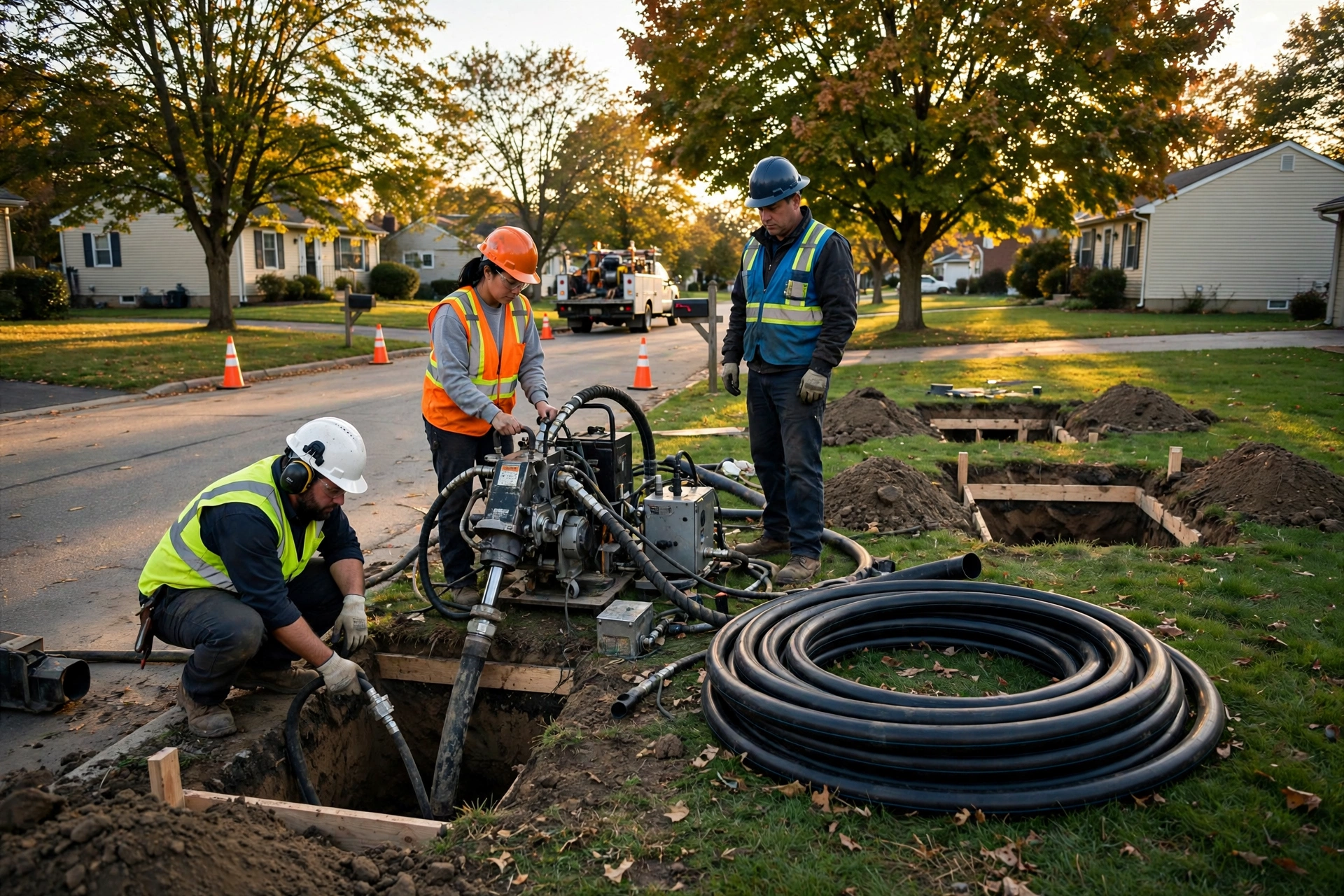
Trenchless repair replaces Greater Akron's failing clay tile with only small access pits, not a full trench.
Age of housing predicts pipe age here better than anything. In Goodyear Heights and Firestone Park, the tire-worker homes of the 1910s through the 1930s almost always have original clay tile laterals, many now shaded by mature maples and oaks whose roots have been probing the joints for decades. Kenmore and parts of Barberton, the "Magic City" that grew up around O.C. Barber's industrial town in the 1890s, tell the same story. In Cuyahoga Falls, the older streets near the river gorge and downtown mix clay tile with early cast iron.
The suburbs run newer but not new. Stow's post-war ranches and split-levels are hitting the 60-to-70-year mark, right when cast iron laterals rust thin and clay joints separate. Hudson mixes 19th-century Western Reserve homes with newer subdivisions, so the pipe under a Hudson house could be almost anything. Twinsburg grew fast in the 1960s and 70s, an era of cast iron and early plastics. Kent's college neighborhoods along the Cuyahoga River sit on saturated ground that keeps laterals wet and speeds joint failure. And in Green, with its larger lots and longer setbacks, laterals run farther from house to main, which gives tree roots more pipe to attack and makes replacement work longer.
You own your sewer lateral from your house to where it connects with the public main. That includes the section under your yard and driveway. Everything from the main outward belongs to the system operator.
The city of Akron runs its own sewer system and bills its own customers, and the same goes for Cuyahoga Falls and Barberton/Norton, which operate independently. Much of the rest of Summit County falls under the Summit County Department of Sanitary Sewer Services, which runs the Summit County Metropolitan Sewer District for unincorporated areas and several cities, including large numbers of customers in Stow, Hudson, and Green. Federal clean-water standards come from the U.S. EPA; the Ohio EPA administers them statewide.
If sewage backs up in just your house, the lateral is the prime suspect, and that is our territory. If it is happening across the whole block at once, call the city or county, because the problem is likely in a public main. One quick test: ask a neighbor. Solo backup means lateral; street-wide means main.
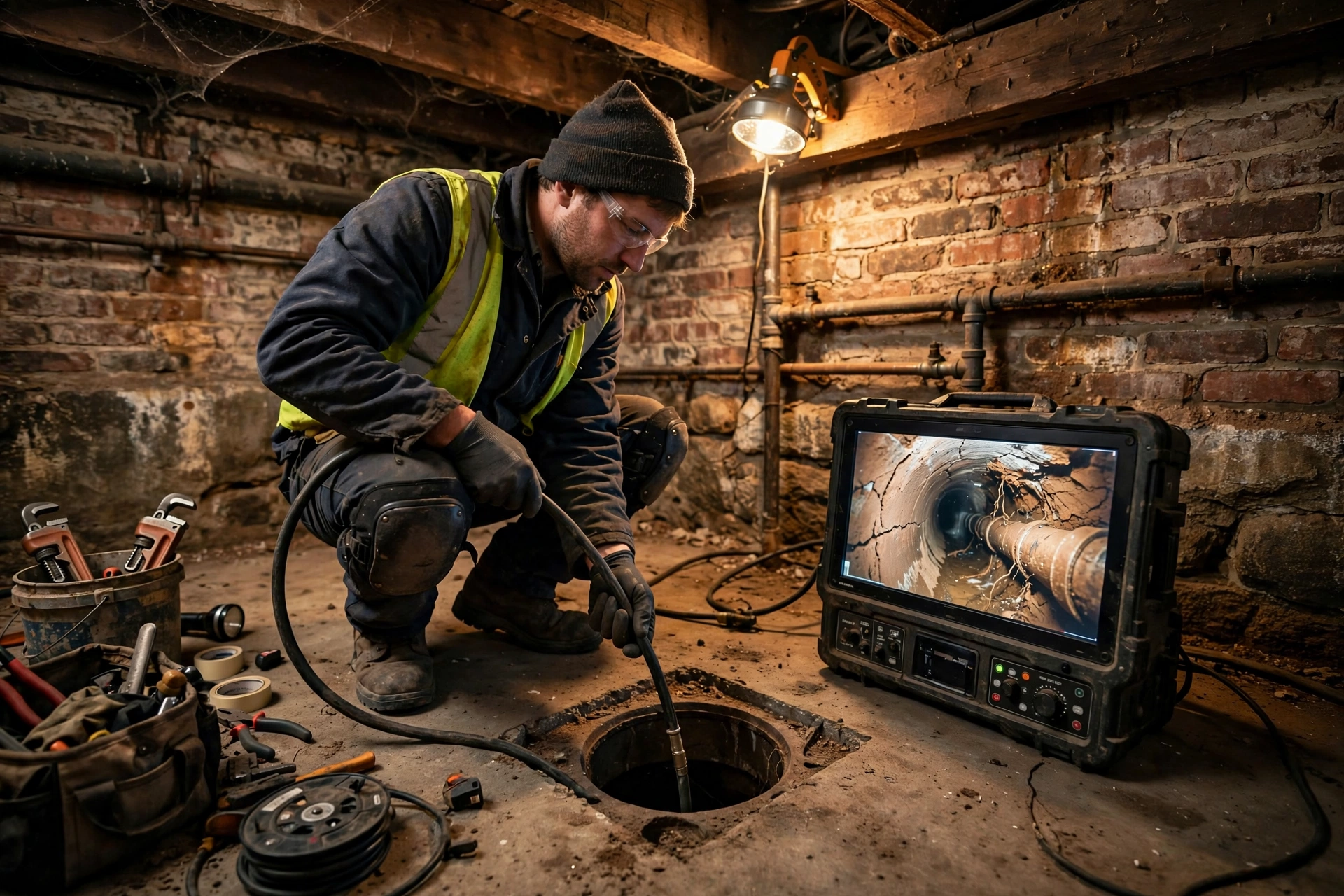
Same region, different failure modes. Here is how sewer trouble shows up in each part of the metro, and how we fix it.
Where: Akron's older neighborhoods on combined sewers. The problem: one pipe carries both sewage and stormwater. The mechanism: a hard storm pushes more water into the system than it can carry, and pressure seeks the lowest outlet, often a basement floor drain. The symptom: sewage backing up into basements after downpours, sometimes with odors that linger for days. The fix: we camera the lateral, and where backups repeat we install a backwater valve that lets flow out but slams shut when the main surges back, or we replace the failing line trenchless.
Where: the tire-worker neighborhoods of east and south Akron. The problem: vitrified clay tile laterals from the 1910s through the 1930s with crumbling mortar joints. The mechanism: mature maples and oaks send fine root hairs into damp joints, and the roots thicken year after year until they wedge joints apart and mat inside the pipe. The symptom: drains that slow down and then recover, gurgling toilets, a cleanout that fills between visits. The fix: hydro jetting clears the roots so the camera can see the real damage; if the joints still hold, we line the pipe and seal every entry point, and if sections have collapsed, we burst and replace.
Where: the hillier suburbs. The problem: clay tile and early cast iron on slopes of glacial soil. The mechanism: seasonal soil movement and slow creep on hillsides shift pipe sections apart, and low spots turn into bellies that hold water and collect solids. The symptom: chronic slow drains, backups that return every few months, and camera footage showing offset joints or standing water. The fix: pipe bursting pulls a new line through the old path on the correct grade, which corrects offsets and bellies without regrading the yard.
Where: Kent and the Cuyahoga River corridor. The problem: a high water table and saturated soils near the river. The mechanism: waterlogged soil keeps laterals under constant pressure, accelerates joint decay, and makes open-trench excavation a muddy, expensive job that can undermine foundations. The symptom: persistent damp basements, slow drains that never fully clear, and lines that fail sooner than their age would suggest. The fix: trenchless lining or bursting needs only small access pits, so we repair deep or hard-to-reach lines without digging up half the property.
Ten cities, one crew with a camera. Pick your city for local details.
The Rubber Capital itself: century-old tire-worker neighborhoods, combined sewers, and the oldest laterals in the metro.
A river city of hillsides and older streets near the gorge, where clay tile meets shifting soil.
Post-war ranches and split-levels hitting the 60-year mark, when cast iron and clay joints start to give out.
A college town on the Cuyahoga River, where saturated soils keep laterals under constant pressure.
A newer suburb of larger lots and long laterals, giving tree roots more pipe to work through.
The Magic City's industrial-era housing stock, with early-1900s clay laterals and mature street trees.
An older downtown core surrounded by newer growth, with laterals spanning every pipe era.
Historic Western Reserve homes beside modern subdivisions, so no two laterals here are quite alike.
A 1960s and 70s boom town, with mid-century cast iron and the early plastics of that era.
A historic circle city where an old town center meets post-war neighborhoods and their aging lines.
Trenchless sewer repair replaces or lines your pipe with minimal digging, the right answer for most of the metro's old clay and cast iron. Sewer camera inspection shows you exactly what your lateral looks like before you spend a dollar on repairs. Hydro jetting scours roots and buildup out of the line so the camera can see the real damage. And tree root removal clears the invaders, while lining or bursting keeps them from coming back.
Much of older Akron runs on combined sewers that carry stormwater and sewage in one pipe. A hard storm can push more water into the system than it can carry, and the pressure finds the lowest outlet, often a basement floor drain. A camera inspection shows whether your lateral is contributing, and a backwater valve can stop main-line surges from entering your home.
Most likely vitrified clay tile with mortar joints, installed when the tire-worker neighborhoods went up in the 1910s through the 1930s. After a century, the mortar crumbles, joints offset, and mature street trees push roots in. A camera inspection shows the exact condition, and many of these lines are strong candidates for trenchless lining or bursting.
It depends on your address. Akron, Cuyahoga Falls, and Barberton/Norton run their own sewer systems and bill their own customers. Much of the rest of Summit County is served by the Summit County Department of Sanitary Sewer Services, including many homes in Stow, Hudson, and Green. Either way, you own the lateral from your house to the public main, and that part is ours to fix.
Most trenchless jobs, lining or bursting, finish in one day. Traditional open-trench replacement usually takes two to four days, depending on length, depth, and what sits above the line. We put the timeline and the fixed price in writing before any work starts.
They exploit weakness more than they create it. Fine root hairs enter damp mortar joints in old clay tile, then thicken year after year until they wedge joints apart and fill the pipe. Snaking buys time; lining or bursting removes the entry points for good. We see this pattern all across the suburbs with mature tree cover.
Also serving Mogadore, Munroe Falls, Norton, Copley, and the greater Akron metro. Major landmarks we work around include Stan Hywet Hall, Canal Park, Lock 3, the University of Akron, Kent State University, and Cuyahoga Valley National Park.
One inspection, one honest diagnosis, one upfront price, anywhere in Greater Akron.
Call (614) 350-5706