Akron, Ohio
Why Does Akron's Rubber-Era Housing Eat Sewer Lines?
Akron grew up around rubber, and its sewer lines are the same age as the industry that built the city.
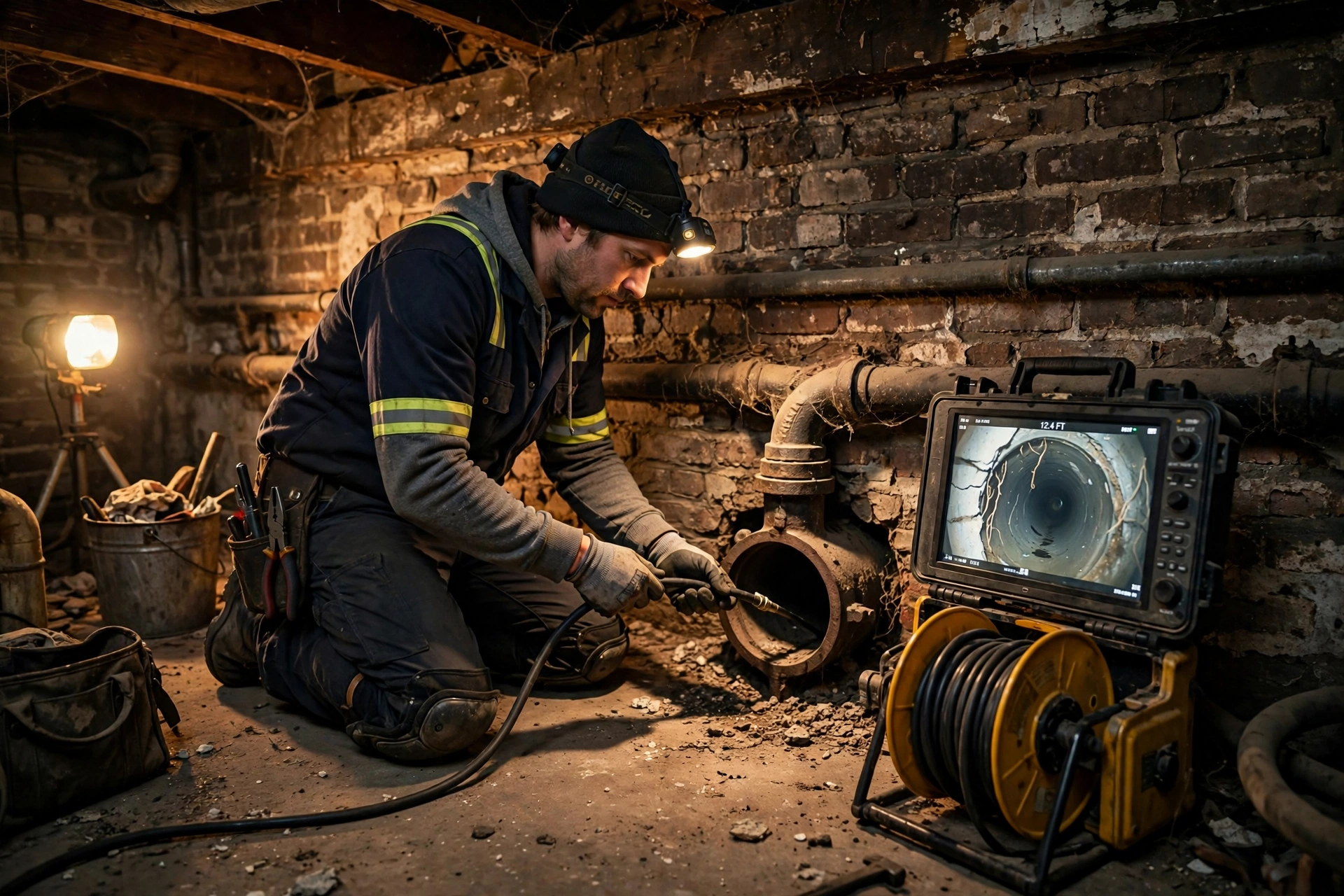
Goodyear, Firestone, and Goodrich didn't just build factories here, they built neighborhoods. Goodyear Heights went up in the 1910s as company housing for tire workers, and the sewer laterals went in with the houses: vitrified clay tile with mortar-sealed joints. A century later, those mortar joints are crumbling, sections have shifted with the soil, and the mature maples lining the streets have spent decades pushing root hairs into every damp joint.
Then there's the ground itself. Summit County sits on glacial clay that swells when wet and shrinks when dry, and Akron's winters deliver dozens of freeze-thaw cycles per season. Water seeps into hairline cracks, freezes, expands, and wedges them wider. Run that loop every winter for a hundred years and even well-made clay tile gives way. The neighborhoods along the Cuyahoga River valley get it worst, because the water table runs high there and keeps the soil around the pipe saturated.
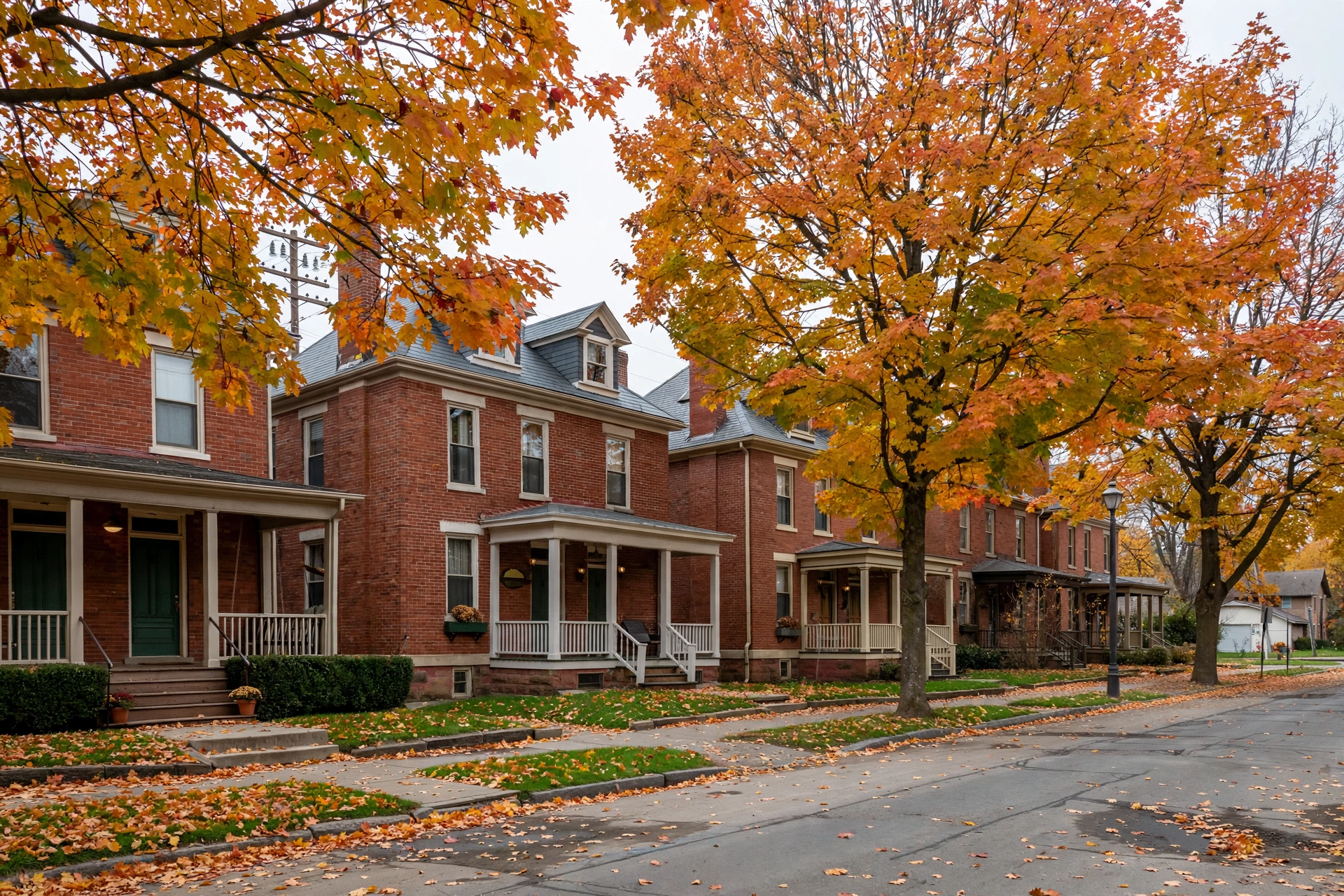
Goodyear Heights went up in the 1910s for rubber workers, and its clay tile sewer laterals went in with the houses.
What Do Akron's Combined Sewers Mean for Your Lateral?
Akron runs a combined sewer system, and the city has spent more than a decade overhauling it under a federal consent decree.
Here's the background. Akron owns and operates a combined sewer collection system, one network of pipes carrying both sewage and stormwater to the Water Reclamation facility. In 2014 the city entered a federal consent decree with the EPA to control combined sewer overflows, and through its Akron Waterways Renewed program it has invested more than a billion steps in storage basins, rehabilitated sewers, and the Northside Interceptor Tunnel, a massive underground tunnel designed to capture wet-weather flow before it reaches the Cuyahoga River. The U.S. EPA and Ohio EPA explain that these overflows send untreated stormwater and wastewater into nearby waterways during heavy rainfall, which is exactly what Akron's storage tunnels and basins are built to prevent.
That work improves the public system, but it doesn't change your side of the deal. You still own the lateral from your house to the public main, and in heavy storms the combined system can still surcharge, pushing sewage back toward the lowest homes on the block. For Akron homeowners, the single best protection is a backwater valve on the lateral, a one-way gate that lets sewage out but slams shut when flow tries to come back in. We install them, and in combined-sewer neighborhoods it's the highest-value upgrade you can buy.
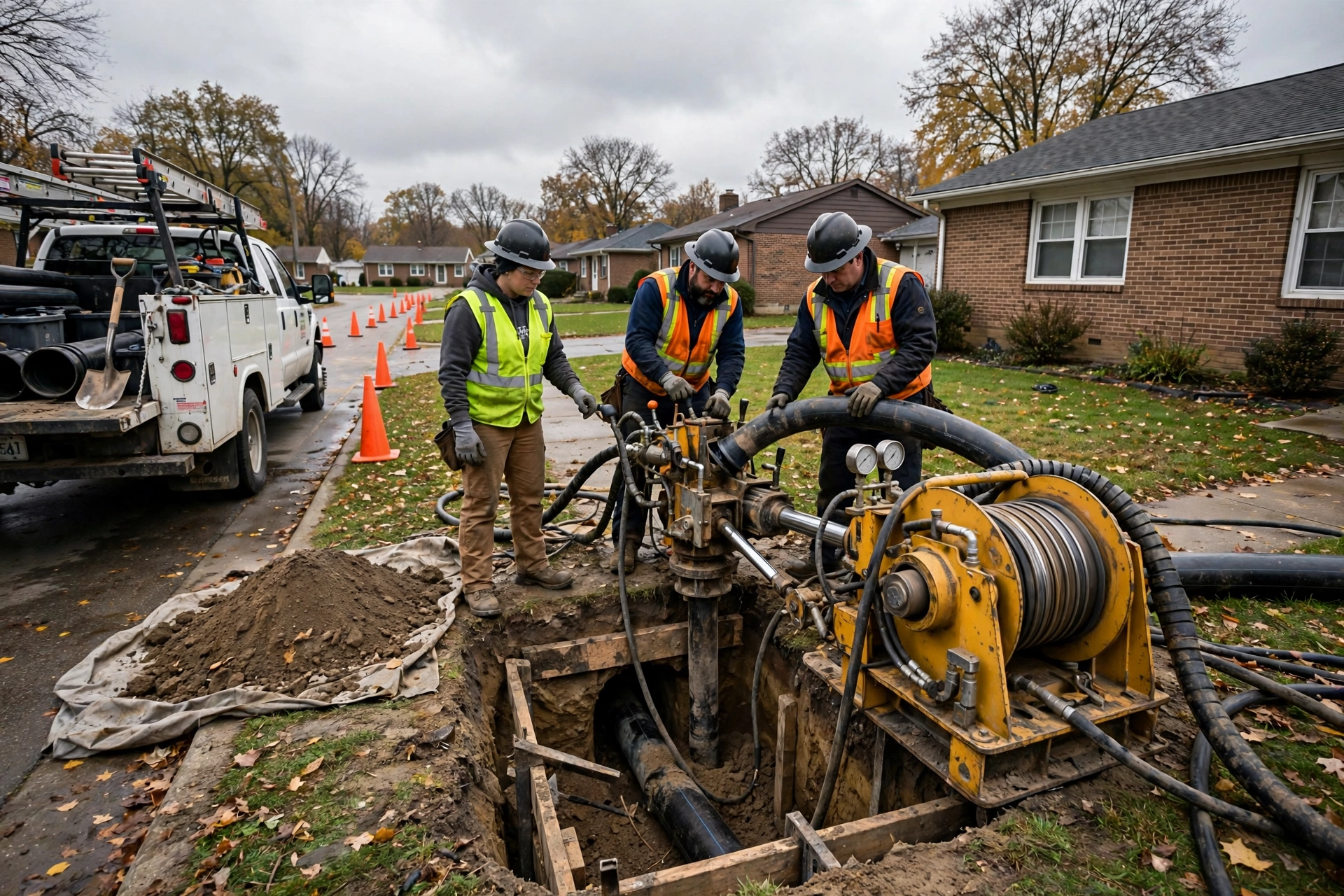
Pipe bursting replaces failed clay tile without digging up the whole yard, a good fit for Akron's older streets.
Which Akron Neighborhoods See the Worst Sewer Problems?
Age of housing plus tree canopy predicts trouble better than anything. Highland Square combines 1920s homes with some of the city's biggest street trees, and root intrusion there is practically a rite of passage. Goodyear Heights pairs 1910s company housing with original clay tile that has simply run out of life. In Ellet and Firestone Park, the post-war ranches and Cape Cods tend toward cast iron laterals that are rusting from the inside out right about now.
Down in the Merriman Valley, the high water table near the Cuyahoga River keeps soil saturated, which accelerates joint failure and makes basements the first place a backup shows up. North Hill's hillside streets add slope movement to the mix, and West Hill's older homes carry the same century-old clay story as Highland Square. Wherever you are in Akron, from the neighborhoods around the University of Akron to the streets off the I-76 and I-77 corridors, the prescription is the same: camera first, then fix what's actually broken. Our trenchless sewer repair options let us fix most of these lines without tearing up the yard.
Is Akron's Water Hard, and Does It Affect Sewer Lines?
Akron's water runs moderately hard, about 7 grains per gallon according to the city's 2024 water quality report. Over years, that mineral content leaves scale on the inside of aging cast iron laterals, narrowing pipes that are already rough with corrosion. A camera inspection shows how much diameter your line has lost, and hydro jetting clears scale before it turns into a full blockage.
Who Owns What: Your Lateral vs. the City's System?
You own the sewer lateral from your house to where it connects with the public main, usually at the street or sidewalk. Everything in between, including the part under your yard and driveway, is your responsibility to maintain and repair. The city owns and maintains the combined collection system and the Water Reclamation facility. Akron's Sewer Maintenance Division operates the sanitary, storm, and combined sewers, plus the pump stations and overflow controls across the city.
One quick way to tell whose problem a backup is: ask a neighbor. A backup limited to your home points to your lateral. Sewage coming up in multiple homes on the street suggests a main-line issue, and that's the city's territory. Permits for lateral work run through the City of Akron, with inspection typically required before backfill, and we pull the permits and schedule the inspection as part of every job. If your situation falls outside the standard, check with the city's building department before work begins.
How Should Akron Homeowners Maintain Their Sewer Lines Through the Seasons?
Year-round attention is far simpler than one emergency dig. Spring means watching for infiltration and surcharge after heavy rains, summer means keeping grease out of drains, fall means roots at their most aggressive and the best time for a camera check, and winter means keeping cleanouts accessible through freeze-thaw. Here is the rhythm we recommend for Akron's combined-sewer neighborhoods.
- Spring: Heavy rains and snowmelt can surcharge the combined system. If drains slow after storms, that is infiltration or surcharge, not a simple clog. Make sure your sump pump discharges outside, not into the lateral.
- Summer: Cooking grease flows easily in heat and hardens in cooler pipe, so keep it out of drains. Heat also pushes tree roots toward moist joints, so watch for the first signs of slow drainage.
- Fall: Roots grow most aggressively in fall, hunting water before dormancy. This is the best time for a camera inspection and preventive root cutting, before winter locks everything in place.
- Winter: Freeze-thaw cycles wedge every crack wider. Know where your cleanouts are and keep them clear of snow. If you have a backwater valve, confirm it still moves freely before the spring thaw.