Sewer Line Repair in Tallmadge, OH
Tallmadge has been organized around its Circle since 1807, and the oldest sewer lines sit under the oldest streets. We camera-diagnose every lateral and fix it trenchless or traditional.
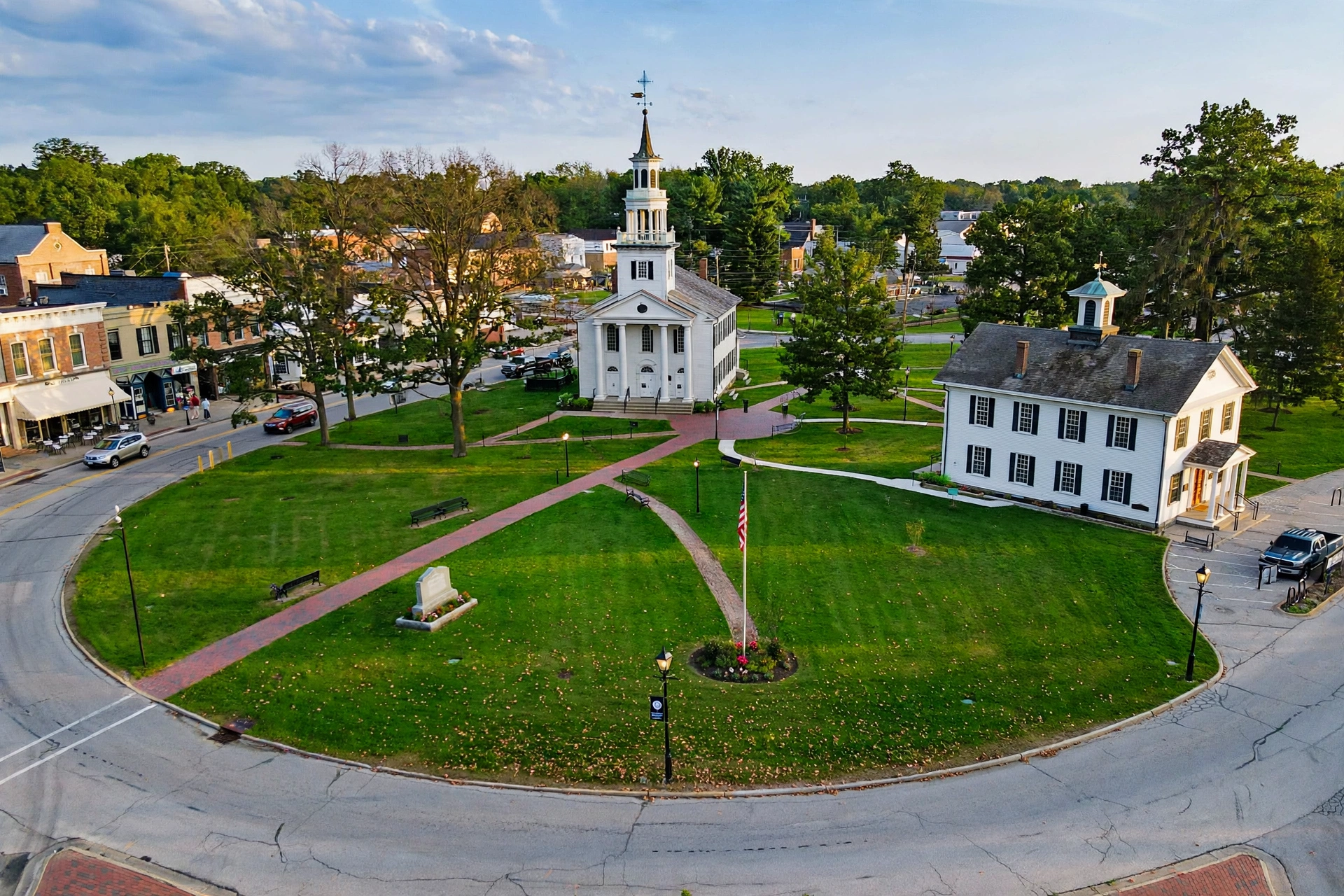
Tallmadge has been organized around its Circle since 1807, and the oldest sewer lines sit under the oldest streets. We camera-diagnose every lateral and fix it trenchless or traditional.
Last updated: October 13, 2026
The Tallmadge Circle is the city's defining landmark, and the streets around it hold some of Tallmadge's oldest homes, and its oldest sewer lines. The Circle is an eight-spoke traffic circle, laid out in 1807 on a New England town plan with eight roads radiating from a central square.
The Circle sits where SR 91 and SR 261 meet, surrounding the Historic Tallmadge Church (built 1825), the Old Town Hall (1859), and Circle Park. The whole town square district sits on the National Register of Historic Places. Tallmadge is the second-oldest city in Summit County, after Hudson, and the streets around the Circle hold some of the city's oldest homes.
Those homes carry Tallmadge's oldest sewer lines: original vitrified clay tile with mortar joints, laid when the neighborhoods around the Circle were built out in the late 1800s and early 1900s. A century-plus of freeze-thaw and mature trees has worn down the joints, and root intrusion is the most common failure we find near the Circle.
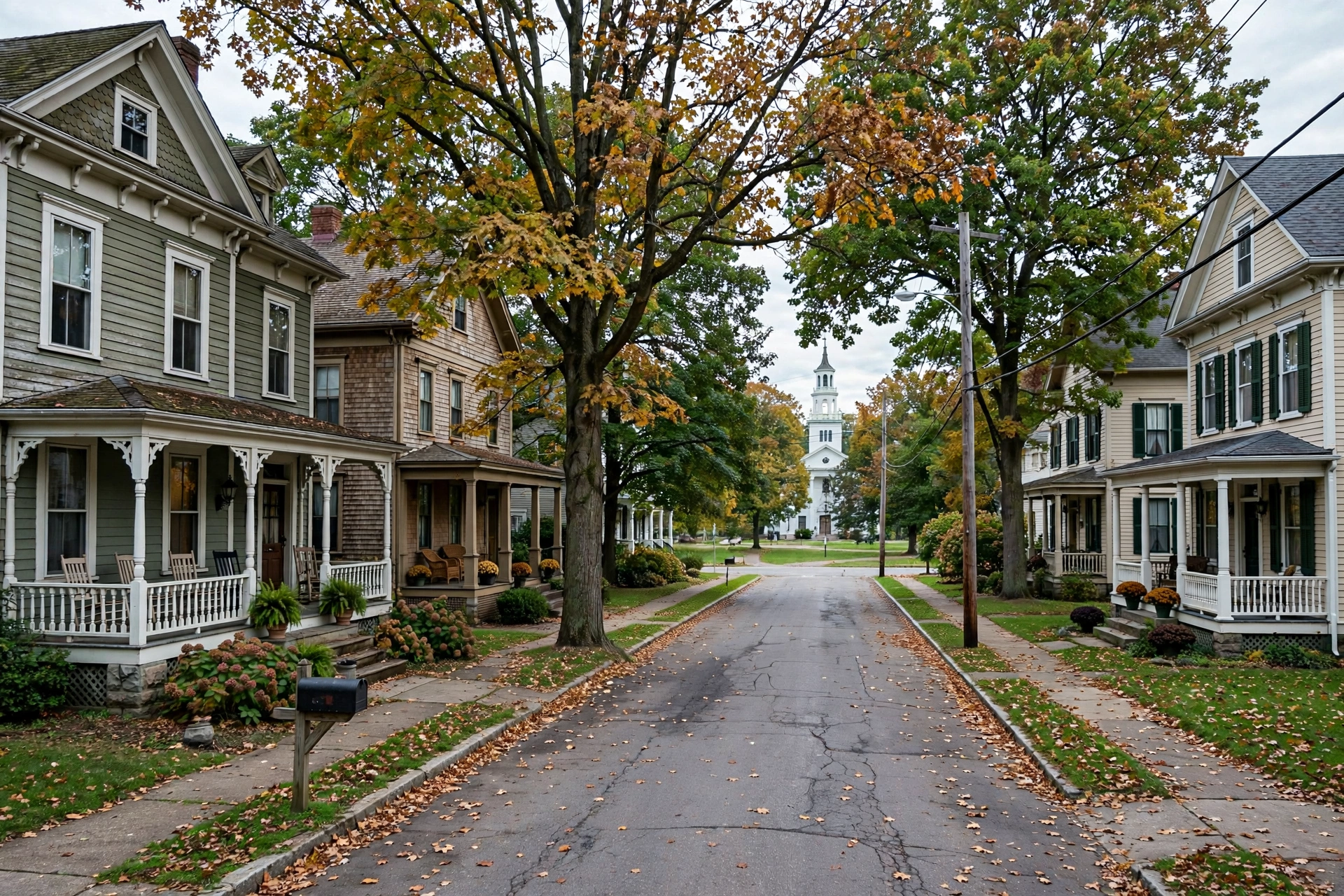
The streets around the Circle hold Tallmadge's oldest homes, and its oldest clay tile laterals.
Tallmadge's grid streets sit on glacial clay, and winter does the rest.
Tallmadge's winters deliver dozens of freeze-thaw cycles per season. Water seeps into hairline cracks and mortar joints, freezes, expands with tremendous force, and wedges the crack wider. Then it thaws, loose soil washes into the opening, and the next freeze starts from a worse position. Glacial clay soil makes it worse: it swells when wet and shrinks when dry, so the ground around the pipe is constantly moving, offsetting joints and shearing sections.
The damage clusters in late winter, when the ground thaws from the top down while deeper soil stays frozen and hydrostatic pressure peaks. Drains that slow every year around the same time are showing you this cycle in real time. A camera inspection in fall, before freeze season, catches cracks while they're still lining candidates instead of collapse jobs. Our trenchless sewer repair options cover both outcomes: lining for cracked but sound pipe, bursting for lines the cycles have destroyed.
The neighborhoods around the Circle carry the oldest clay tile and the biggest trees, the worst combination for root intrusion. The older grid neighborhoods, laid out on Bacon's original town plan, have similar-era laterals with the same story. Mid-century areas add cast iron that's rusting from the inside out, and the newer subdivisions toward the Portage County line mostly need joint repairs from ground settling.
You'll find us working all over Tallmadge, from the streets around the Circle and the Freedom Trail corridor to the neighborhoods along the SR-91 and SR-261 corridors. Wherever the lateral runs, the process is the same: camera first, honest diagnosis, then the right fix.
Tallmadge's water runs moderately hard, about 6 grains per gallon in the city's water quality report. Over decades, that mineral content leaves scale inside aging laterals, worst in old cast iron where corrosion gives deposits a rough surface to cling to. A camera inspection tells us whether a slow drain is scale, roots, or a failing joint.
You own the sewer lateral from your house to where it connects with the public main, usually at the street or sidewalk. Everything in between, including the part under your yard and driveway, is your responsibility to maintain and repair. Water and sewer service in Tallmadge runs through the city's own Water and Sewer Department, which also handles tap-in permits and inspections.
A backup limited to your home points to your lateral, and that's our territory. Permits for lateral work run through the City of Tallmadge, with inspection typically required before backfill, and we pull the permits and schedule the inspection as part of every job. When several homes on the street back up together, the public main is the likely cause, and the EPA explains how sanitary sewer overflows push sewage back into homes. If anything about your property is unusual, check with the city's building department before work begins.
Year-round attention is far simpler than one emergency dig. Spring means watching for infiltration after heavy rains, summer means keeping grease out of drains, fall means roots at their most aggressive and the best time for a camera check, and winter means keeping cleanouts accessible through freeze-thaw. Here is the rhythm we recommend for Tallmadge's old Circle-area lines and mid-century neighborhoods.
The Circle is Tallmadge's defining landmark: an eight-spoke traffic circle at the center of town where SR 91 and SR 261 meet, surrounding the Historic Tallmadge Church (built 1825), the Old Town Hall (1859), and Circle Park. It dates to the town's 1807 founding, when the Rev. David Bacon laid out Tallmadge on a New England town plan. The streets around it hold some of the city's oldest homes, and its oldest clay tile sewer lines.
Most likely vitrified clay tile with mortar joints, original to the house. The neighborhoods around the Circle were built out in the late 1800s and early 1900s, and the laterals went in with them. A century of freeze-thaw and mature trees wears down mortar joints, but many of these lines still qualify for trenchless lining, which the camera inspection confirms.
Freeze-thaw cycles. Water seeps into hairline cracks and mortar joints, freezes, expands, and wedges them wider, then thaws and lets soil wash in. By late winter, weakened clay tile and cast iron lines start failing. Drains that slow every year around the same time are showing you this cycle, and a fall camera inspection catches cracks while they're still lining candidates.
The homeowner. In Tallmadge you own the lateral from your house to its connection with the public main, including the portion under your yard and driveway. The city maintains the public mains. A backup limited to your home points to the lateral.
Yes. The City of Tallmadge requires permits for sewer lateral repair and replacement, with inspection typically required before backfill. We pull the permits and schedule inspections as part of every job.
Also serving Akron, Stow, Cuyahoga Falls, Kent, Mogadore, and Brimfield. Tallmadge's ZIP code is 44278. Ohio Sewer Masters works around major landmarks including the Tallmadge Circle, the Historic Tallmadge Church, and the Freedom Trail.
Circle-area clay tile or freeze-thaw damage, one inspection tells the story.
Call (614) 350-5706