Sewer Line Installation in Ohio
New construction, a home addition, or a detached garage with a bathroom: when there's no sewer line yet, we install one. Sized right, sloped right, permitted, and inspected.
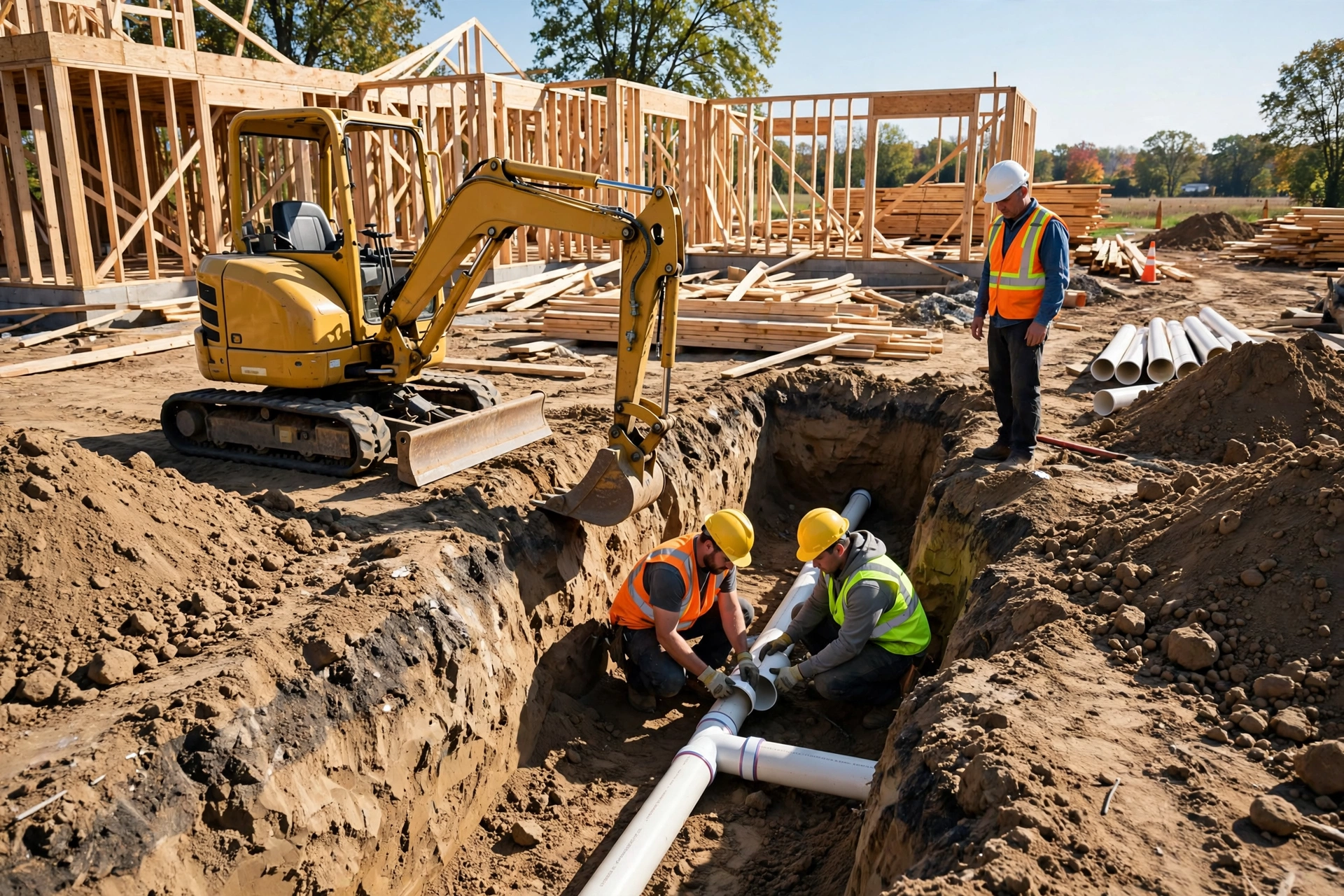
New construction, a home addition, or a detached garage with a bathroom: when there's no sewer line yet, we install one. Sized right, sloped right, permitted, and inspected.
Last updated: October 13, 2026
Sewer line installation is the process of laying a brand-new sewer lateral where none exists: from a building to the city main or a septic system, sized, sloped, permitted, and inspected.
Installation is for places with no sewer line yet. That's a different job from repairing an existing line, and it comes up in a handful of common situations across Ohio.
If your line already exists and just needs fixing, you're looking for repair, not installation: trenchless repair or traditional replacement, depending on the pipe's condition.
Most Ohio residential laterals are 4-inch pipe laid at 1/4 inch of fall per foot of run, the industry-standard grade for that size. Get either number wrong and the line either clogs constantly or drains so fast the solids get left behind.
Sizing. Most Ohio residential laterals are 4-inch pipe, which handles a typical home's fixtures with room to spare. Larger homes, multi-unit buildings, and commercial properties step up to 6-inch or larger, sized from fixture counts per the plumbing code. Undersizing is a false economy: a line that's too small for the load will clog for the life of the building.
Slope. The standard for 4-inch residential pipe is 1/4 inch of fall per foot of run: enough grade to carry solids along, not so much that water outruns them. Too flat and solids settle, creating chronic clogs. Too steep and the water races ahead, leaving solids stranded. We set slope with a laser level or transit as the pipe goes in, and we verify it before backfill.
Cleanouts. Code requires cleanouts at the building exit, at major bends, and at intervals along long runs, typically every 100 requirementt. We place them where they'll actually be useful: accessible, marked, and out of future landscaping.
PVC is the modern standard for buried sewer laterals, and it's what we install unless your city's code specifies otherwise:
What we don't install anymore: clay tile, Orangeburg, or cast iron for new buried laterals. They were the standards of their eras, and every one of them is the reason we have a repair business. A new line should be the last one the property ever needs.
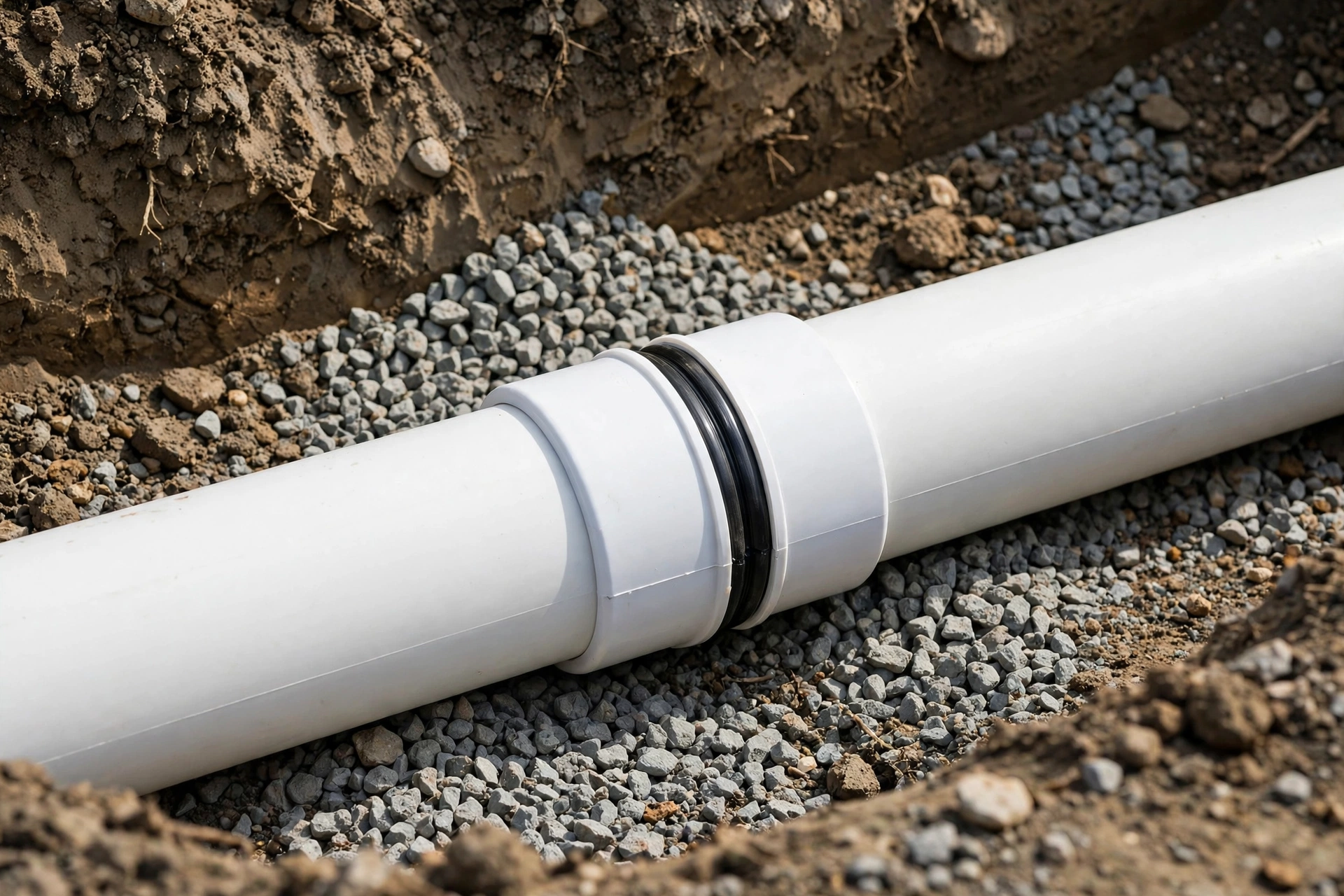
New PVC on a proper gravel bed, aligned and ready for inspection before backfill.
We dig the trench to the designed depth and grade, bed the pipe on 4 to 6 inches of compacted gravel, lay it to slope, and backfill in compacted lifts. These unglamorous steps are where installations succeed or fail over the long term.
We dig to the designed depth and grade, keeping the trench bottom smooth and at the right slope. In Ohio's clay soil, we watch for unstable trench walls and shore where needed.
The pipe sits on 4 to 6 inches of compacted gravel or sand bedding. Bedding spreads the load evenly so the pipe doesn't develop bellies as the ground settles.
Pipe goes in section by section, joints seated per manufacturer spec, slope verified with a level as we go. The inspector sees the open trench at this stage.
After inspection passes, we backfill in lifts with proper compaction, no large rocks against the pipe, and the surface restored to grade.
Open trench is the usual way to install a new lateral, but it is not the only way. Here is how it compares with trenchless installation.
| Factor | Open-trench installation | Trenchless installation (boring) |
|---|---|---|
| How it works | Trench dug along the full route; pipe laid to exact grade | A bore path is drilled underground; pipe is pulled through |
| Soil type | Works in any soil; rock slows digging | Clay bores well; rock and loose fill are difficult |
| Depth | Any depth with proper shoring | Limited by boring equipment and soil conditions |
| Permits | Standard excavation and right-of-way permits | Same base permits; some cities add conditions near utilities |
| Surface disruption | The full trench path is disturbed and restored | Minimal: entry and exit points only |
| Best for | Most new laterals; routes needing exact grade control | Long runs under driveways, roads, or landscaping |
Ohio's freeze-thaw cycles punish sloppy backfill. Soil that isn't compacted settles, the pipe settles with it, and five years later there's a belly collecting solids. We compact in lifts because the line has to hold its slope for decades, not just until the final inspection.
The connection at the far end is the most regulated part of the job, and it depends on what your property uses.
City sewer main. We tap into the municipal main under the street, which usually means excavating at the curb or in the right-of-way, cutting in a saddle or wye connection per the city's spec, and getting the city's inspector to sign off on the tap. Some cities do their own taps or require a licensed tapper; we handle whichever process your municipality uses. The lateral from your building to that tap is our work, permitted and inspected. Disassessments from sewer systems are regulated at the federal level too: the EPA's NPDES program covers sewer discharge permits.
Septic system. Where no city sewer is available, the new line runs to the septic tank inlet. We set the line at the right elevation to hit the tank's inlet baffle, and we coordinate with the septic installer on tank placement so the grades work. The U.S. EPA publishes homeowner guidance on septic and sewer systems, including how septic lines should be installed and maintained.
Septic-to-sewer conversion. When the city main reaches your street, we run the new lateral to the main, connect it, and abandon the old septic tank according to local health department rules, usually pumped out and filled or crushed. Your permit covers both the new connection and the abandonment.
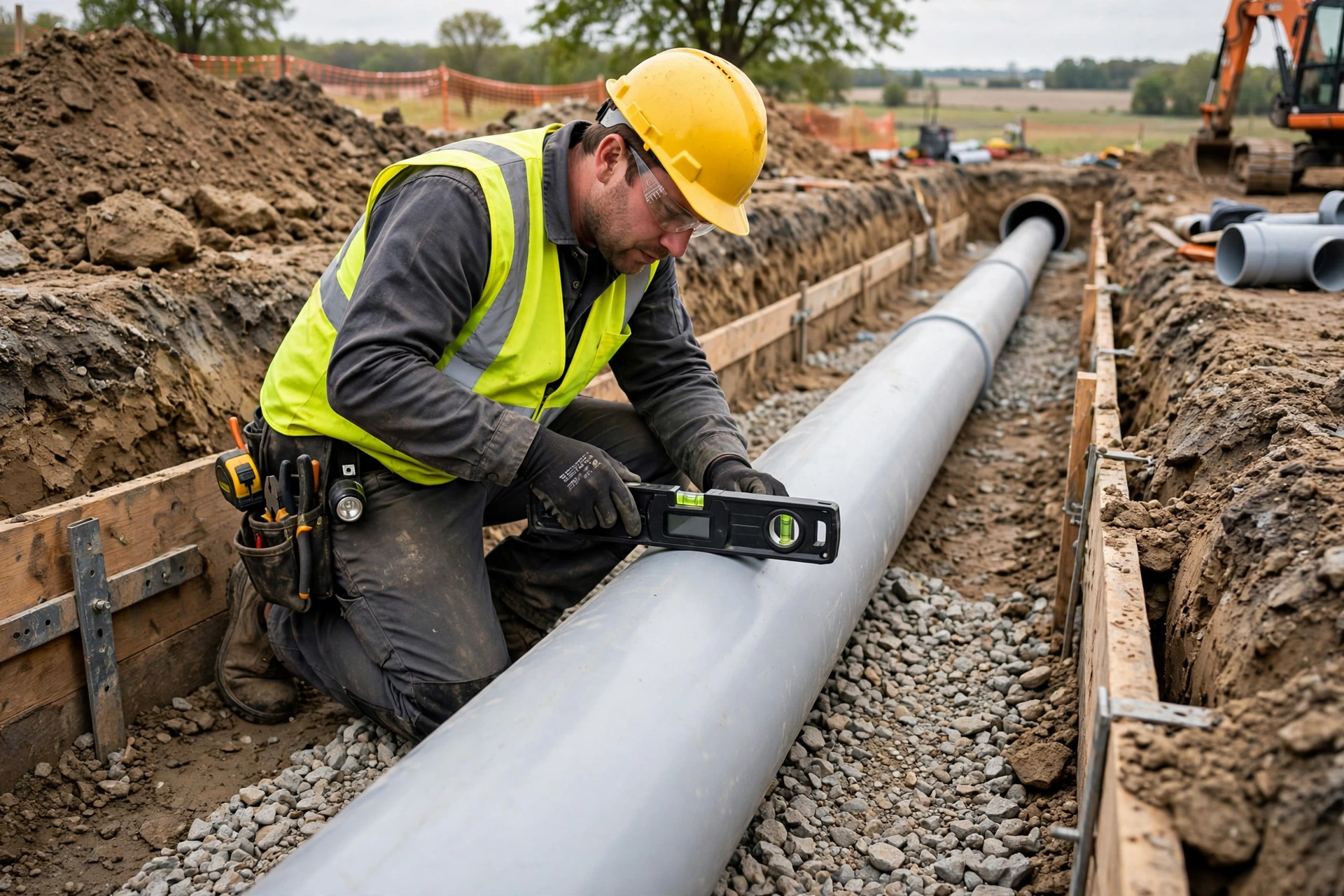
Slope gets verified as the pipe goes in: a laser level doesn't guess, and neither do we.
Every new sewer lateral in Ohio needs a permit, and the inspection schedule is not optional. Here's the typical sequence:
We pull the permits, schedule the inspections, and meet the inspectors on site. You don't touch the paperwork. State-level rules come from the Ohio EPA, which oversees wastewater permitting in Ohio. And because inspectors see our work regularly, we know what each municipality looks for, which keeps the process moving.
Most installations happen inside a larger project, so coordination is half the job. We work from your builder's site plan and schedule, and we slot the sewer work where it belongs in the sequence: after rough grading and foundation work establish final elevations, before driveways, sidewalks, and landscaping cover the route.
Elevation is the critical handoff. The lateral's slope is fixed by two points: where it leaves the building and where it meets the main. We confirm both elevations with the builder before we dig, because a foundation poured an inch too high or a main that's shallower than the plans showed can change the whole design. Catching that on paper is free. Catching it in an open trench is not.
For additions and detached structures, we coordinate with the plumber roughing in the building's interior drains so our exterior line meets their stub-out at the right spot and elevation. One conversation before digging saves a day of rework after.
Installations vary more than repairs, because every site is different. These are the factors that set your plan:
You get a written plan from the site plan before we mobilize, with the scope, the schedule, and the permit handling spelled out. For what repairs work when an existing line fails instead, see our Ohio sewer repair guide.
Below the frost line, which runs about 32 inches in most of Ohio, with residential laterals typically buried 3 to 6 requirementt deep depending on the house's basement depth and the elevation of the city main. The exact depth is set by your local code and by the slope the line needs to reach the main. We verify depths against your city's requirements before we dig.
PVC is the standard: SDR-35 for buried laterals and Schedule 40 where the line runs under slabs or driveways or needs extra crush resistance. PVC is smooth, jointed with gaskets or solvent welds that roots can't penetrate, and it carries a long service life. We size and spec the material to your city's code.
Yes. Ohio cities and counties require permits for new sewer laterals, and most require inspections at key stages: the open trench before backfill, and the connection to the city main. We pull the permits, schedule the inspections, and coordinate with the inspector as part of the job.
Most residential installations take a few days of actual work, but the timeline depends on length, depth, soil conditions, weather, and how fast permits and inspections move in your municipality. We give you a written schedule before we start, and we coordinate with your builder so our work fits the overall construction timeline.
Yes. We handle the full connection: the tap into the city main, the lateral from your building to that tap, and the inspections the city requires. If your property uses a septic system instead, we connect to the tank inlet. Either way, the connection is permitted and inspected.
Installation is for new lines. If your line already exists and needs work, see trenchless sewer repair for no-dig fixes or traditional sewer replacement for full excavation. And if you're buying a property and want the existing line checked first, our pre-purchase sewer inspection is the place to start.
Send us the site plan and we'll plan the sewer work with a written schedule that fits your builder's timeline.
Call (614) 350-5706