Commercial Sewer Services in Ohio
A backed-up sewer line can shut down your business for a day. We keep Ohio restaurants, offices, retail spaces, and apartment buildings flowing, with work scheduled around your hours, not ours.
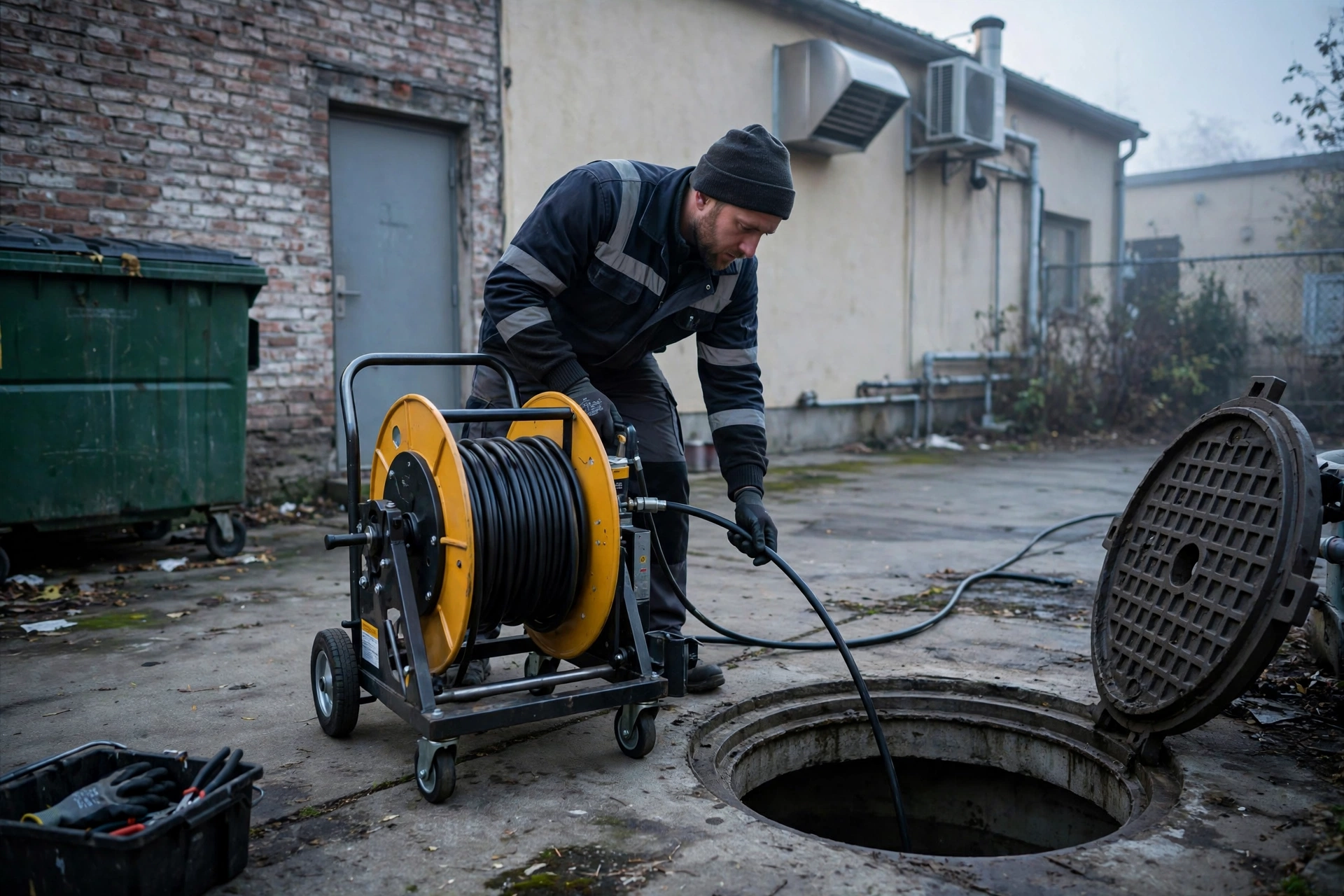
A backed-up sewer line can shut down your business for a day. We keep Ohio restaurants, offices, retail spaces, and apartment buildings flowing, with work scheduled around your hours, not ours.
Last updated: October 13, 2026
Commercial sewer service is the inspection, maintenance, repair, and replacement of sewer lines serving businesses rather than homes. Any Ohio business with drains, bathrooms, or a kitchen has a sewer lateral, and commercial laterals fail differently than residential ones. Higher volume, harsher waste, and zero tolerance for downtime change the whole job.
The throughline: a homeowner can live with a slow drain for a week. A business can't. Our commercial work is built around that difference.
The short answer: it is a different job, not a bigger version of the same job. Commercial laterals carry far more volume and harsher waste, run through places you cannot dig up, and get maintained on a calendar instead of when something breaks. The table below lays out the four factors that change the scope, the methods, and the schedule.
| Factor | Commercial | Residential |
|---|---|---|
| Usage load | Dozens to hundreds of daily users through restrooms and kitchens | A few household members |
| Grease and solids | Heavy grease loading in food service; process waste in industrial buildings | Normal household waste |
| Access constraints | Lines under slabs, parking lots, dining rooms, and finished interiors | Usually a yard lateral with a clear cleanout |
| Maintenance cadence | Scheduled jetting and camera checks on a calendar matched to business volume | As-needed, often years between visits |
We plan the job around your operating hours first and our convenience second. Here's what that looks like in practice:
Early mornings, evenings, nights, and weekends. Your customers and staff never see us, and the line is back in service before you open.
Bigger jobs get split into phases with a written schedule, so you always know which areas are affected and when.
Where the pipe allows it, lining or bursting means no excavation through your slab, parking lot, or entrance. Less disruption by design.
Camera footage, written scope, permits handled. You get records your landlord, insurer, or the city can review.
When you call about an active backup, tell us it's commercial and it's affecting operations. Those calls go to the front of the line, and we'll give you an honest arrival window. We won't promise a time we can't keep.
Grease is the defining problem of commercial sewer work, and restaurants are ground zero. Hot grease goes down the drain as a liquid and cools into a solid inside the pipe. Layer by layer, it narrows the line until one busy Friday night pushes it past the tipping point.
The trap is only half the system. A grease interceptor catches what it can at the fixture, but lines downstream still accumulate coating, especially in older cast iron with rough internal scale that grease grabs onto. That's why restaurants with regularly pumped traps still back up: the line past the trap is the problem.
Our answer is the full chain: grease trap cleaning and installation for the interceptor, plus hydro jetting for the lines. Jetting strips the grease coating off the pipe walls in a way snaking can't, and on a schedule it keeps the line at full diameter. For non-food businesses, the same high-use wear applies to restroom and process lines, just without the grease.
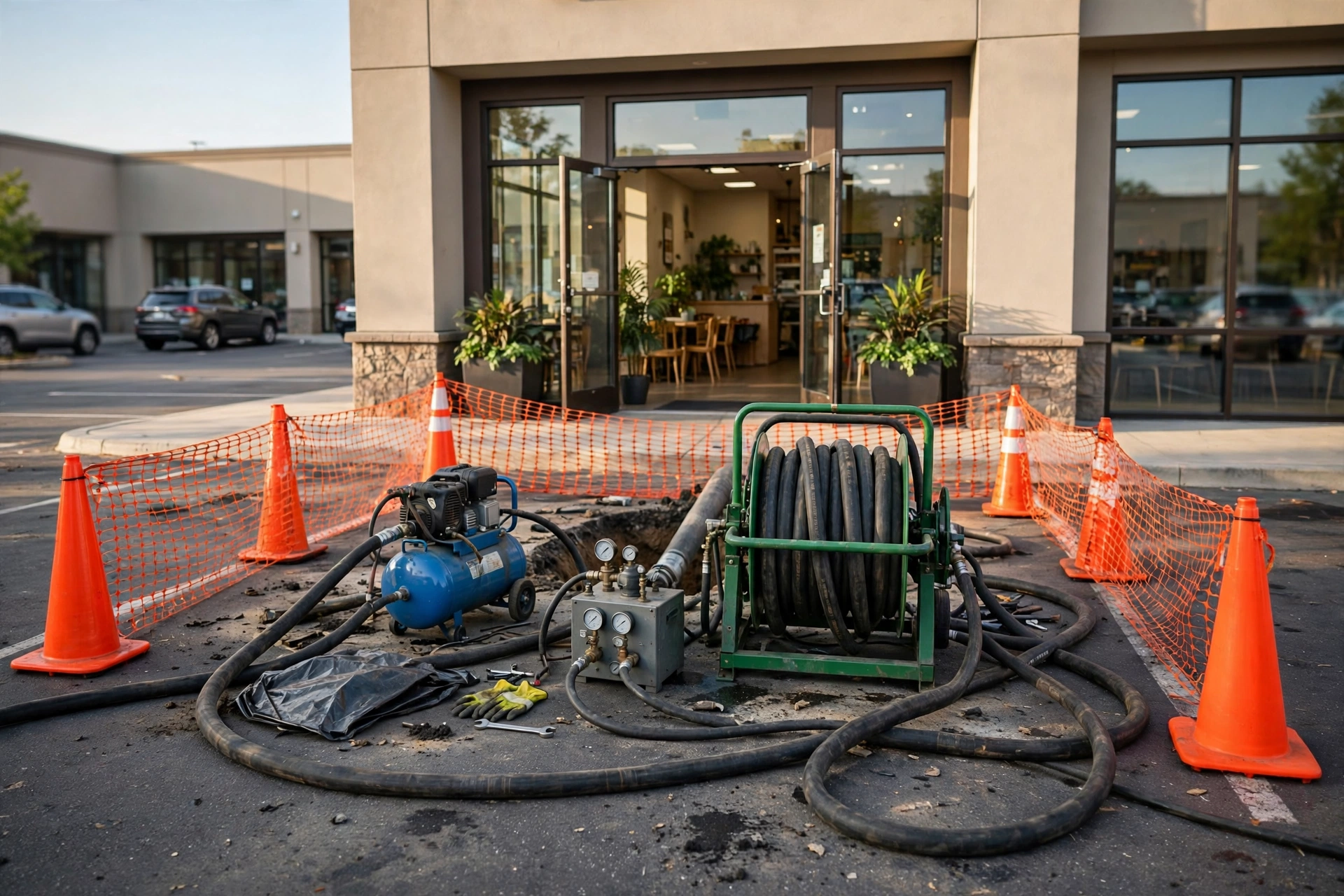
Trenchless repair in a commercial parking lot: a small work zone, the entrance stays open, customers keep coming.
Ohio cities take commercial wastewater seriously, and the rules are stricter than anything residential owners deal with. The big one is FOG: fats, oils, and grease programs run by municipal sewer authorities.
Food-service businesses in most Ohio cities are required to install grease interceptors sized to their operation, maintain them, and in many jurisdictions keep documented pump-out records for inspection. Some cities require periodic reporting. Failures can mean fines, and a grease-caused blockage in the city main traced back to your line can mean liability for the cleanup. These local programs sit on top of a federal framework: the EPA's NPDES permitting program governs municipal wastewater discharge, and Ohio EPA administers the state's wastewater permitting rules, which is one reason requirements vary from city to city.
Beyond FOG, commercial sewer work itself usually needs permits and inspections, we pull those as part of the job, and some municipalities require specific materials or connection methods for commercial taps. We check your city's requirements before we start, and we document everything so you have a paper trail for inspectors, landlords, and insurers.
Most do, and it's the simplest line item in this whole conversation. A commercial lateral takes years of residential wear in months: higher volume, harsher waste, and in restaurants, constant grease loading. Waiting for a backup is the major strategy.
A commercial maintenance plan is built around your operation, not a generic calendar. For a restaurant, that usually means scheduled jetting of kitchen lines and grease trap service timed to your volume. For an office or retail building, periodic camera checks and jetting of the main lateral. For multi-unit properties, a yearly inspection that catches tenant-abuse issues, wipes, "flushable" products that aren't, before they become building-wide backups.
Plans also keep you compliant: documented maintenance is exactly what FOG inspectors and insurers want to see. Our residential-side sewer maintenance program page explains the general approach; commercial plans are the same idea scaled to your usage.
Because excavation is a business problem, not just a construction problem. A traditional dig means tearing up the parking lot your customers use, the entrance they walk through, or the slab your kitchen sits on. Trenchless methods, pipe lining and pipe bursting, repair or replace the line through small access points.
For a restaurant, that means the dining room stays open. For retail, the storefront stays accessible. For an office, the parking lot keeps its spaces. The line gets fixed underground while business continues above it. Our trenchless sewer repair page covers both methods in detail.
Not every line qualifies, a fully collapsed run under a slab sometimes still needs excavation, and we'll tell you when that's the case. But when trenchless works, it's the difference between a repair your customers never notice and one they can't ignore.
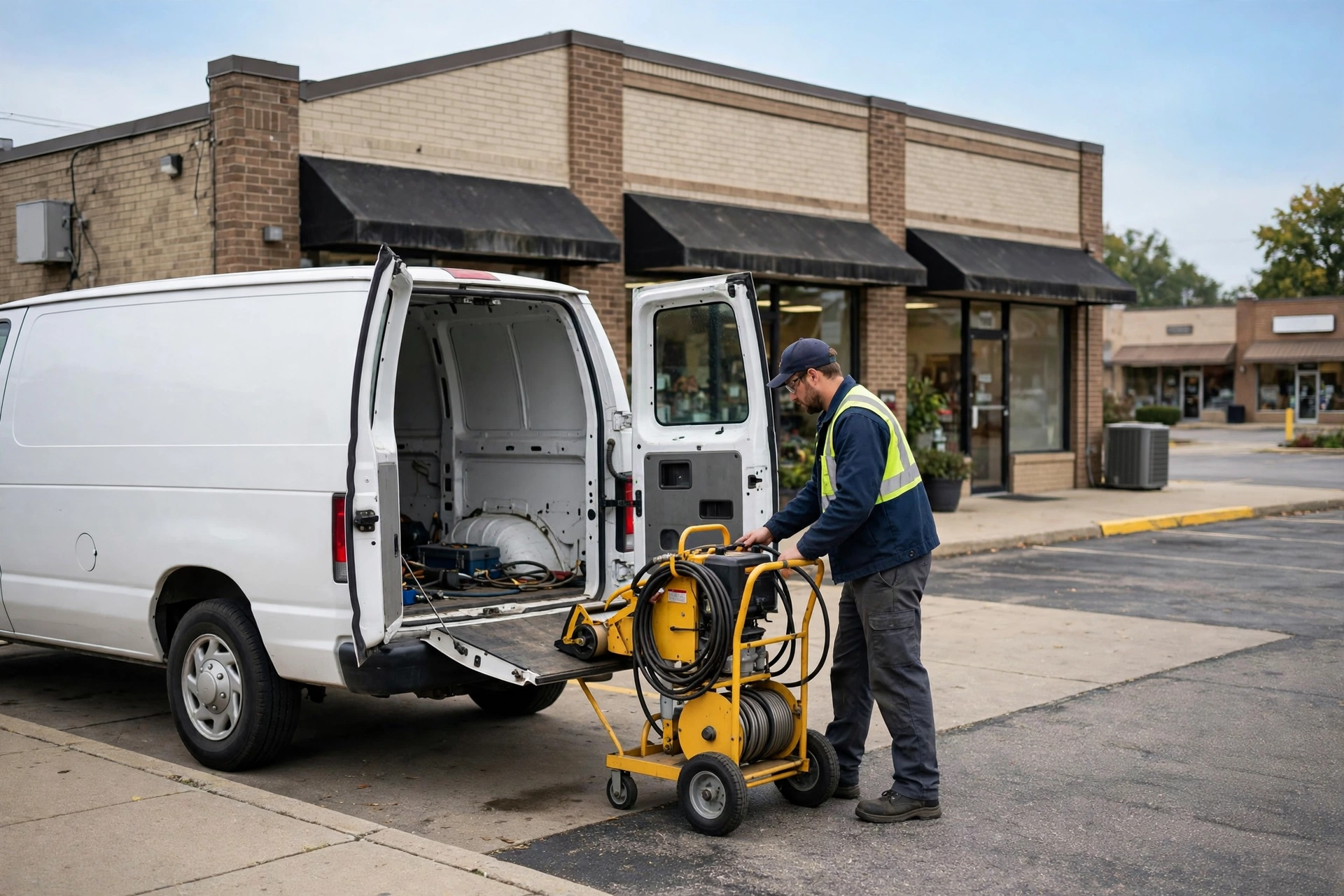
Commercial calls get commercial scheduling: off-hours, phased work, and a written plan before we start.
Commercial process has more variables than residential, so anyone quoting blind is guessing. What actually drives your number:
What we will do: camera the line, show you the footage, and give you a written scope with a fixed plan before any work starts. For property managers comparing options across buildings, that written scope is also what lets you plan accurately. Our Ohio guide covers residential ranges; commercial plans are always site-specific.
Usually, yes. Most commercial sewer work happens during off-hours, early mornings, evenings, or weekends, and trenchless methods let us repair or replace a line without tearing up entrances, dining areas, or parking. For work that can't avoid disruption, we phase it and give you a written schedule so you can plan around it.
Yes. We clean and maintain the sewer lines that carry kitchen waste, and we handle grease trap cleaning and installation as well. Grease is the number one cause of restaurant backups, and a line that gets jetted on a schedule stays open. If your kitchen is backing up repeatedly, the line needs attention, not just the trap.
Ohio cities with FOG (fats, oils, and grease) programs require food-service businesses to install and maintain grease interceptors, and many require documented pump-out records. Requirements vary by municipality, so we check your city's rules as part of the job. We document our work so you have records for inspectors.
Yes. Commercial laterals take far more abuse than residential ones, so scheduled maintenance usually is worth it. A plan typically includes scheduled jetting, camera checks, and grease line service on a calendar that fits your business. We build the plan around your usage, your pipe material, and your city's requirements.
Call us at (614) 350-5706 and tell us it's an active backup. Commercial backups that threaten operations go to the front of the line, and we will give you an honest arrival window when you call. We won't promise a time we can't keep.
Commercial sewer work usually pulls in a few of our other services: grease trap cleaning and installation for food-service compliance, hydro jetting for grease and buildup in high-use lines, and trenchless sewer repair when the line needs fixing without shutting you down.
Off-hours scheduling, phased work, and trenchless options that keep your doors open. Tell us it's commercial when you call.
Call (614) 350-5706