Pipe Descaling & Milling in Ohio
Your cast iron sewer line is not broken. It is choked. Decades of mineral scale and corrosion have narrowed it from the inside, and descaling grinds that buildup out to restore full flow, with no digging.
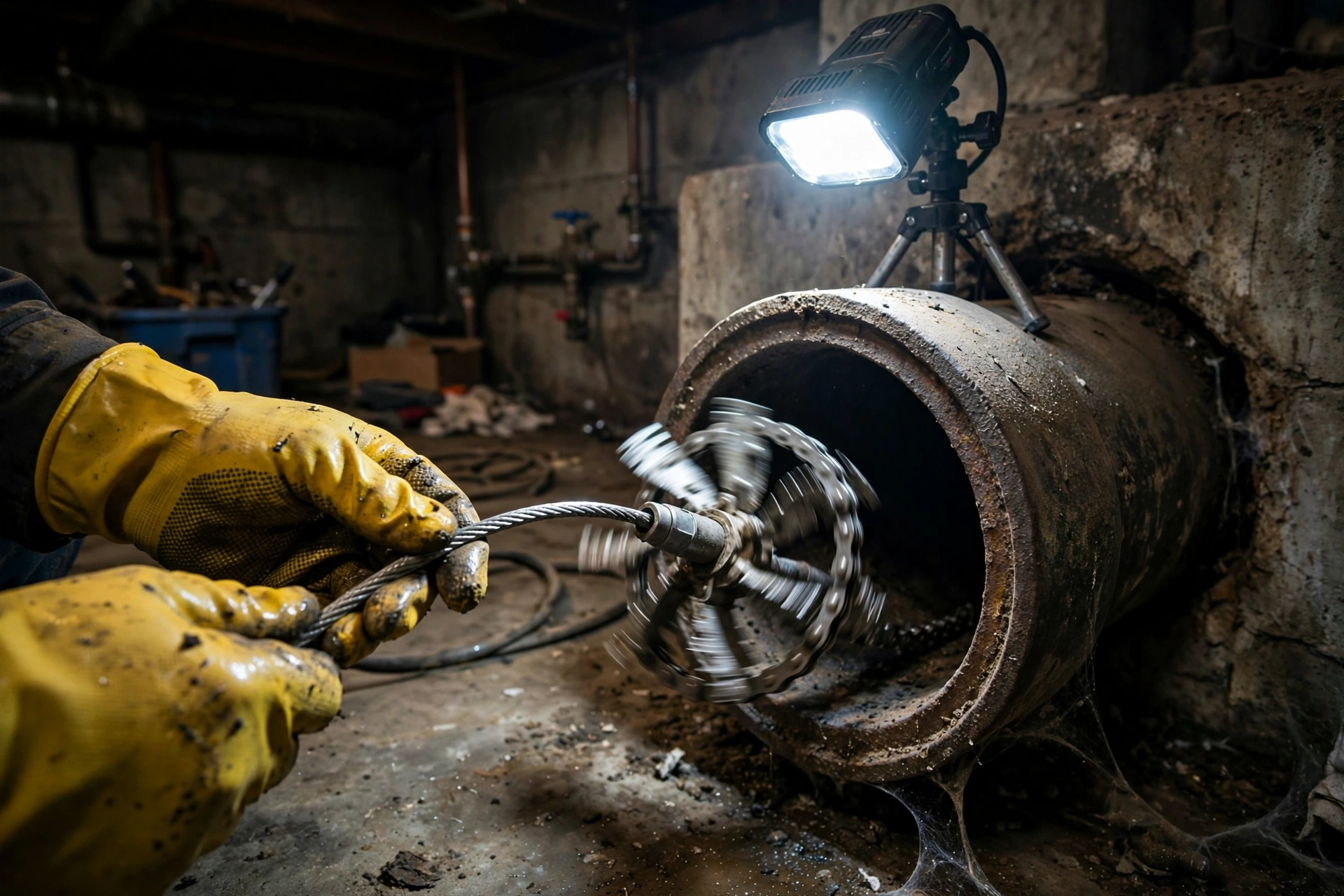
Your cast iron sewer line is not broken. It is choked. Decades of mineral scale and corrosion have narrowed it from the inside, and descaling grinds that buildup out to restore full flow, with no digging.
Last updated: October 13, 2026
Pipe scale is hard mineral and corrosion buildup that grows on the inside walls of a sewer line. Over decades, it can shrink a 4-inch cast iron pipe down to a 2-inch opening, and the rough surface catches everything that flows past.
Two kinds of buildup cause most of it. First, mineral scale: Ohio has moderately hard water in many areas, and calcium and magnesium in the water leave crusty deposits on pipe walls year after year. Second, corrosion: cast iron rusts from the inside out. The rust forms rough bumps and nodules called tubercles, and those bumps grab paper, grease, and solids, which builds more sludge on top of the rust. It is a slow requirementdback loop, and in a 60-year-old line, it is usually well advanced.
Ohio homes get this worse than many states for a simple reason: age and material. Huge numbers of houses in Columbus, Cleveland, Cincinnati, Toledo, Dayton, and Akron were built in the 1940s through the 1970s with cast iron drain lines and clay tile laterals. Those materials are now 50 to 80 years old, right in the window where scale and tuberculation peak. For the regulatory side, the Ohio EPA publishes Ohio's water and wastewater guidance.
Here is the part homeowners miss: a scaled-up line behaves exactly like a clogged line. Slow drains, gurgling toilets, backups after heavy laundry days. So people call for snaking, the snake punches a hole through the sludge, and everything works for a few months. Then it clogs again, because the scale is still there, catching the next load of debris. If you have been snaking the same line twice a year, you probably do not have a clog problem. You have a scale problem, and no snake will fix that.
Pipe descaling is the mechanical removal of hard scale and corrosion from the inside of a sewer line. We send a spinning tool through the pipe that physically grinds the scale and corrosion off the walls, restoring the pipe's original diameter. Here is how the job actually goes.
Every descaling job starts with a camera inspection. We need to see what kind of scale we are dealing with, how thick it is, and whether the pipe is still structurally sound underneath. If the camera shows the pipe walls are paper-thin or the line is cracked through, we stop right there and talk about replacement instead. Descaling a pipe that is falling apart is worse than useless: it can break through the last thin wall of metal.
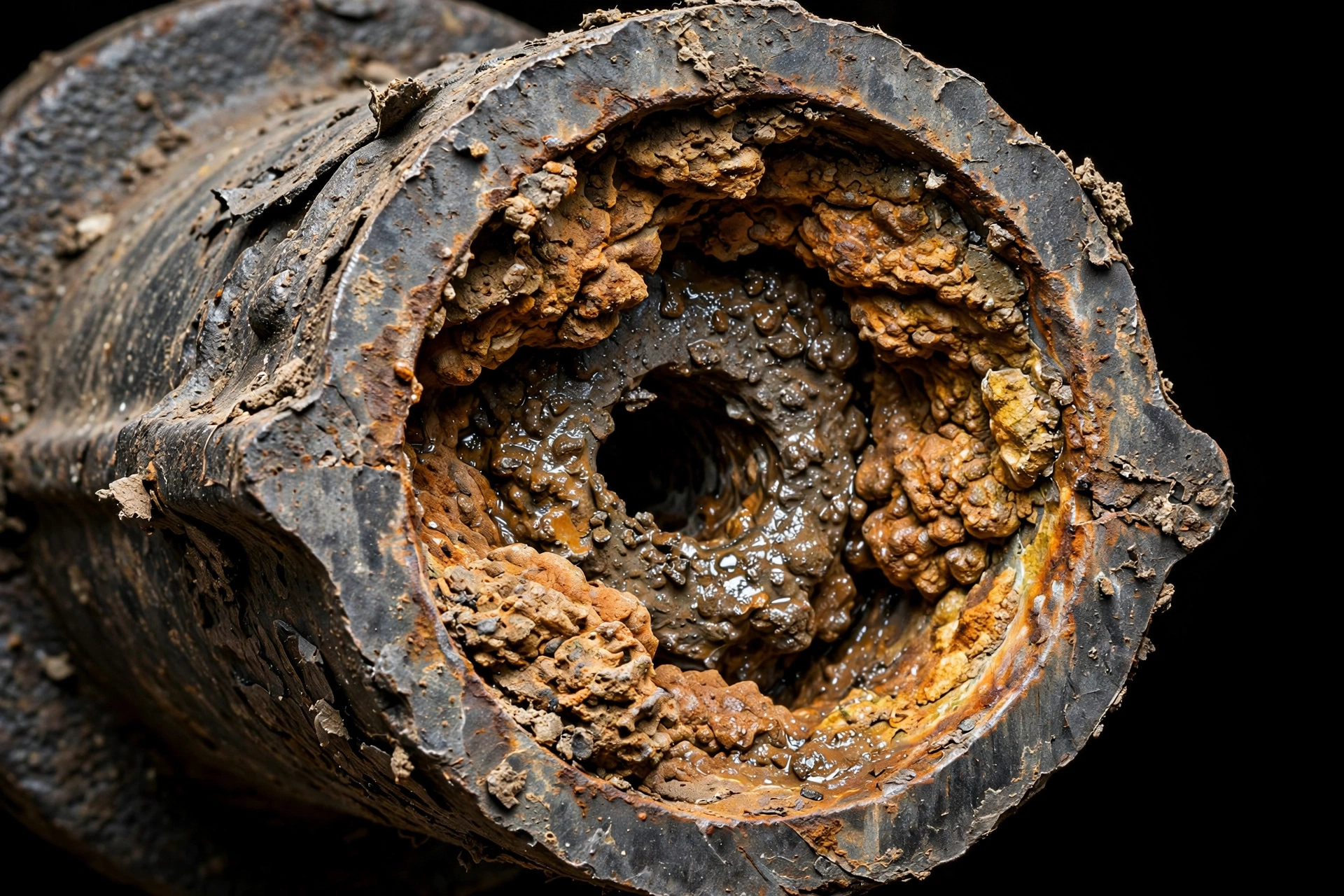
What descaling removes: hard mineral scale and corrosion tubercles like these can cut a pipe's capacity in half.
The tool is a flexible cable machine, like a heavy-duty drain machine, but the cutting head is different. Instead of a simple cutter, it carries a milling head: carbide cutters or chain flails that spin at high speed and whip outward against the pipe walls. The flails fling against the scale hundreds of times per minute, fracturing it off the wall while the pipe's round shape guides the tool. We work the head back and forth along the full run, sizing the head to the pipe so it clears the scale without gouging sound metal.
Thick, rock-hard scale takes patience. We make multiple passes, stepping up head sizes, until the pipe walls are clean to bare metal. A badly scaled 60-foot run can take several hours of milling.
All that broken-up scale is sitting in the pipe as debris, so the next move is a high-pressure water jetting pass to flush every chunk out to the city main. Then the camera goes back in for the proof run. You watch the monitor with us: smooth, clean walls, full diameter restored, water flowing freely. We record the footage and give you the before-and-after comparison, because that is what you paid for and you should see it.
Descaling fixes the inside of the pipe. It cannot fix the pipe itself. The camera inspection draws that line, and here is how we read it:
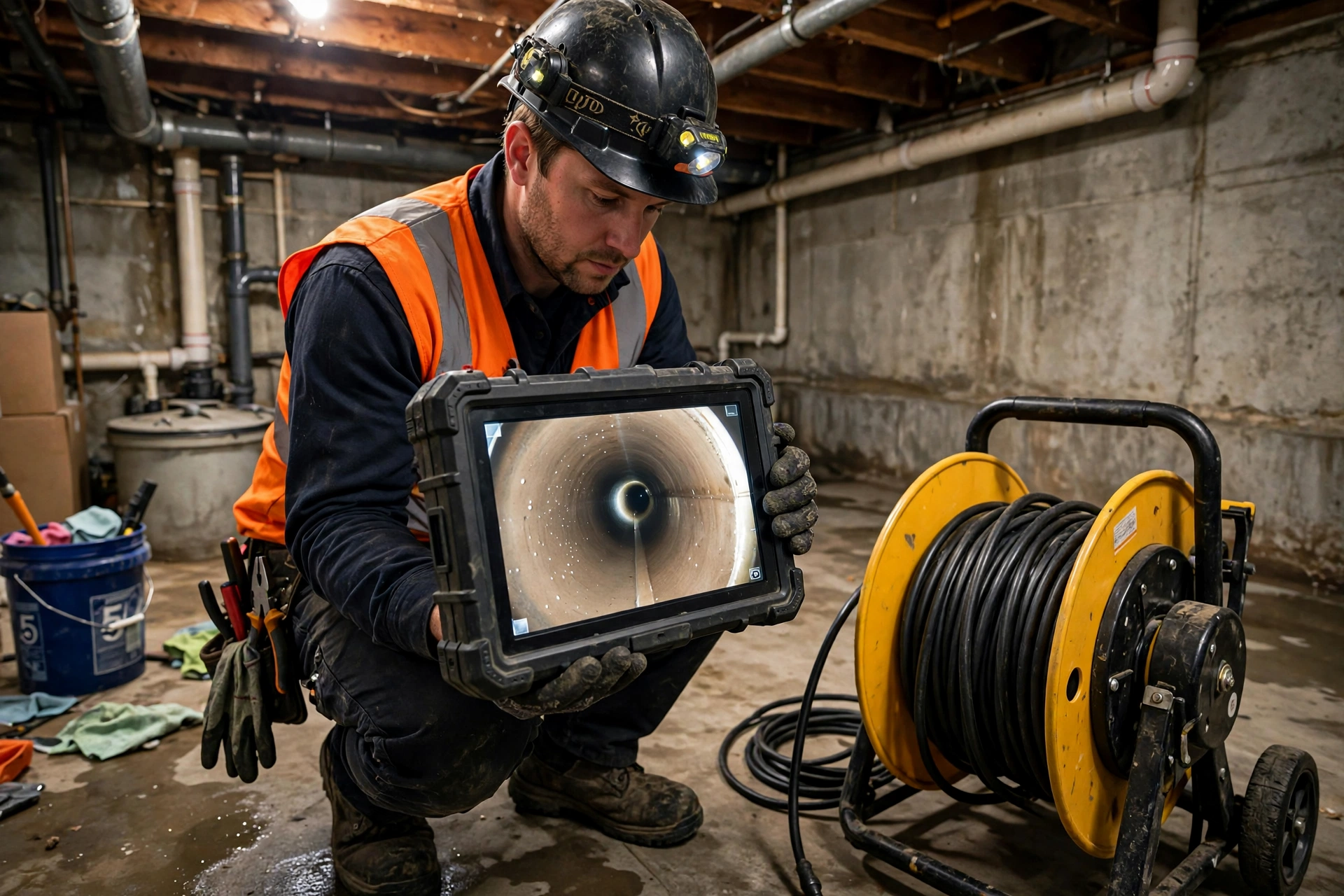
The post-descaling camera run is the proof: clean walls, full diameter, free-flowing water.
Scale is not a city-sewer-only problem: homes on septic systems build it up in their building drains too. The EPA's septic system guidance explains how those systems differ from a city sewer connection.
The honest version: descaling is simpler than replacement, and we still talk homeowners out of it when the pipe will not hold. A camera does not lie, and we would rather lose a descaling job than take your money for work that fails in a year.
These two services sound similar and do opposite things. Descaling is restoration: we keep your existing pipe and clean it from the inside. Cast iron replacement is removal: we take the old pipe out and put new pipe in. The pipe's condition decides which one you need, not your plans and not our preference.
Descaling wins when the metal underneath the scale is still healthy. You keep the original pipe, with no excavation. Replacement wins when the metal itself is done: corroded through, cracked, collapsed, or so thin that cleaning it would break it. Our cast iron pipe replacement page walks through that side in detail, including when full replacement is the only honest answer.
One thing to know: these are not competitors the way two contractors compete. They are stages of a pipe's life. A cast iron line gets descaled in its 50s, maybe lined in its 60s, and replaced in its 70s or 80s. Skipping the descaling stage and jumping straight to replacement on a sound pipe wastes money. Replacing a pipe that could have been descaled is just as wasteful as descaling one that should have been replaced. The camera tells us which stage your line is in.
| Factor | Descaling | Replacement |
|---|---|---|
| What it fixes | Hard mineral scale, corrosion tubercles, and sludge narrowing the pipe | Pipe that is structurally finished: thin walls, cracks, or collapsed sections |
| Pipe condition required | Sound walls underneath the buildup | None; the old pipe comes out |
| How it is done | Through cleanouts, with no digging | Excavation, or trenchless methods where the line qualifies |
| When replacement is the better call | When walls are paper-thin, channeled, or cracked through | When the pipe cannot be cleaned or lined safely |
Pipe lining, CIPP, creates a new pipe inside your old one, but the resin liner needs a clean, stable surface to bond to and cure against. You cannot line over heavy scale. The liner would cure against a lumpy, uneven surface, the liner's diameter would shrink around the buildup, and the bond would be unreliable in spots. Most lining failures we are called to look at trace back to poor prep, not poor resin.
That is why descaling is the standard first step of a proper lining job, and why our pipe lining (CIPP) process lists cleaning before installation. We descale, jet flush, camera-verify, and only then install the liner. If a contractor plans you lining without mentioning descaling or cleaning, ask them what the liner is bonding to. The answer matters more than the plan.
Camera through the full line, recorded. We measure scale thickness and check wall integrity before any tool touches the pipe.
The milling head travels the run, grinding scale and tubercles off the walls in multiple passes until the pipe is clean to bare metal.
High-pressure jetting washes every loosened chunk of scale out to the city main, so nothing settles back in the line.
Post-cleaning camera run proves the walls are clean and the full diameter is restored. You watch the footage with us.
We show you the before-and-after and talk through what is next: leave it clean, line it, or plan for eventual replacement, your call.
Anyone quoting a plan without seeing your line is guessing, because the plan follows the scale, not the address. But homeowners deserve to know what drives the number before they call. These are the factors that move a descaling plan up or down in Ohio:
Our full breakdown of sewer repair process, including when descaling makes a lining or replacement simplerr overall, is in our Ohio sewer repair guide. The number that matters is yours: call (614) 350-5706 for a camera inspection and a written, fixed plan before any work starts.
Hydro jetting blasts away soft buildup like sludge, grease, and roots with high-pressure water. Descaling removes hard mineral scale and corrosion that water alone cannot cut. Think of jetting as a deep clean and descaling as grinding the pipe walls back to bare metal. Most Ohio descaling jobs use both: milling first to break up the hard scale, then jetting to flush it all out.
Not when it is done right. The milling heads are sized to the pipe, and the chain flails are designed to knock scale off without cutting into sound metal. We camera-inspect before and after, so we can see exactly how much wall thickness remains. If the pipe is already paper-thin from corrosion, we will tell you descaling is a bad idea and talk about replacement instead.
It depends on what caused the buildup. In a cast iron line that is still structurally sound, descaling followed by pipe lining can give the line decades of life. Descaling alone on bare cast iron slows down over time, because the same water chemistry that built the scale is still flowing through it. We give you an honest read based on your pipe's actual condition.
Usually the whole accessible line. The cable machine requirementds through cleanouts, and the milling head travels the length of the run, scraping the full circumference of the pipe. If one section is too damaged for the tool to pass, we map that section on camera and talk through options for it separately.
No. Descaling is done through existing cleanouts or access points, so there is no excavation. That is the whole point of doing it before a line gets bad enough to need replacement.
Descaling rarely travels alone. Most jobs start with a sewer camera inspection to map the scale and check the pipe's condition, pair with hydro jetting to flush the line after milling, and lead into pipe lining when the clean pipe needs a new inner surface. And when the camera shows the pipe is past saving, our cast iron pipe replacement page explains what comes next. Start with the camera, and let the pipe tell us which service it needs.
One camera inspection shows whether scale is the real problem. Then you get a fixed written plan before any work starts.
Call (614) 350-5706