New pipe needs to go under your driveway, the road, or a 60-year-old oak, and you don't want a trench through any of them. Directional drilling installs it underground along a steered path, with the surface untouched.
Horizontal directional drilling, or HDD, is a trenchless method for installing brand-new underground pipe along a steered, controlled path. Instead of digging a trench from the surface, the rig drills underground from an entry pit to an exit pit, steering around obstacles, and the new pipe goes in through the bore. The driveway, road, patio, or landscaping above never gets touched.
Don't confuse it with trenchless repair. Pipe lining and pipe bursting fix or replace an existing line along its existing path. Directional drilling installs a new pipe along a new path, which is what you need when the old line is in the wrong place, when you're adding a service that never existed, or when open trenching would destroy something major. For repairing what's already in the ground, see our trenchless sewer repair page.
How Does a Directional Bore Actually Work?
Every bore follows the same three phases. Understanding them explains both the power and the limits of the method.
Phase 1: The pilot bore
The rig pushes a steerable drill head into the ground at the entry pit, following a planned path to the exit pit. A transmitter in the drill head sends position, depth, and pitch data to a locator walking the path above ground, and the operator steers in real time. The pilot bore is small, just the drill string, but its accuracy determines everything that follows.
Phase 2: Reaming
Once the pilot breaks through at the exit pit, reaming tools get attached and pulled back through the bore, enlarging it in one or more passes. Drilling fluid, a mix of water and bentonite clay, flows through the whole operation: it carries cuttings out, stabilizes the bore walls, cools the tooling, and lubricates the pullback.
Phase 3: Pullback
The new pipe, usually fused HDPE in one continuous length with no joints, attaches behind the reamer and gets pulled back through the enlarged bore from exit pit to entry pit. When it surfaces, the pipe is in place underground along the steered path, and the pits get backfilled.
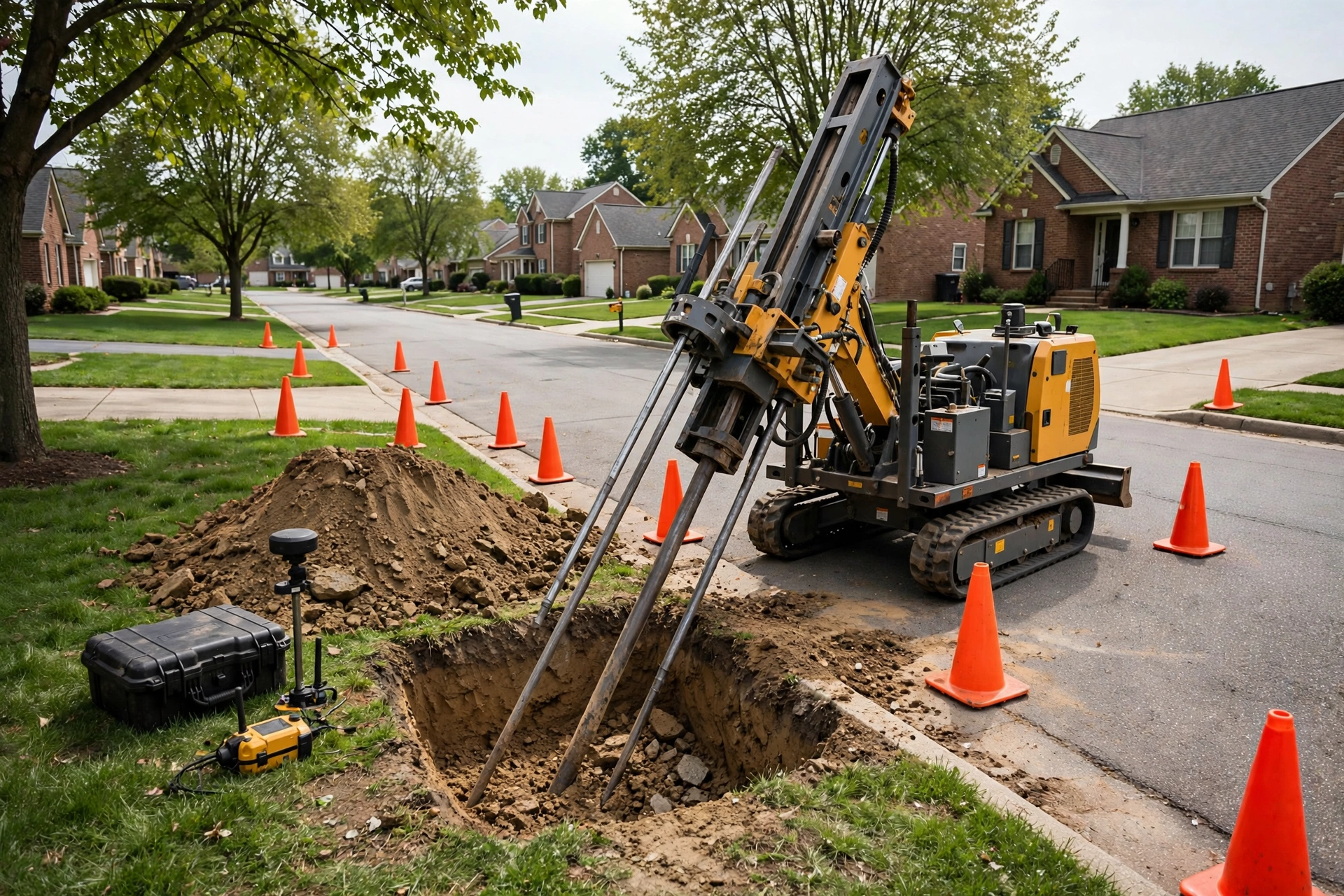
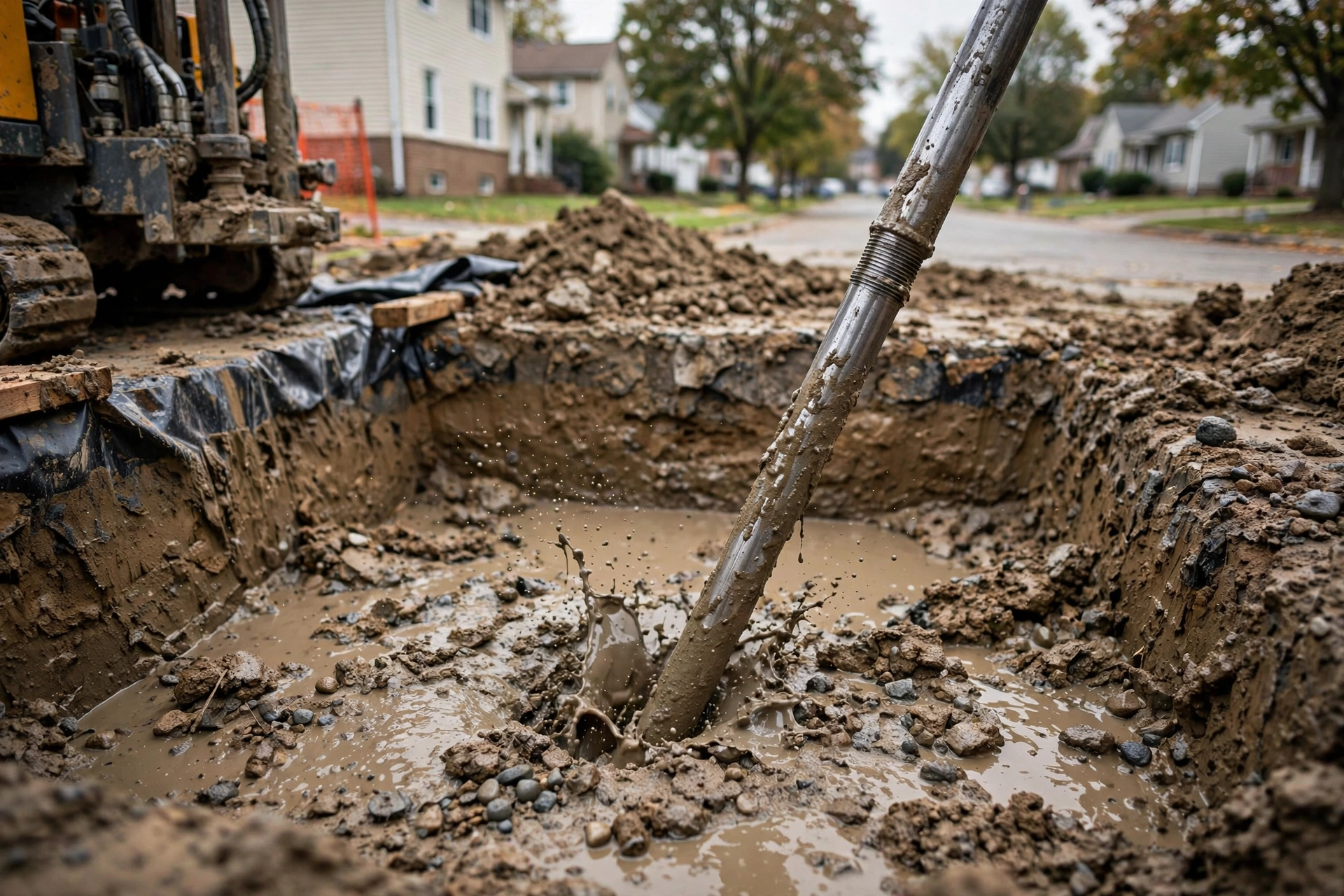
The entry pit during a bore: drill rods angled into the ground, drilling fluid stabilizing the hole.
What Can Directional Drilling Install?
The method doesn't care much what's in the pipe, so the list is broad:
Sewer laterals and mains. Our most common drilled install: a new sewer line from house to main that crosses under a driveway, road, patio, or mature trees.
Water service lines. New or replacement water lines on the same crossings, often drilled in the same mobilization as the sewer.
Electrical and communications conduit. Commercial sites and new construction use HDD for conduit runs under pavement.
Septic-to-sewer conversions. When a home leaves septic for city sewer, the new lateral often has to cross the whole front yard. Drilling gets it there without trenching the landscaping. The EPA's septic system guidance explains how septic systems work, and our septic-to-sewer conversion page covers the full process.
HDPE is the standard pipe for drilled sewer and water work: it fuses into one jointless length, bends through the bore path without fittings, and doesn't corrode in Ohio's clay soils.
When Does Directional Drilling Beat Open Trenching?
Drilling isn't always the answer, and an honest contractor says so. Here's the real comparison:
Factor
Directional drilling
Open trench
Surface disruption
Minimal: an entry pit and an exit pit, with the surface between them untouched
A continuous trench dug through everything above the pipe path
Best for
Long crossings under driveways, roads, patios, mature trees, and finished landscaping
Short runs in open ground where nothing major sits above the pipe
Limitations
Rock, glacial till, and buried rubble can stop or deflect the bore; grade control is less direct
Restoration work: cutting and repaving driveways or roads can exceed the pipe work itself
Permits
Road crossings need right-of-way or road-bore permits, same as any utility work
Same municipal plumbing permits, plus road-cut permits and traffic control for street work
When Does Drilling Win Over Trenching?
Under driveways and patios. Cutting, removing, and repaving concrete or pavers takes more work than the bore itself on many jobs.
Under public roads. Road cuts mean permits, traffic control, and full-depth pavement restoration. A bore under the road skips all of it.
Around mature trees. Ohio's big maples and oaks have root zones that trenching destroys. Drilling passes underneath with the tree untouched.
Across finished landscaping. A new patio, retaining walls, irrigation, and grading all survive a bore.
Long crossings. The longer the run under an obstacle, the bigger drilling's advantage over excavation.
When Does Open Trenching Beat Drilling?
Very short runs. On a 15-foot run in open lawn, a trench is faster and simpler than mobilizing the rig.
Rock and rubble. Glacial till, buried foundations, and riprap can stop or deflect a bore. Ohio's geology varies by county, and we check what's likely underground before recommending drilling.
Precise grade requirements. Gravity sewer needs exact slope. Steering holds grade well on most bores, but where the tolerance is tight and the ground is difficult, an open trench gives the installer direct control.
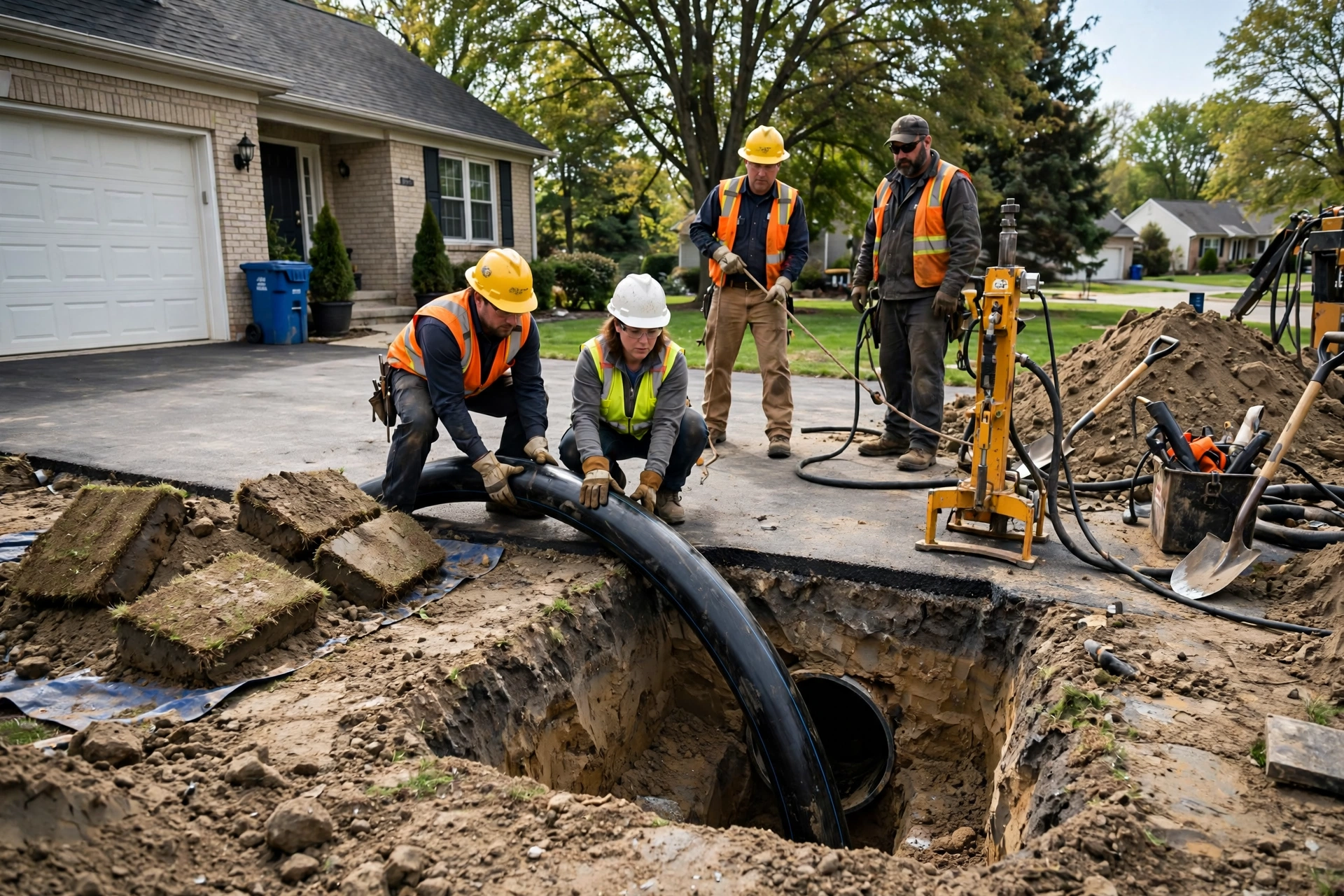
Pullback under an intact driveway: the new pipe goes in underground while the pavement above stays untouched.
How Do You Steer a Drill You Can't See?
The drill head carries a transmitter that broadcasts its position, depth, pitch, and roll. A locator walks the planned bore path above ground with a receiver, tracking the head in real time and calling steering corrections to the rig operator. On longer or deeper bores, wireline systems give continuous data instead of walkover readings.
Depth control matters for two reasons: staying deep enough to clear the obstacle and existing utilities, and holding the grade a gravity sewer line needs. Residential and light commercial bores typically run 3 to 15 requirementt deep, which covers sewer laterals and water lines comfortably.
Before any bore starts, Ohio's 811 utility locate runs (call 811 or contact the Ohio Utilities Protection Service), and we pothole, expose by vacuum excavation, any critical crossings to confirm exact depth. Steering around a marked utility is routine; hitting an unmarked one is what the verification step prevents.
Our 5-Step Directional Drilling Process
Plan
We survey the bore path, review the 811 locates, check soil conditions, and confirm the pipe size, depth, and grade the job needs.
Set up
Entry and exit pits get dug, the rig gets positioned and anchored, and drilling fluid mixing starts.
Drill
The pilot bore goes in along the planned path, with the locator tracking and steering around utilities in real time.
Pull back
Reamers enlarge the bore, then the fused HDPE pipe pulls through in one continuous length.
Connect
The new pipe gets tied into the house plumbing and the main, pressure or camera tested, and the pits backfilled and restored.
Do You Need a Permit for Directional Drilling in Ohio?
In most cases, yes. Sewer and water work needs the same municipal permits as open-trench work, and most Ohio cities require an inspection of the connections before the line goes live. Bores that cross a road right-of-way need a separate right-of-way or road-bore permit from the city, township, or county, which comes with its own depth and restoration requirements.
Bores near streams or wetlands can trigger environmental review, just like any excavation near water, and Ohio's review runs through the Ohio EPA. We check the requirements for your address, pull every permit the job needs, and schedule inspections as part of the work. The 811 locate is legally required before digging, and we handle it on every job.
What Does Directional Drilling Involve in Ohio?
Drilling plans by the foot, but the job around the footage matters as much as the footage itself. These factors set your plan:
Bore length and pipe diameter. Longer bores and bigger pipe work more, straightforwardly.
Soil conditions. Clean clay and loam drill fast. Rock, cobble, and buried debris slow the bore and wear tooling.
Depth. Deeper bores take longer and need bigger equipment.
What it crosses. A road bore needs traffic control and right-of-way permits; a yard bore doesn't.
Connections. Tying into the house plumbing and the city main, plus any interior work, is included with the bore.
Restoration avoided. The honest math compares drilling against the trench alternative: on many jobs, skipping driveway or road restoration makes drilling the simpler total.
Our Ohio guide covers process across our services. For your bore, call (614) 350-5706: we'll walk the path, check the conditions, and give you a written, fixed plan.
Directional Drilling FAQs
Horizontal directional drilling, or HDD, is a trenchless method for installing new underground pipe along a steered, controlled path. The rig drills a small pilot bore from an entry pit to an exit pit, enlarges it with reaming tools, then pulls the new pipe back through. The surface above, driveway, road, landscaping, stays intact.
Sewer laterals and mains, water service lines, electrical and communications conduit, and gas lines. For our work it's mostly sewer laterals that need to cross under driveways, roads, patios, or mature trees, plus water lines and conduit on commercial sites. HDPE pipe is the standard for drilled sewer and water installs because it's flexible, jointless, and corrosion-proof.
Whenever the surface above the pipe is a bigger job to destroy and rebuild. Cutting and repaving a driveway, boring under a public road, saving a mature oak, or crossing a landscaped yard all favor drilling. Open trenching wins on very short runs, in ground full of rock or rubble, or where the pipe needs a precise grade that steering can't hold.
Residential and light commercial bores typically run 3 to 15 requirementt deep, plenty for sewer laterals and water lines. The drill head carries a transmitter, and a locator walks the bore path above ground tracking its exact position, depth, and pitch. The operator steers around known utilities in real time. Ohio's 811 utility locate happens before any bore starts.
In most cases, yes. Sewer and water work needs the same municipal permits as open-trench work, and bores that cross a road right-of-way need a separate right-of-way or road-bore permit from the city, township, or county. We pull the permits and coordinate inspections as part of the job.
Related Services
Directional drilling installs new pipe; trenchless repair fixes existing pipe. If your current line can be saved, our trenchless sewer repair page explains pipe lining and pipe bursting. If you're leaving a septic system for city sewer and the new lateral has to cross the yard, start with our septic-to-sewer conversion page.
Need New Pipe Under Something You Don't Want Dug Up?
We'll walk the bore path, check the ground conditions, and tell you straight whether drilling or trenching is the smarter call.