The pipe under your driveway carries every storm's runoff. When it rusts out, crushes, or clogs, you get sinkholes, flooded driveways, and washed-out ditches. We repair and replace culverts across Ohio, sized for real storm flows.
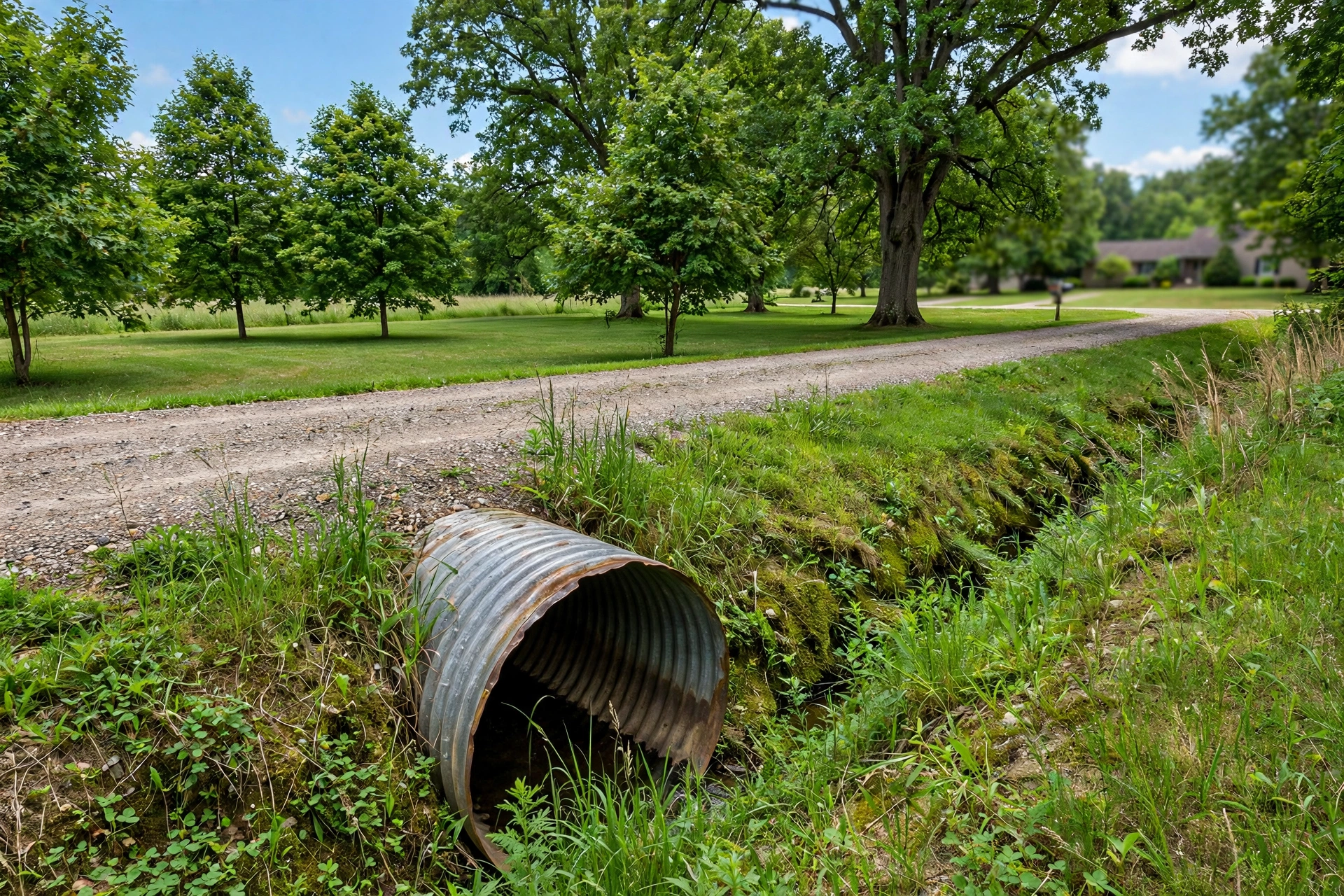
A culvert is a short pipe that carries water under something: your driveway, a walkway, a farm lane, or a road. Roadside ditches collect runoff from the land and the road, and wherever a driveway crosses that ditch, a culvert keeps the water flowing underneath instead of over your pavement.
Most Ohio homeowners only meet their culvert when it fails, which is a shame, because it's doing quiet work every time it rains. A healthy culvert moves ditch water through with no ponding above the driveway and no erosion around the pipe ends. The failures are predictable: metal rusts, soil settles, ditches clog with leaves and silt, and upstream development sends more water down the ditch than the old pipe was sized for.
Culverts are not sewer pipe. They carry stormwater, not sewage, and they fall under different rules, including the federal stormwater permit program, the EPA's NPDES program. But the skills overlap: excavation, pipe bedding, slope, and backfill done right, which is why a sewer crew that does drainage work is the right call.
What Are the Signs Your Culvert Is Failing?
Culvert failures announce themselves in the driveway and the ditch. Here's what to look for:
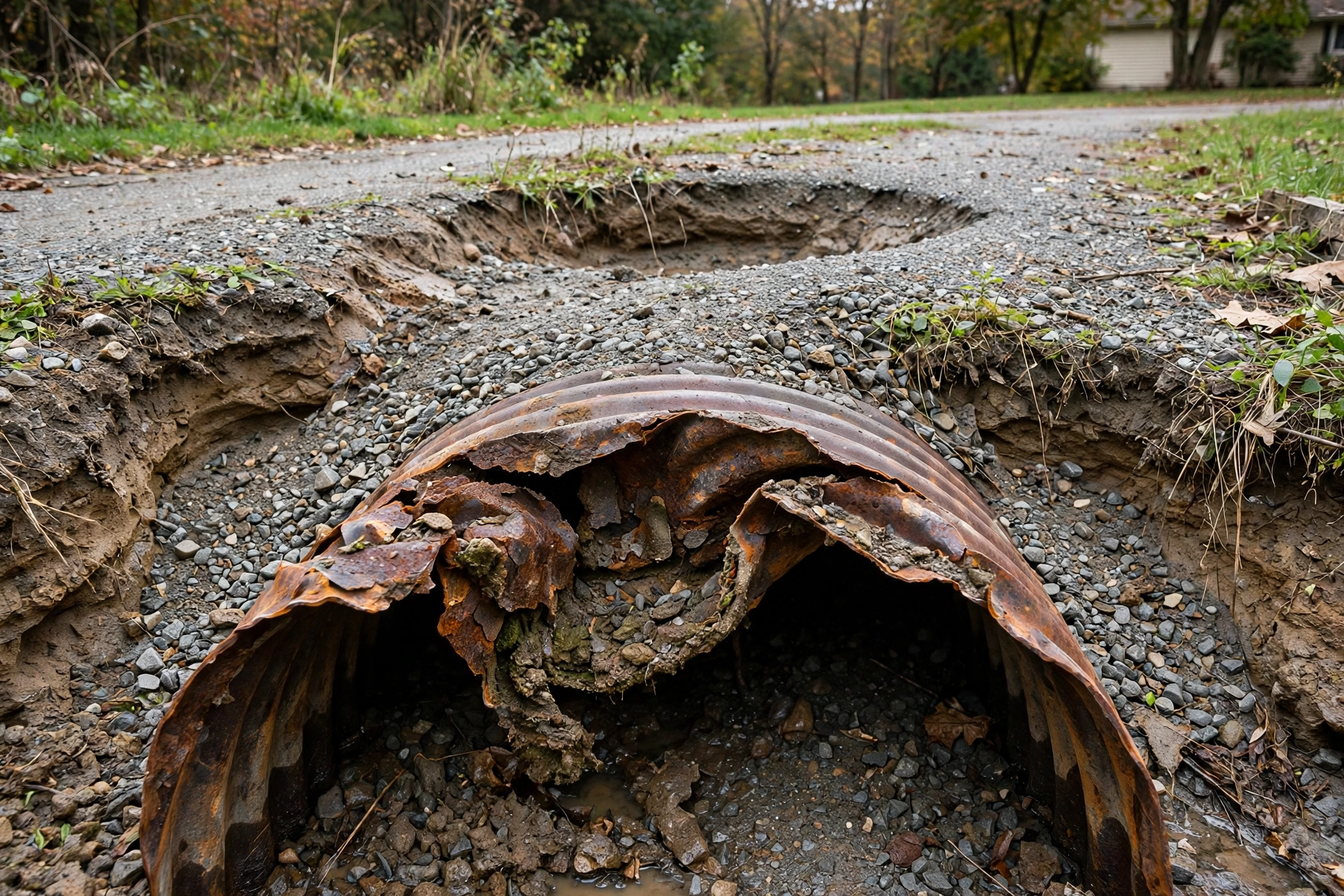
A sinkhole or dip over the culvert. This is the classic one. Soil washes into the pipe through rusted-through spots or separated joints, and the driveway surface sags above it. It only gets worse.
Crushed, rusted, or collapsed pipe ends. Walk the ditch and look at both ends. Corrugated metal rots from the bottom up, so the invert (the bottom of the pipe) goes first. If you can poke through the metal with a screwdriver, it's done.
Water pooling above the driveway. A culvert that's clogged with silt and leaves, or one that's undersized for current runoff, backs water up on the upstream side.
Driveway settling or cracking over the pipe. Poor original bedding plus a rusting pipe lets the soil compact unevenly, and the pavement follows it.
Erosion around the pipe ends. Water finding its way around the pipe instead of through it chews out the ditch banks and undermines the driveway edges.
Water overtopping the driveway in normal storms. If storms that used to pass fine now run across the pavement, the pipe has lost capacity, either to blockage or to upstream development increasing the flow.
Rust-through on the pipe invert lets soil wash inside, and the driveway above starts to sink. This pipe needs replacement, not repair.
Can a Damaged Culvert Be Repaired, or Does It Need Replacement?
It depends on the pipe's shape. A culvert that still holds its round profile can often be saved. A crushed, flattened, or severely corroded one can't. Here's how we decide:
When Can a Damaged Culvert Be Repaired?
Cleaning and desilting. Many "failed" culverts are just full of silt, leaves, and gravel. A thorough cleanout restores full capacity at a fraction of replacement work.
Slip lining or relining. A structurally sound pipe with a rough or lightly corroded interior can get a new liner or a smaller pipe slipped inside. Flow stays close to original, and the driveway never gets dug up.
End repairs. Damaged headwalls, wingwalls, or pipe ends can be cut back and refitted without touching the buried barrel.
When Is Replacement the Honest Answer?
Crushed or collapsed sections. Once the profile is gone, no liner can restore it.
Severe rust-through. Corrugated metal that has lost its invert along most of its length is structurally finished.
Chronic undersizing. If the pipe can't pass current storm flows even when clean, a bigger pipe is the only fix.
Wrong slope or alignment. A culvert installed flat or against the ditch grade will keep silting up no matter how often you clean it.
We'll show you the inside of the pipe and explain which category yours falls in. Relining a pipe that needs replacement wastes your money, and replacing a pipe that could be lined wastes it too.
What Culvert Materials Hold Up in Ohio?
Three materials cover nearly all residential and light commercial culverts. Ohio's freeze-thaw cycles and road salt are hard on the wrong choice.
HDPE (corrugated plastic). Our default recommendation for most driveway culverts. It doesn't rust, road salt doesn't touch it, it's light to handle, and the smooth interior resists silting. Typical service life is measured in decades.
Reinforced concrete (RCP). The heavy-duty option for larger diameters, deeper cover, or where a road carries truck traffic. Immune to rust, very long-lived, but heavier and more major to install.
Corrugated metal (CMP). The old standard, and what most failing Ohio culverts are made of. Galvanized coatings buy time, but road salt and acidic soils attack the invert, and once rust starts, it goes fast. We still install it where a county spec calls for it, but we don't recommend it as the default.
Material is only half the story. Proper bedding, correct slope, compacted backfill in lifts, and protected pipe ends with headwalls or riprap matter as much as what's in the ground. A simple pipe installed well outlasts an major pipe installed badly.
How Do Culvert Materials Compare?
The lifespans below are widely published industry ranges; real life depends on soil, salt exposure, and how well the pipe was bedded:
Material
Typical lifespan
Weakness
Reinforced concrete (RCP)
Typically 50 to 75 years
Heavy and a bigger job to install; cracks if the bedding settles or it takes impact loads
Corrugated metal (CMP)
Typically 25 to 50 years
Corrosion: road salt and acidic soils attack the coating, and the invert rusts through first
HDPE (corrugated plastic)
Typically 50 to 100 years
UV degrades exposed pipe ends, and it needs correct bedding or it can deflect under load
What Size Culvert Does Your Driveway Need?
Sizing follows the drainage area requirementding the ditch, the ditch slope, and the storm flows your county designs for. The hard rule: the replacement should never be smaller than the pipe that was there. And "match the old one" is often not good enough, because many older Ohio driveways have pipe sized for a landscape that no longer exists. Upstream lots got developed, roofs and pavement got added, and the same ditch now carries much more water.
Undersized culverts cause the worst problems: water overtops the driveway, erodes the ditch banks, and floods the yard every heavy rain. We size replacements for current upstream runoff, using the drainage area and local design standards, so the new pipe handles the storms your neighborhood actually gets. When a culvert sits in a county or township right-of-way, the local engineer may dictate the minimum size, and we build to that.
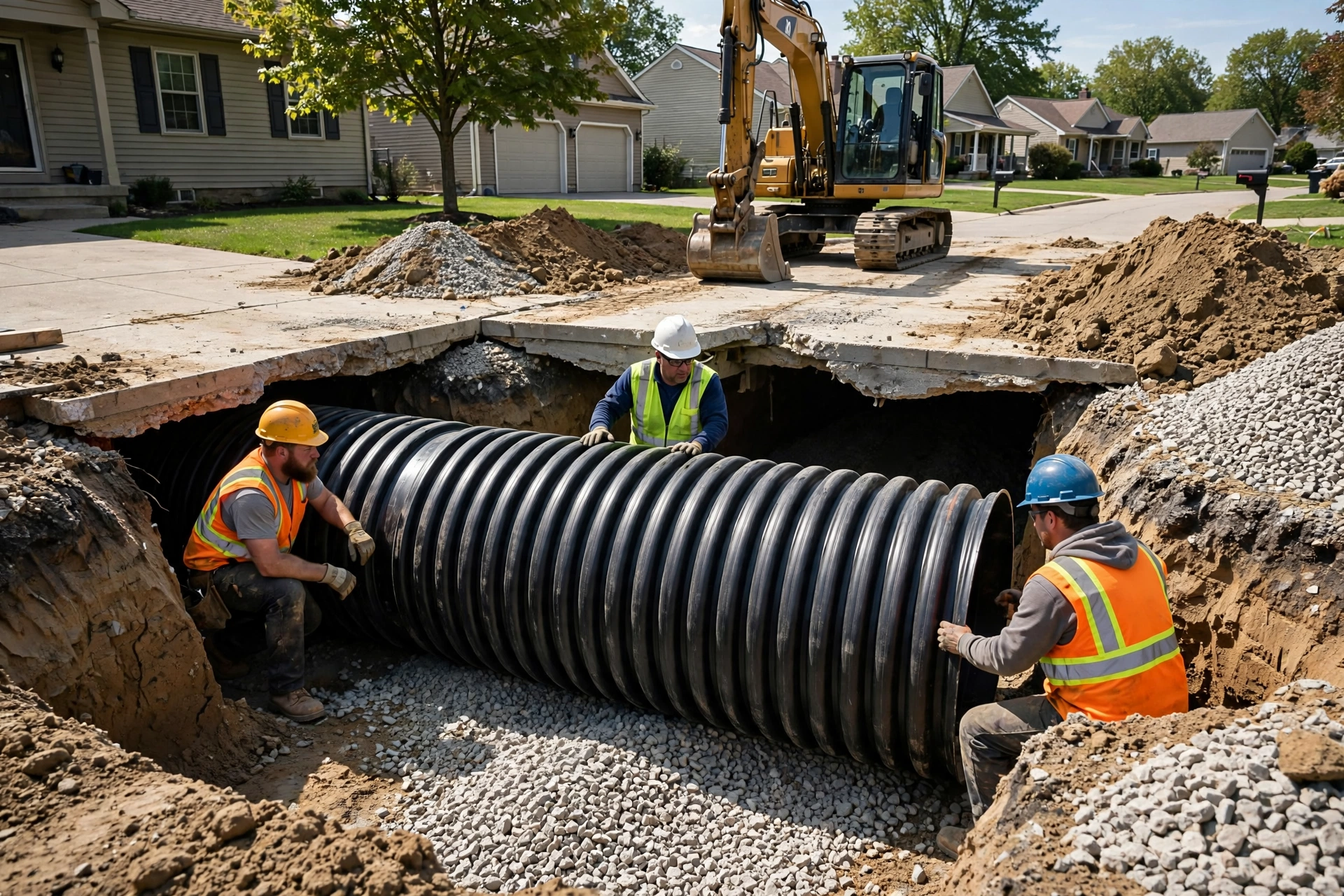
A new HDPE culvert going in on proper gravel bedding. Correct slope and compaction are what make it last.
Do You Need a Permit to Replace a Culvert in Ohio?
Often, yes. Townships and counties commonly require permits for driveway culvert work, especially where the culvert sits in a road right-of-way. That permit usually comes with a minimum pipe size and installation standards, which is actually helpful: it means the replacement gets done to a spec that works.
Work near streams, wetlands, or drainage channels that connect to waterways can trigger additional review. Ohio's environmental rules, overseen by the Ohio EPA, treat stream crossings more carefully than a simple roadside ditch, and some projects need clearance before excavation starts near the water. We check the local requirements for your address, pull the permits, and schedule any inspections as part of the job, so the paperwork doesn't land on you.
One practical note: call 811 before any digging, every time. Culvert trenches cross the same ground as gas, electric, and communications lines, and Ohio law requires the locate. We handle the call on every job.
Our 5-Step Culvert Replacement Process
Survey
We measure the drainage area, check the existing pipe's size and condition, confirm utility locates, and verify permit requirements.
Excavate
The driveway section over the culvert is cut and removed, the old pipe pulled, and the trench dug to grade with a proper bedding layer.
Set
The new pipe goes in on compacted gravel bedding at the right slope, with joints sealed and ends protected.
Backfill
Soil goes back in compacted lifts to prevent the settling that causes driveway dips later.
Restore
The driveway surface is rebuilt, gravel regraded or pavement patched, and the ditch regraded so water flows cleanly to and from the pipe.
What Does Culvert Work Involve in Ohio?
Culvert jobs vary more than most people expect, because length, diameter, and driveway restoration drive the number. These are the factors that set your plan:
Length and diameter. A 20-foot, 12-inch driveway culvert and a 60-foot, 36-inch crossing are different jobs entirely.
Material. HDPE is the economical long-life choice; concrete takes more work for larger or deeper installs.
Depth and access. Deep ditches, steep banks, and tight access for equipment add labor.
Driveway restoration. Regrading gravel is quick. Cutting and repaving asphalt or concrete takes more work.
Dewatering. If the ditch runs wet during the job, pumping and temporary diversion add time.
Permits and inspections. Township, county, and any waterway review requirements are part of the written plan.
Repair vs. replacement. Cleaning or relining an existing pipe is far simpler than a full excavation and replacement.
Our Ohio guide covers process across our services. For a real number on your culvert, call (614) 350-5706: we'll look at the pipe, check the drainage, and give you a written, fixed plan.
Culvert FAQs
The classic sign is a sinkhole or dip forming in the driveway directly over the culvert. Others include crushed or rusted-through pipe ends, water pooling above the driveway after rain, the ditch eroding around the pipe, and water overtopping the driveway in storms it used to handle fine. Any of these means the pipe is losing structure or capacity.
It depends on the damage. A pipe that still holds its shape can often be relined or slip-lined, which restores flow without digging up the driveway. A crushed, badly corroded, or undersized pipe needs full replacement. Collapsed sections, severe rust-through along the invert, and chronic undersizing all point to replacement.
Sizing follows the drainage area requirementding the ditch, the slope, and the storm flows your county designs for. As a rule, the replacement should never be smaller than what was there, and many older Ohio driveways have undersized pipe from when the land upstream was less developed. We size replacements to handle current upstream runoff, not just match the old pipe.
Often, yes. Townships and counties commonly require permits for driveway culvert work, especially where the culvert sits in a road right-of-way or near a stream or wetland. Work near waterways can trigger additional environmental review. We check the local requirements and pull the permits as part of the job.
A properly installed HDPE or concrete culvert lasts for decades, typically 50 years or more. Corrugated metal pipe lasts less, especially in Ohio where road salt and freeze-thaw cycles attack the coating and the invert rusts through first. Good bedding, proper slope, and protected ends matter as much as the pipe material.
Related Services
Culverts are one piece of a property's drainage picture. If stormwater is the bigger issue, our storm drain repair and cleaning page covers pipes, inlets, and underground systems. And when a new culvert or pipe needs to cross under pavement without tearing it up, directional drilling and boring installs it trenchlessly.
Sinkhole Over Your Culvert? Don't Wait on It.
We'll inspect the pipe, check the drainage, and tell you honestly whether it needs cleaning, relining, or replacement.