7 Warning Signs Your Sewer Line Is Failing
Sewer lines rarely fail without warning. They slow down, gurgle, smell, and leave clues in the yard for weeks or months first. Here are the seven signs Ohio homeowners should never ignore.
Sewer lines rarely fail without warning. They slow down, gurgle, smell, and leave clues in the yard for weeks or months first. Here are the seven signs Ohio homeowners should never ignore.
Last updated: October 13, 2026
A slow drain is a fixture that empties noticeably slower than it should because something is restricting the flow of wastewater through the pipe. The earliest signs are subtle: drains that take a little longer, a toilet that gurgles now and then, a faint smell near a floor drain. They mean the line is restricted but still passing waste, and this is the simplest stage to fix. The later signs are not subtle: sewage coming back up, a sunken strip in the yard, standing water that should not be there. By then the restriction has become a blockage or a break. Every sign below is your line asking for attention in the only language it has.
| Warning sign | What it usually means | How urgent |
|---|---|---|
| Multiple drains slow at once | A restriction in the shared sewer lateral | Schedule service this week; this is the simplest stage to fix |
| Gurgling toilets | Air escaping past a partial blockage or root intrusion | Get it checked before it becomes a backup |
| Sewage smells | A cracked pipe, a broken seal, or a dried-out trap | Find the source; do not mask it with air freshener |
| Water backing up in the lowest drain | The lateral cannot carry the flow | Call today and stop running water |
| Soggy, sunken, or extra-green yard patch | A broken or leaking pipe underground | Call today for a sunken yard; schedule soon for a soggy or green patch |
| Foundation cracks near the line | Soil washed out by a leak, letting the foundation settle | Schedule a camera inspection |
| Clogs that keep coming back | A structural problem: roots, a belly, or a partial collapse | Fix the pipe; repeated snaking only clears the symptom |
One slow sink is a local clog. The tub, the toilet, and the washing machine all draining slowly is a main line problem. When every fixture shares the same symptom, the restriction is in the pipe they all share: your sewer lateral. This is the most common first sign, and the most commonly ignored, because each fixture still "works," just slowly. A professional drain cleaning can clear the buildup causing early-stage slowdowns, but if the camera shows a break or a belly, cleaning only buys time.
Gurgling is air escaping. When a restriction narrows the line, wastewater pushes air ahead of it, and that air bubbles up through the nearest trap, usually the toilet. Occasional gurgling after heavy use can be a venting quirk. Regular gurgling, especially when it happens across multiple fixtures or when the washing machine drains, points to a partial blockage or root intrusion in the lateral. Think of it as the line clearing its throat. You want to act while it is still just a sound.
A healthy sewer line is sealed. When you smell sewage in the basement, near a floor drain, or in the yard, something has opened: a cracked pipe, a dried-out trap, a broken seal, or a line so restricted that gases are forcing their way out. Outdoor smells that get stronger after rain are a classic sign of a cracked lateral in Ohio clay soil, where wet ground shifts the pipe and opens the cracks wider. Do not mask it with air freshener. Find the source.
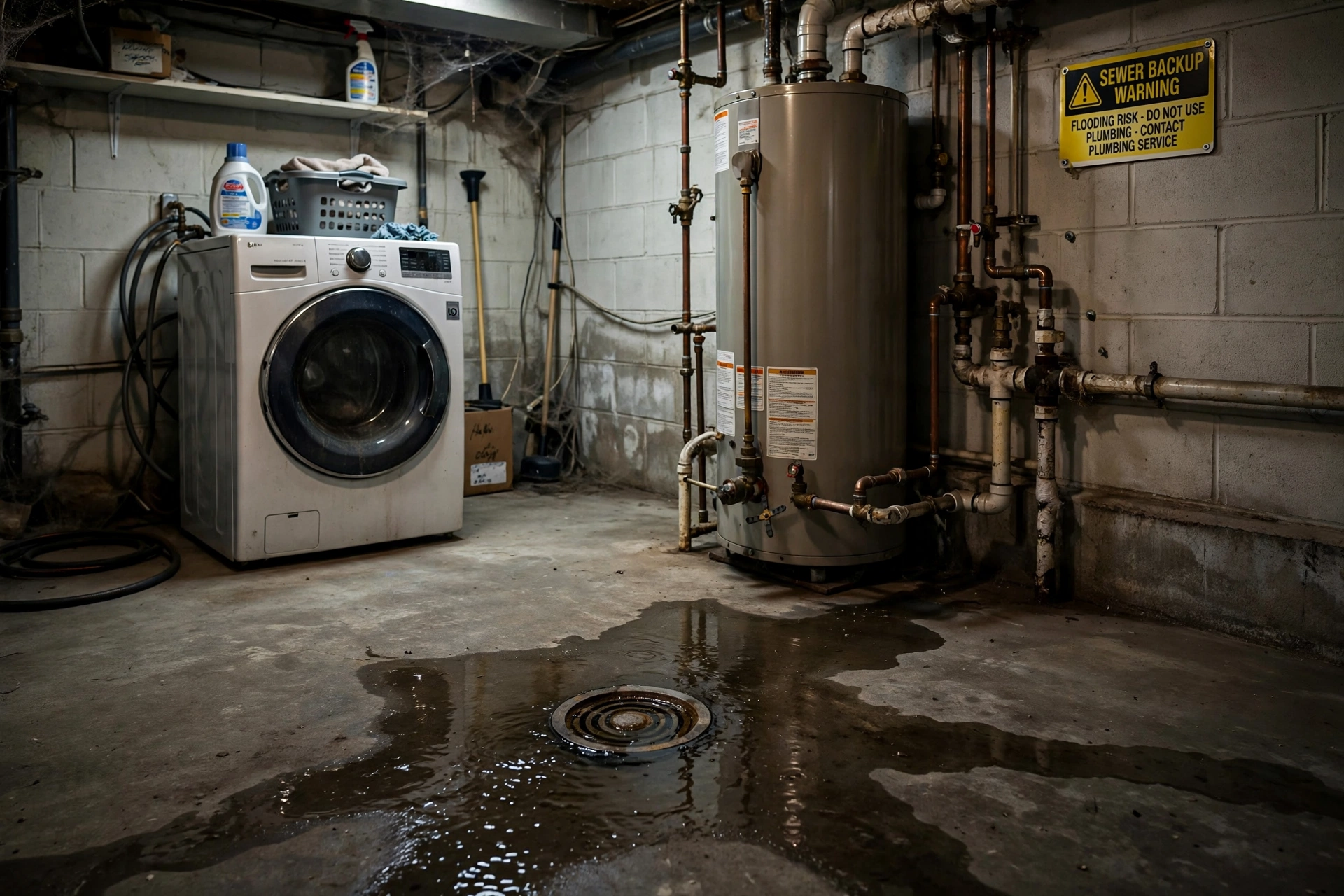
Water around the basement floor drain is the lowest fixture in the house telling you the line is backing up. Do not wait on this one.
In most Ohio homes the lowest drain is the basement floor drain, and it is the canary. When the lateral cannot carry the flow, wastewater takes the path of least resistance, which is up through the lowest opening. If running the washing machine makes water rise in the shower, or flushing the upstairs toilet gurgles the basement drain, the line is telling you exactly where it stands. An active backup is call-today territory: every flush adds to the mess, and contaminated water is a health hazard, not just a plumbing problem. If this is happening now, call (614) 350-5706 right away and stop running water.
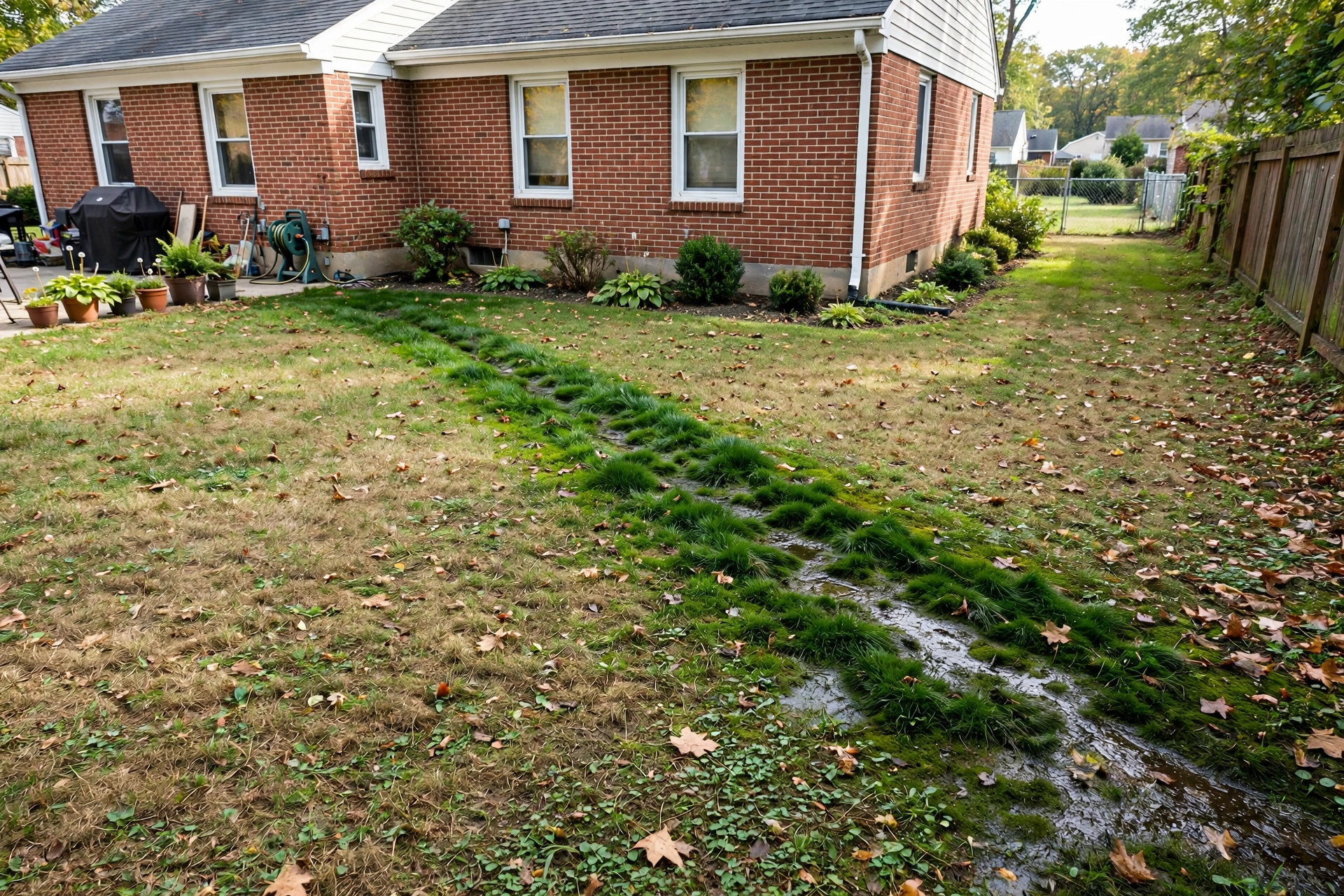
It usually means your lateral is leaking underground. A strip of grass that is greener, lusher, and faster-growing than the rest, especially in a line running from the house toward the street, is being fertilized by that leak. A soggy patch that never dries, or a section of yard that has settled into a shallow trench, means the pipe below has broken and soil is washing into it. In Ohio's clay soil this shows up clearly, because clay holds the water at the surface instead of draining it away. If you can trace the green stripe from your house to the curb, you have probably just located your sewer line the hard way.
Sometimes. A leaking sewer line washes soil out from around the pipe, and that missing soil leaves voids. Voids near the foundation let the foundation settle, and settling opens cracks. Not every foundation crack is a sewer problem, most are just concrete doing what concrete does, but new or growing cracks on the same side of the house as the sewer lateral deserve a camera inspection. In Cleveland's older neighborhoods, where stone foundations and century-old clay tile meet, this connection is one we see regularly.
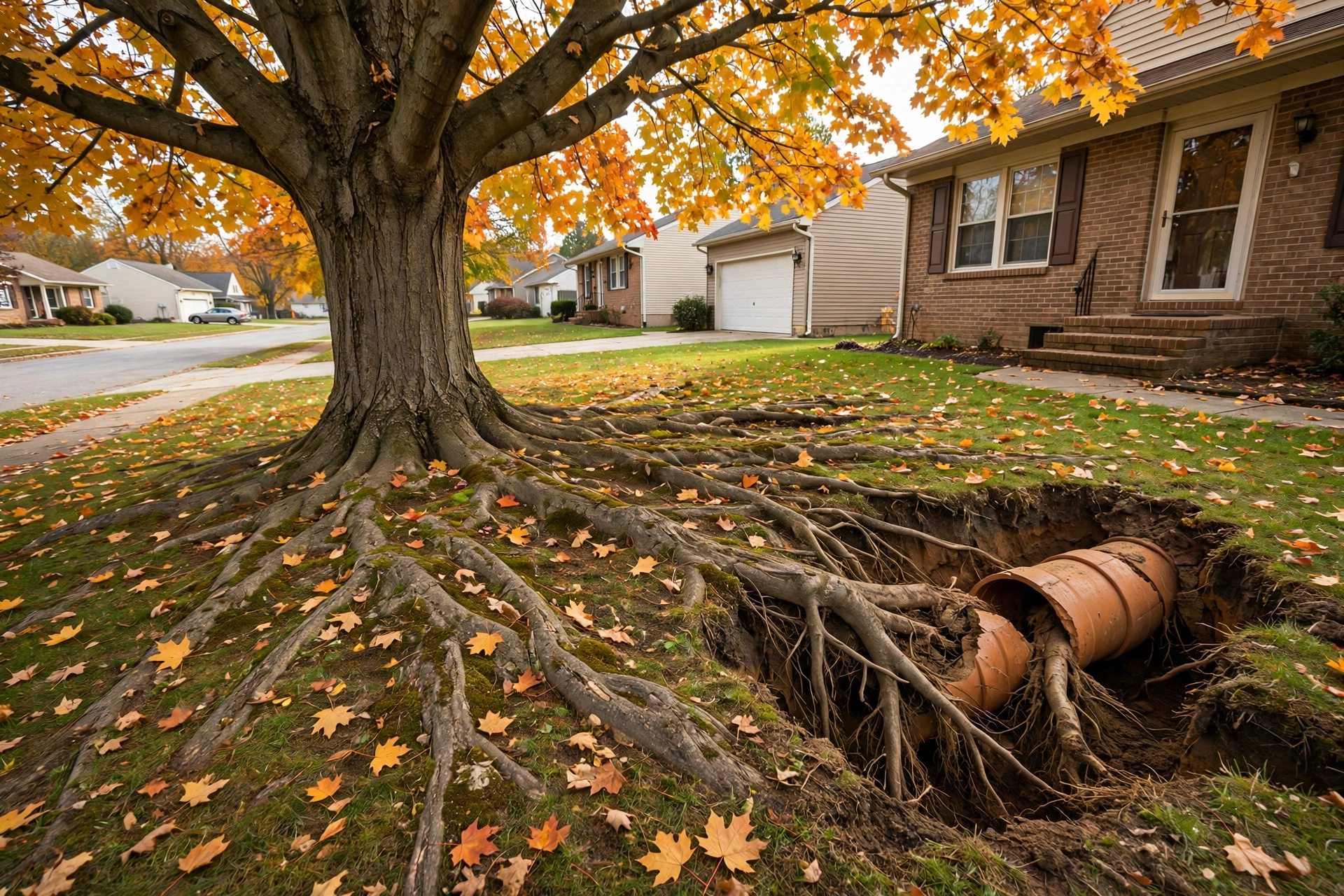
Silver maples and oaks are Ohio's most aggressive root intruders. That beautiful shade tree may be drinking from your sewer line.
A clog you clear once is bad luck. The same clog returning every few months is a structural problem wearing a clog workume. The usual suspects in Ohio: tree roots growing back through clay tile joints, a belly in the line where waste settles and builds up, or a partially collapsed section that catches everything. Repeated snaking clears the symptom for a while and never touches the cause. If you are on a first-name basis with your drain cleaner, stop treating the clog and get the roots and the pipe dealt with properly. A sewer maintenance program with scheduled camera checks catches these cycles before they become emergencies.
The signs are universal, but Ohio adds its own accelerants. Freeze-thaw cycles heave clay soil every winter and shift pipe joints a little more each year. Silver maples, oaks, and willows, the most common large trees in Ohio yards, send fine requirementder roots into any clay tile joint with moisture in it, and those roots grow into masses that catch everything. Much of the housing stock predates 1970, which means clay tile and cast iron laterals now decades past their prime. And in older cities with combined sewers, heavy rain can send flow backward through a compromised lateral, turning a slow line into a sudden backup. None of this is mysterious. It is just what happens to buried pipe in this state over forty or fifty years.
Do not start with a plunger or a bottle of drain cleaner. Start with information, in this order:
Our Ohio guide shows the difference early action makes. Buying a home? Get a pre-purchase sewer inspection before closing. It is the simplest insurance against inheriting someone else's failing line.
Multiple slow drains, gurgling toilets, and sewage smells are the earliest signs. They mean the line is restricted but still passing waste. A backup in the lowest drain, standing water over the line, or a collapsed section means the restriction has become a blockage, and that is the point where waiting grows.
A clog affects one fixture; a broken line affects several at once. If one sink drains slowly, it is probably a local clog. If the tub, toilet, and washing machine all drain slowly or gurgle, the problem is in the shared line. A camera inspection settles it in under an hour: you see exactly what is wrong and where.
Often, yes. Gurgling means air is trapped by a restriction in the line and escaping through the toilet trap. Occasional gurgling after heavy use can be a venting quirk, but regular gurgling, especially across multiple fixtures, points to a partial blockage or root intrusion in the lateral. Get it checked before it becomes a backup.
Do not. Chemical cleaners cannot fix broken pipe, bellies, or root masses, and they can damage old pipes and create a chemical hazard for whoever works on the line next. If several drains are affected, the problem is past the point where anything you pour down a drain will help. Call for a camera inspection instead.
Slow drains and odors are schedule-it-this-week urgent. Standing sewage, an active backup, or a visibly sunken yard over the line is call-today urgent. Lines rarely fail all at once; they give weeks or months of warnings first. The homeowners who handle the most are the ones who waited through all of them.
A camera inspection shows you the problem on a screen, and from there we give you a fixed written plan. No guessing.
Call (614) 350-5706