Sewer Line Repair Permits in Ohio: What Homeowners Need to Know
Permits are the least exciting and most skipped-over part of sewer work. Here is who handles them, what the inspection actually checks, what skipping one work you, and where Ohio 811 fits in.
Do You Need a Permit for Sewer Line Repair in Ohio?
Almost certainly yes. Nearly every Ohio city and village requires a permit for sewer lateral repair or replacement, and most require a city inspector to see the work before it gets covered up. This applies to full replacements, spot repairs, and trenchless work alike. The permit is how the city confirms the new pipe meets code: correct material, correct slope, proper connections, and proper bedding. It protects you more than it protects the city, because a permitted job has an independent set of eyes on the part you will never see again.
Who Handles the Permit, You or the Contractor?
The contractor. A reputable sewer contractor pulls the permit as part of the job, includes the requirement in the written plan, and schedules the inspection. That is the industry standard in Ohio, and you should treat anything else as a warning sign. What you should do is confirm it: ask which department issued the permit and ask to see it before work starts. It takes thirty seconds, and it is the simplest fraud check in home improvement. A contractor who suggests skipping the permit to save you money is asking you to take on their risk.
What Does the Permit Process Look Like?
Five steps: application, review, issuance, inspection, and closeout.
Submit the permit application to the city building or engineering department, with the address, scope, pipe material, and method.
Wait for the city to review the plan, usually within a few business days for residential work.
Handle the requirement and receive the permit, which authorizes the work to begin.
Pass the city inspection with the trench open or the trenchless work exposed.
Get final sign-off, cover the work, close the permit, and keep the paperwork with your house records.
Jobs that cross the sidewalk or street add a second permit, often called a right-of-way or street-cut permit, from the city's engineering or public works department. That one takes longer and takes more work, because the city wants its pavement restored to its standards. Your contractor should identify this during the assessment, not on job day. If the repair stays within your property, the standard permit is usually all you need.
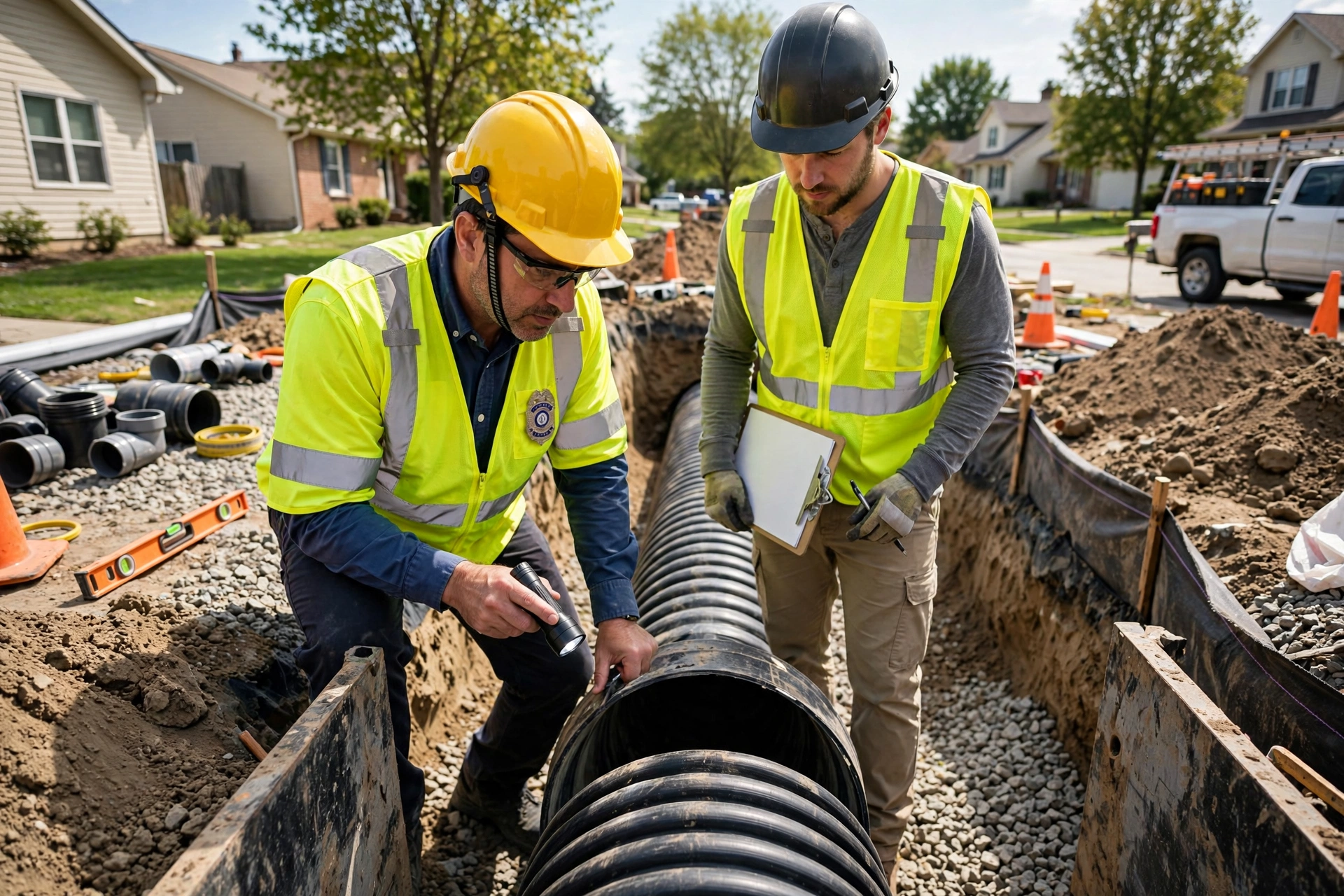
The inspection is your free quality check: the city verifies the pipe, slope, and connections before anything gets buried.
What Does the Inspector Actually Check?
The inspection is short and specific. The inspector looks at the pipe material (is it the approved type and size?), the slope (does it fall correctly toward the main so waste flows instead of sitting?), the joints and connections (are they sealed and properly made?), the bedding (is the pipe sitting on proper material, not sharp rock?), and the connection to the city main or existing line. For trenchless jobs, the inspector typically reviews the finished work and the final camera footage. This is not bureaucracy for its own sake. Every item on that list is a failure mode, and a failed inspection caught before backfill is a problem fixed for free.
What Happens If You Skip the Permit?
Four consequences, roughly in order of how fast they find you:
Stop-work orders and fines. If the city learns about unpermitted work, and neighbors notice excavation equipment, it can halt the job mid-trench and fine you per day until it is resolved.
Uncover and redo. The city can require the work to be exposed for inspection, and anything not to code gets corrected at your expense.
Home sale problems. Buyers, inspectors, and title companies ask about permits for major work. Unpermitted sewer work is a negotiation weapon in the buyer's hands, and it can delay or kill a closing.
Insurance complications. If a future claim touches that line, the insurer will ask about permits. Unpermitted work gives them a reason to say no.
The permit requirement is a tiny fraction of a sewer job. Skipping it to save a modest step risks thousands. There is no version of this math that works out.
What About Ohio 811 Utility Locates?
Separate from the permit, and equally required: Ohio law says you must call 811 at least two business days before any digging. The utility companies then mark their underground lines, gas in yellow, electric in red, water in blue, telecom in orange, for free. Your contractor usually makes the call, but the legal responsibility sits with whoever digs, so confirm it happened.
Two things homeowners miss about locates. First, the free locate only covers public utility lines up to your meter. Private lines, a sprinkler system, landscape lighting, a gas line to a detached garage or pool heater, are yours to mark or tell the contractor about. Second, the marks expire: in Ohio, a locate ticket is generally good for a limited time, so if the job gets delayed, the contractor may need to refresh it. Striking an unmarked gas line is the nightmare scenario that two free phone calls prevent.
Permit in hand before the first shovel: that is how a professional job starts.
Does Any of This Change by City?
The requirement does not change, but the details do. Columbus runs permits through its building services division; older cities with combined sewers may add requirements about the connection point; townships and villages have their own offices and requirement schedules. The right-of-way rules vary the most: some cities let the contractor restore the sidewalk, others require the city's own crew or an approved restoration spec. This is exactly why the contractor pulls the permit, not you: they do this in your city every week. If you are comparing contractors, the one who can name your city's process from memory is the one who has done it before. Ohio EPA publishes statewide wastewater information at epa.ohio.gov, but the permit for your lateral comes from your city, not the state.
Almost certainly yes. Nearly every Ohio city and village requires a permit for sewer lateral repair or replacement, and most require a city inspection before the work is covered up. Your contractor should pull the permit; you should confirm that it happened before work starts.
Yes. Trenchless methods skip the open trench, not the paperwork. Municipalities permit the work being done, not the method, so lining and bursting need permits and inspections just like traditional digging.
For a standard residential lateral, usually a few business days once the contractor submits the application. Jobs that cross into the street or public right-of-way can take longer because a separate right-of-way or street-cut permit is involved. Your contractor should build this into the schedule, not discover it on job day.
The city can issue a stop-work order and fines, require the work to be uncovered for inspection, and force corrections at your expense. Unpermitted work also surfaces during a home sale, when buyers and title companies ask for permits, and it can complicate insurance claims. The permit is the simplest part of the job; skipping it is the biggest mistake.
Yes, Ohio law requires it before any digging. Call 811 at least two business days ahead, and the utility companies mark their gas, electric, water, and telecom lines for free. The locate does not cover your private lines, like a sprinkler system or a line to a detached garage, so mention those to your contractor separately.
We Handle the Permits, the Locates, and the Inspections.
You should never have to visit a city office for your sewer repair. We pull the permits, call 811, and schedule the inspections.