Tree Root Removal in Ohio
Roots in your sewer line are a symptom, not the disease. We cut them out with mechanical augers or hydro jetting, then show you on camera exactly where they got in and what it takes to stop them for good.
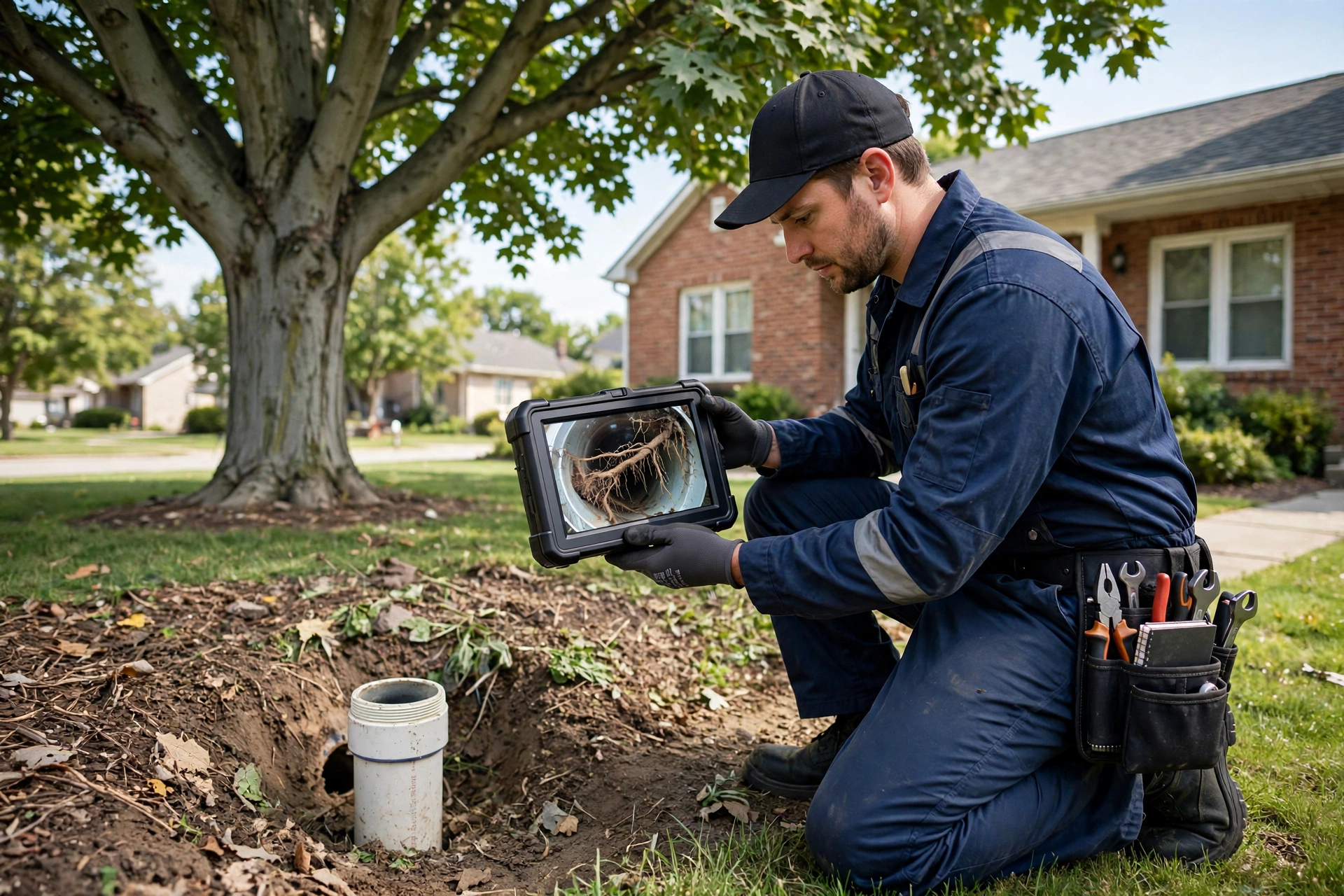
Roots in your sewer line are a symptom, not the disease. We cut them out with mechanical augers or hydro jetting, then show you on camera exactly where they got in and what it takes to stop them for good.
Last updated: October 13, 2026
Tree root removal is the clearing of tree roots from inside a sewer line, usually by mechanical cutting or hydro jetting. Roots enter through open joints and cracks in the pipe, so removal clears the symptom. The permanent fix is sealing or replacing the damaged pipe. The U.S. EPA publishes homeowner guidance on septic and sewer systems with tips for keeping private wastewater lines healthy.
Roots do not break into healthy pipes. They walk through doors the pipe already left open: separated joints, hairline cracks, and loose fittings. Once inside, they feast.
A sewer lateral is a warm, wet, nutrient-rich tunnel, and tree roots are built to find exactly that. A root hair finer than a thread detects moisture vapor escaping through a tiny gap in a joint. It grows toward it, slips through, and once it is inside the flow, it explodes into a fibrous mass that traps paper, grease, and everything else going down your drains.
Ohio makes this worse in a few specific ways. Much of the state was built out in the 1940s through the 1970s with clay tile sewer lines, and clay tile has a joint every two to three requirementt. Every one of those joints is a potential entry point, and after 50 to 70 years of Ohio freeze-thaw cycles, soil movement, and heavy clay soil that swells and shrinks with the seasons, many of those joints have shifted just enough to open a gap. A single 60-foot clay lateral can have twenty or more joints, and roots only need one.
The trees themselves are part of the story too. Ohio's older neighborhoods are lined with mature silver maples, red oaks, and Norway maples, all fast-growing species with aggressive, thirsty root systems. A silver maple in a front yard can send requirementder roots dozens of requirementt in every direction, right across the path of your sewer lateral. In spring and early summer, when growth is fastest, a root mass can double in size in a single season.
Cast iron, concrete, and Orangeburg pipe, all common in mid-century Ohio homes, develop their own openings: separating joints, cracks, and deformations that roots exploit. The material matters less than most people think. After decades in Ohio soil, most old pipes have gaps somewhere.
Roots announce themselves the same way every time: drains that slow down, get cleared, and slow down again. If that cycle sounds familiar, roots are the most likely suspect.
Here is the catch: every one of these symptoms can also come from a belly (a sagging section that holds water), heavy scale buildup, or a partially collapsed pipe. The symptoms point to the main line, but only a sewer camera inspection shows whether roots are the cause. We never recommend a fix based on symptoms alone.
There are two proven ways to clear roots, and the right one depends on how bad the infestation is. Both work through a cleanout, so neither one requires digging.
Mechanical cutting runs a steel cable with a spinning cutting head through the line. The head, usually a saw-tooth or chain-flail cutter sized to your pipe diameter, shreds the root mass and scrapes the pipe walls clean. It is fast, it handles heavy root balls well, and it works in every pipe material. For a line that is packed solid, this is almost always the first step. The limitation is precision: a cutter clears the roots, but it also roughens the pipe interior a bit, and it cannot tell you what the pipe looks like underneath. That is what the camera is for.
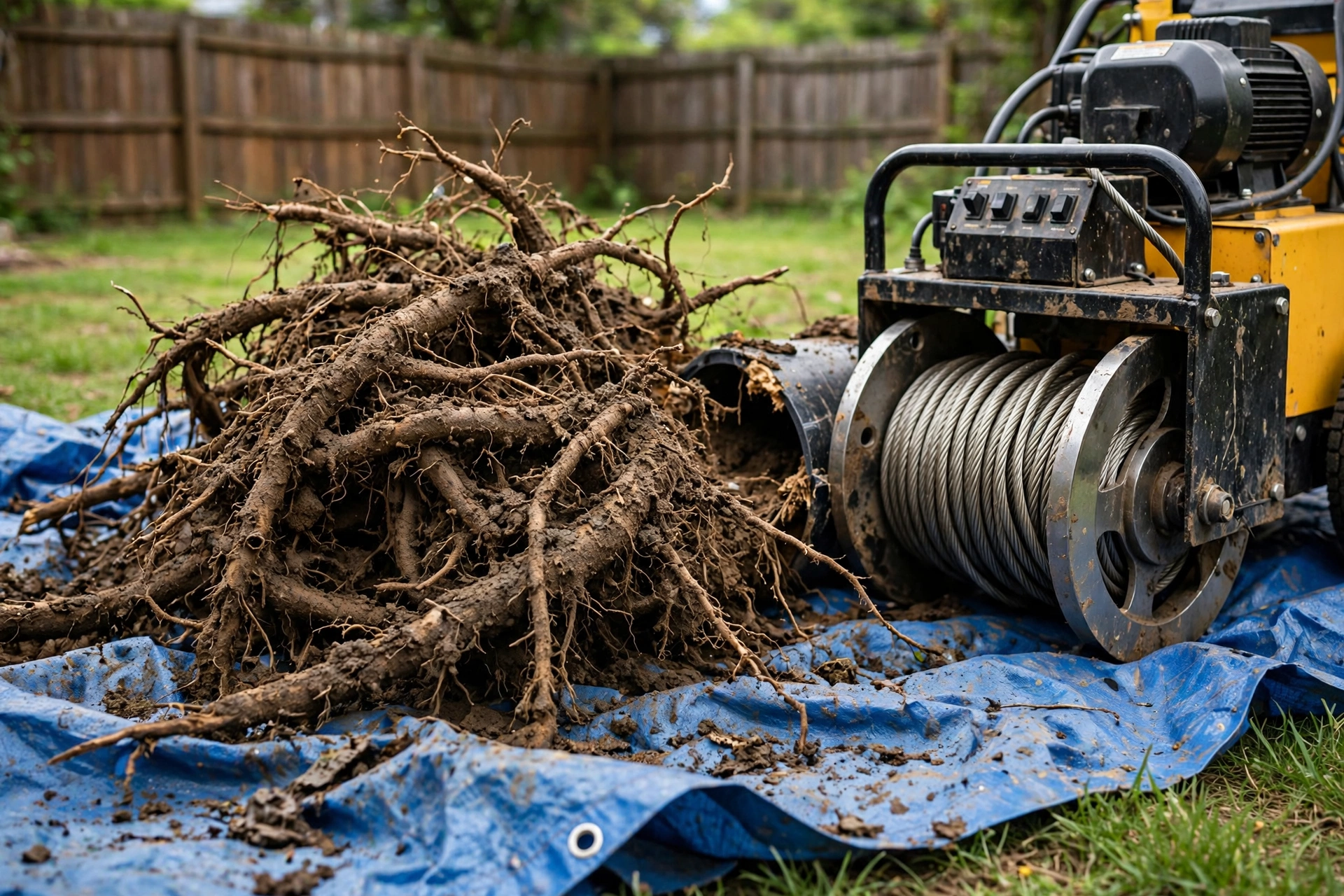
This is what comes out of a root-packed Ohio sewer line: one cutting session can pull pounds of roots from a single lateral.
Hydro jetting fires high-pressure water, typically 3,000 to 4,000 PSI, through a specialized nozzle that scours the full inside circumference of the pipe. For root masses, we use a root-cutting nozzle with forward and rear jets that slice through fibrous growth and flush the debris downstream. Jetting cleans more thoroughly than a cutter alone: it strips the fine root hairs and sludge film that a spinning head leaves behind, which buys you more time before regrowth. It is also the required prep step before pipe lining, because a liner will not bond to a dirty pipe. The honest limitation: jetting cannot fix the cracked joint the roots came through. It just cleans better.
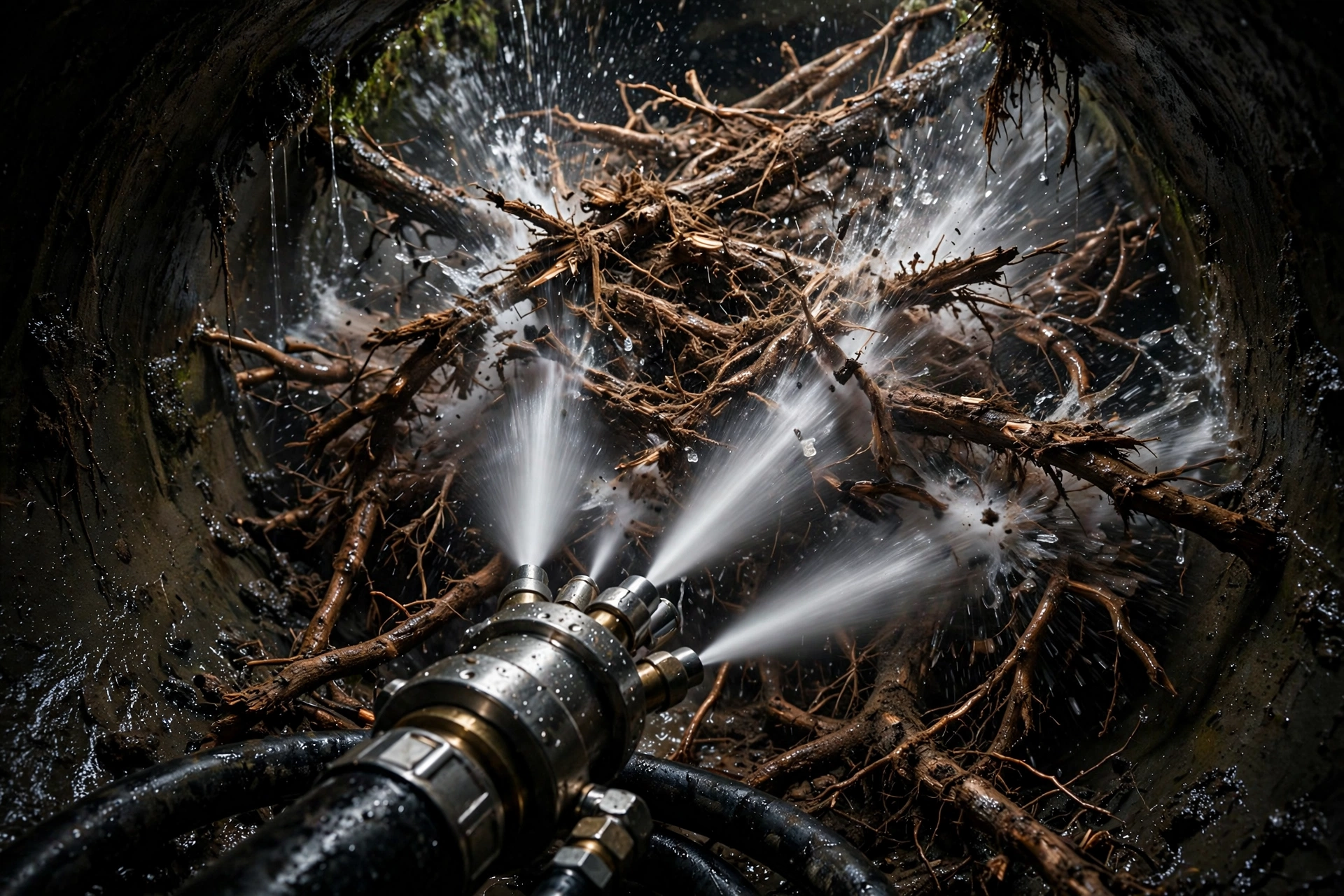
Hydro jetting scours the full circumference of the pipe, stripping the fine root hairs that mechanical cutters leave behind.
You will see foaming copper sulfate sold as a root killer. It can slow regrowth in a lightly affected line, but it does not remove an existing root mass or repair the opening, and many Ohio cities discourage it from washing into the municipal system. At best it delays the next service call; at worst it gives false confidence while the pipe keeps deteriorating. Federal rules on what reaches municipal treatment plants come from the EPA's NPDES program, which is why cities take this seriously.
| Method | How it works | Limitation |
|---|---|---|
| Mechanical root cutting | A spinning cutter on a steel cable shreds the root mass and scrapes the pipe walls | Removes the roots but leaves the entry points open, so regrowth usually returns within a year or two |
| Hydro jetting | High-pressure water scours the full inside of the pipe, stripping fine root hairs and sludge off the walls | Cleans more thoroughly than cutting, but cannot fix the cracked joint or separated joint the roots came through |
| Chemical root treatment | Foaming copper sulfate products suppress regrowth in the line | Does not remove an existing root mass or repair the opening, and many cities discourage washing it into the municipal system |
| Pipe lining or bursting | Lining creates a smooth jointless pipe inside the old one; bursting replaces the line entirely with new seamless pipe | The permanent fix, but it takes more work up front, and lining needs a pipe that still holds its shape |
No. Cutting roots is maintenance, not repair. It resets the clock, but the pipe defect that let the roots in is still there, and the tree is still there.
Here is what actually happens after a cutting. The line flows freely, so everything requirementls fixed. But severed root ends sprout multiple new shoots, the same response gardeners see when pruning, so the regrowth is often thicker than what we removed. Most Ohio homeowners who rely on cutting alone are back within a year or two, and each visit tends to find a worse infestation than the last.
Meanwhile the pipe keeps aging. The cracked joint that admitted the roots does not heal: freeze-thaw works it wider, soil keeps shifting, and every cutting cycle buys a little less time while the risk of a full basement backup keeps climbing.
So when does cutting make sense? When you need the line flowing today and you want time to plan the permanent fix. Plenty of our customers do exactly this: we clear the roots, run the camera, show them the footage, and give them a written plan for the lasting repair. They schedule that repair on their own timeline, with full information, instead of making a panicked decision during a backup. That is the smart way to use root cutting: as step one of a plan, not as the plan.
The permanent fixes are straightforward. Pipe lining creates a smooth, jointless pipe inside the old one, and roots cannot penetrate a jointless surface. Pipe bursting replaces the line entirely with new seamless pipe. A spot sewer repair replaces just the bad section when the camera proves the rest of the line is sound. All three remove the openings roots exploit, which is the only thing that actually ends the cycle.
Camera inspection first, always. We locate every root intrusion, mark its depth and position, and record the footage so you see exactly what we see.
Mechanical cutter sized to your pipe shreds the root mass and reopens the line. For heavy infestations, this is the step that restores flow.
Hydro jetting scours the pipe walls clean of fine root hairs and sludge, giving you the longest possible interval before regrowth.
Post-cleaning camera run documents the cleared line and, just as important, shows the condition of the pipe underneath: the cracks and joints the roots used.
You get the footage, a plain-language explanation of what we found, and a written plan for the permanent fix. No pressure, no same-day hard sell.
Anyone quoting a plan without seeing your line is guessing. Root cutting is usually one of the more straightforward sewer services, but the permanent repair is a separate conversation.
What moves the plan of a root removal visit:
The bigger work question is the one most companies dodge: how many more cutting visits before a permanent repair is worth it? We will do that math with you openly. Our full breakdown of repair work across Ohio is in our sewer line repair guide. And the only number that matters is yours: call (614) 350-5706 for a camera inspection and a written, fixed plan.
Yes, in most cases. Cutting removes the roots inside the pipe, but the opening they came through is still there, and the tree is still there. Roots typically start growing back within months, and the regrowth is often thicker because the cut ends sprout multiple new shoots. That is why we treat cutting as a reset, not a cure: it buys time while you plan the permanent fix, like lining or replacing the damaged section.
Yes. Mechanical cutting and hydro jetting both work through an existing cleanout or an access point we create, so there is no digging to remove the roots themselves. Digging only enters the picture if the pipe needs a permanent repair afterward, like a spot repair or a full replacement. Many homeowners get the roots cleared first and schedule the repair separately.
You can, and some homeowners do, but the math usually stops working. A yearly root cutting keeps the line open, yet the pipe keeps aging, the roots keep returning, and one year the snake punches through and the line backs up anyway. Compare the work of repeated service calls over five years against a one-time lining or spot repair that ends the cycle. If the camera shows the rest of the line is sound, a single permanent fix almost always wins.
Almost never. The problem is not the tree, it is the pipe. A sound, jointless pipe can sit next to a hundred-year-old oak and never get a root inside. Removing the tree is drastic, it hurts your property, and it does not fix the cracked joint the next tree's roots will find. Fix the pipe with lining, bursting, or a spot repair, and the tree can stay.
The symptoms overlap with other sewer problems, so you cannot tell from inside the house. Slow drains that keep returning, gurgling toilets, and backups that follow heavy rain all point to the main line, but only a camera inspection shows whether roots, a belly, scale, or a collapse is the cause. The inspection takes under an hour and shows you the answer on a screen.
Root removal starts with a sewer camera inspection to confirm roots are the real problem, and it usually ends with a permanent fix: pipe lining to seal the joints roots exploit, or a spot sewer repair for one bad section. For a line failing everywhere, our trenchless repair options replace it without tearing up the yard.
Get the line cleared and see the camera footage that shows exactly where they are getting in. Then decide on the permanent fix with real information.
Call (614) 350-5706