Ohio's older homes are full of aging cast iron, and it fails from the inside out. We replace deteriorated cast iron with modern PVC, inside the house and out to the street, with a camera survey that proves what actually needs replacing.
Cast iron pipe replacement is the removal of deteriorated cast iron drain pipe and its replacement with modern PVC. It becomes necessary because cast iron does not fail all at once: it corrodes from the inside out over decades, losing wall thickness a fraction of a millimeter at a time, until the pipe that looks solid from the outside is paper-thin or perforated.
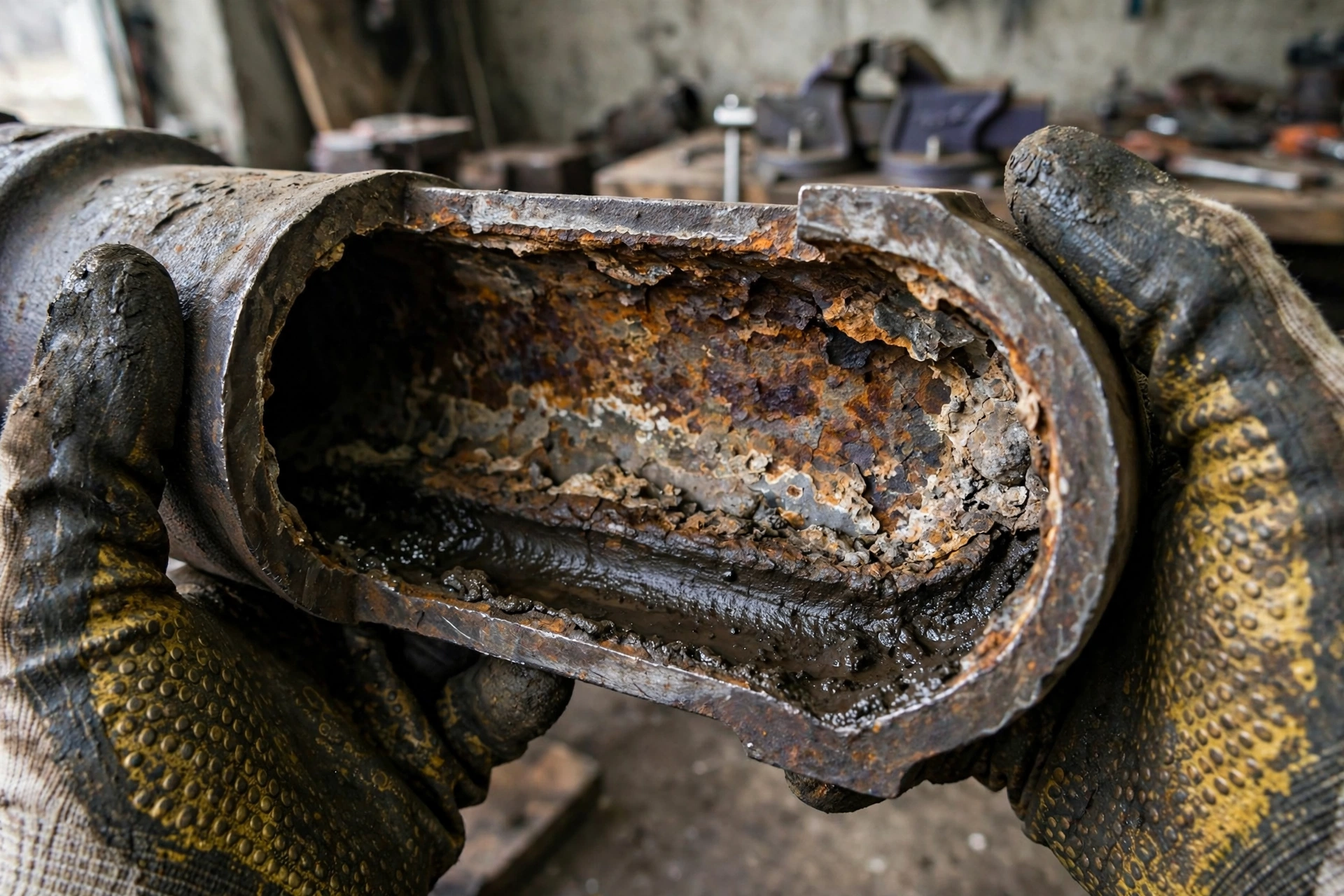
The process starts with tuberculation, the bumpy rust nodules that grow inside the pipe. They build into a rough scale that does two kinds of damage. First, it narrows the pipe: a four-inch cast iron line can lose a third or more of its diameter, which is why old cast iron drains slow down gradually. Second, wastewater flows along the bottom, so the bottom corrodes fastest and channels: a worn groove where the wall thins until it cracks or collapses.
Ohio conditions accelerate all of this. Many Ohio homes have moderately hard water, and mineral content requirementds scale formation. Basements keep interior pipe in damp air year-round. Exterior laterals sit in clay soil that holds moisture against the pipe and shifts with freeze-thaw cycles, working the old hub-and-spigot joints until they separate. And modern drain chemistry has not helped: decades of harsh chemical cleaners etch the interior and speed the whole process.
This is what aging cast iron looks like inside: tuberculation, scale narrowing the pipe, and channeling worn along the bottom where wastewater flows.
The joints fail on their own schedule. Old cast iron used hub-and-spigot joints packed with oakum and sealed with lead, and after 60 or 80 years that packing deteriorates. Joints loosen, shift, and open gaps that leak wastewater into the surrounding soil and let in roots and groundwater. A line can have solid pipe walls and still fail at every joint, which is why the camera survey matters more than any rule of thumb about pipe age. Keeping wastewater contained protects the soil and groundwater around your home; the EPA's guidance on septic and onsite wastewater systems explains why containment matters.
How Long Do Different Sewer Pipe Materials Last?
Cast iron is one of several materials found in Ohio sewer lines. Here is how they compare on typical lifespan and their most common weakness:
Material
Typical lifespan
Common weakness
Cast iron
50 to 75 years
Internal corrosion and scale buildup (tuberculation)
Clay (vitrified clay tile)
50 to 60 years
Root intrusion at joints, cracking
PVC
50 to 100 years
Joint separation if poorly bedded
ABS
50 to 80 years
Brittleness with age, failed solvent joints
Orangeburg
30 to 50 years
Deformation and collapse under soil pressure
What Are the Signs Your Cast Iron Is Failing?
Cast iron gives plenty of warning before it fails completely. The trouble is that the warnings look like ordinary drain problems, so homeowners treat the symptom for years while the pipe keeps deteriorating.
Chronic slow drains that snaking never really fixes. A snake clears a path through scale, but the scale is the pipe itself corroding. When drains slow down again within months, the interior is closing in.
Rust flakes or grit in the line. If a plumber's cable comes back with rust scale, or you see reddish grit around a floor drain, the pipe wall is shedding. That material used to be your pipe.
Persistent sewer odor in the basement. Corroded-through spots and failed joints vent sewer gas. In Ohio basements, where the main stack and lateral connections live, this is often the first sign anyone notices.
Damp spots, stains, or leaks on basement ceilings and walls. Interior cast iron runs through ceilings and walls. Pinhole leaks from internal corrosion show up as stains long before they show up as drips.
Frequent clogs in the same fixtures. Scale creates a rough interior that snags paper and waste. When the same toilet or tub clogs repeatedly and nothing else explains it, the pipe surface is the problem.
A plumber tells you the pipe is "closing up." That phrase means scale has narrowed the line significantly. It is a late-stage warning, not an early one.
Any one of these deserves a sewer camera inspection. The camera shows the actual wall condition, the scale thickness, and whether the pipe still has structural life or is past saving. Everything downstream of that inspection, descaling or replacement, follows from what the footage shows.
Replacement or Descaling: Which Do You Need?
Not every aging cast iron pipe needs to be replaced. When the pipe still has structural wall thickness, descaling restores it. Replacement is for pipe that is structurally finished.
Pipe descaling is the restoration option. A specialized milling head travels through the line and grinds the tuberculation and scale off the interior walls, returning the pipe to near-original diameter and smooth flow. It is the right call when the camera shows heavy buildup but the pipe walls are still thick, the joints are holding, and there is no channeling or cracking. Descaling is simpler than replacement, disrupts less, and buys a structurally sound pipe many more years of service. We recommend it whenever the pipe qualifies, because it is the honest answer for pipe that still has life in it.
Replacement is the answer when the camera shows the pipe is done: walls worn paper-thin, channeling grooved along the bottom, cracks, holes, collapsed sections, or joints separated beyond what any restoration can fix. At that point descaling would just polish a pipe that is about to fail, and the money is better spent on new pipe. The camera makes this a clear call, not a judgment call: you can see the wall thickness, or the lack of it, on the screen.
There is also a common middle case. The camera shows a line that is mostly sound but has one or two sections that are finished: a badly channeled stretch, a cracked joint, a collapsed hub. That is a sectional replacement, not a full one. We replace the failed sections with PVC, tie into the sound cast iron on both sides with proper transition couplings, and leave the good pipe alone. This is where an honest camera survey saves real money, because it separates the sections that need replacing from the ones that just need descaling or nothing at all.
Our rule: we descale what can be saved and replace what cannot, and we show you the footage that puts each section in its category. If another company plans a full replacement without a camera survey, get the survey before you sign.
What Happens During a Cast Iron Replacement?
Cast iron replacement covers two different territories, interior pipe inside the house and the exterior lateral underground, and they are different jobs with different methods.
How do you replace interior cast iron?
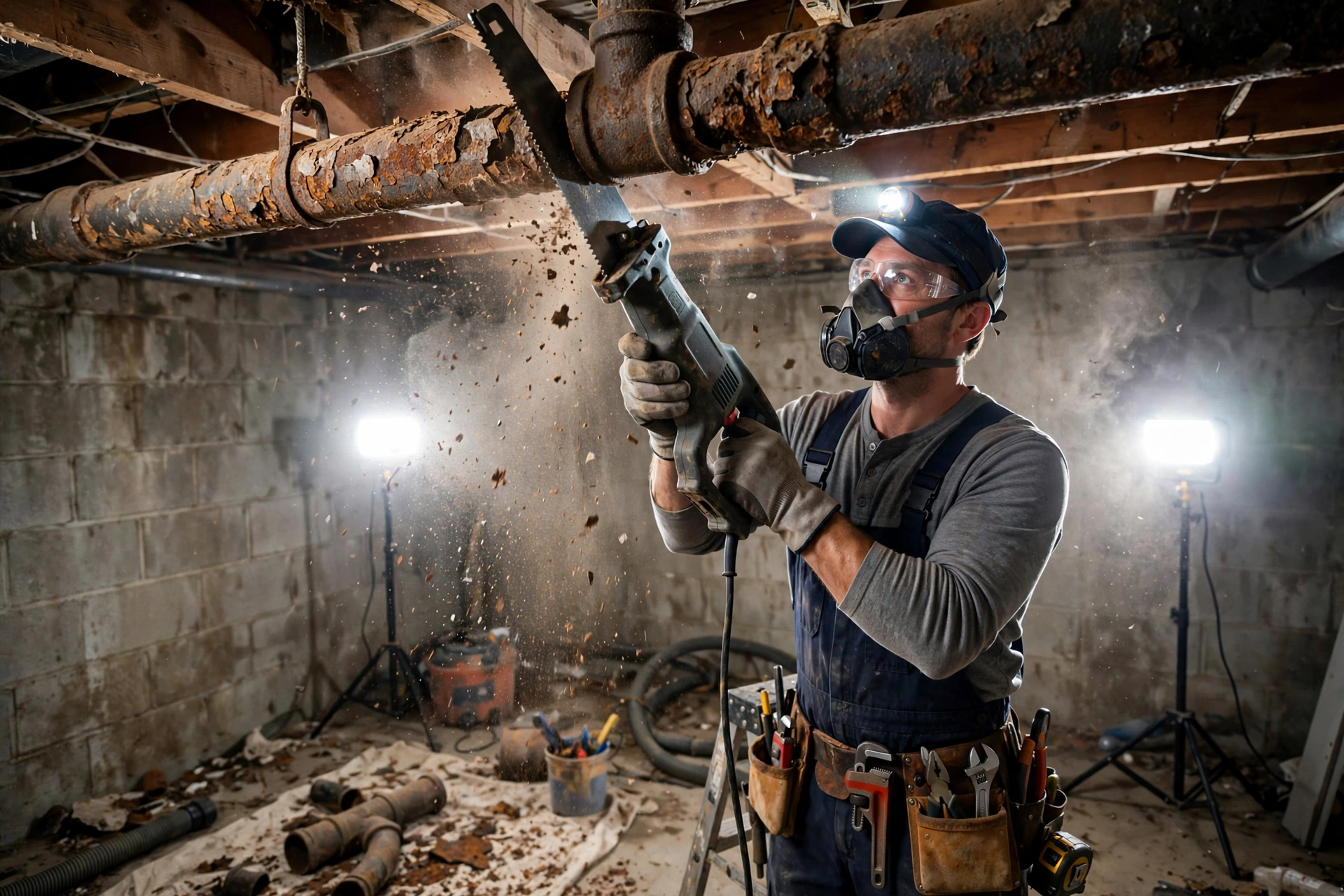
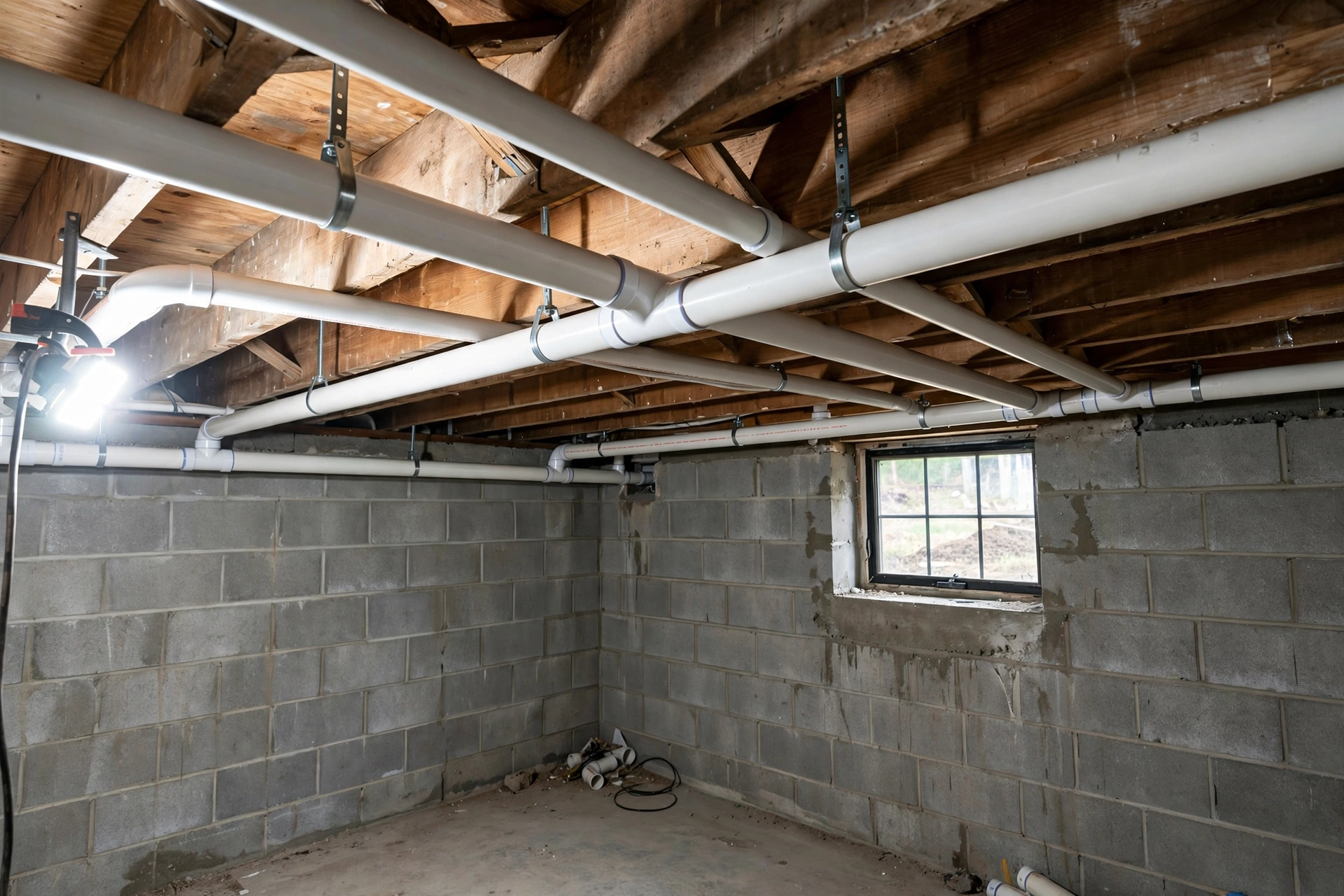
Interior replacement targets the stacks, branches, and horizontal runs inside the home, most often in basements with exposed ceilings. We map the runs from the camera survey, cut the old cast iron out in sections, and install new PVC with proper hangers, slope, and fittings. Where pipe runs inside finished walls, we cut neat access openings at the pipe locations only and close them up afterward. New PVC gets solvent-welded joints that will never separate the way old hub joints did. Most interior replacements take one to three days.
New PVC goes in with proper hangers and slope: smooth, joint-sealed, and immune to the corrosion that finished the old cast iron.
How do you replace the exterior cast iron lateral?
The underground lateral gets the same options as any sewer line replacement. When the old cast iron is collapsed or heavily deformed, traditional excavation replaces it with new PVC, bedded in stone and backfilled in compacted lifts. When the pipe still roughly holds its shape, trenchless methods apply: pipe lining creates a new jointless pipe inside the old cast iron, and pipe bursting shatters the old line while pulling new pipe through the same path. Our trenchless sewer repair page walks through both methods. The camera survey decides which approach fits your line. Ohio municipalities inspect the work, which we schedule as part of the job, under statewide wastewater rules published by the Ohio EPA.
What about the noise difference with PVC?
Worth an honest mention: cast iron is quiet, and wastewater running through PVC is more audible. In basements, utility rooms, and exterior lines, nobody notices. Where new PVC runs inside a bedroom or living-room wall, we wrap the pipe with insulation to dampen the sound. It is a small detail, but it is the kind of thing you appreciate at 2 a.m., so we bring it up before you have to ask.
What Happens on Replacement Day? Our 5 Steps
Survey
Camera inspection maps every run: wall condition, scale, channeling, joint state. We mark exactly which sections need replacing and which can stay.
Permit
We pull the municipal plumbing permit. Ohio cities require permits for drain replacements, and inspections happen before walls close or trenches backfill.
Remove
Old cast iron comes out in sections. Interior work uses contained cutting with dust control; exterior work opens the planned excavation or trenchless access.
Install
New PVC goes in with proper slope, hangers, and sealed joints, tied into sound existing pipe with code-approved transition couplings. Inspection here.
Restore
Access openings closed, trenches backfilled in compacted lifts, surfaces restored. Final camera run proves the new pipe flows cleanly end to end.
What Does Cast Iron Pipe Replacement Involve in Ohio?
Cast iron replacement spans a wide range because "cast iron replacement" covers everything from one basement run to a full house plus the lateral. Honest key factors, not invented plans:
Interior vs. exterior. Interior basement runs with exposed ceilings are the most straightforward. The exterior lateral adds excavation or trenchless work, depth, and length to the equation.
How much pipe. One failed section work a fraction of a whole-house repipe. The camera survey defines the scope, and the scope defines the plan.
Access. Exposed basement ceilings are easy. Pipe buried in finished walls or under slabs needs access openings or concrete work, which adds labor.
Depth and length outside. Laterals under Ohio basements often run eight to ten requirementt deep, and runs to the city main can stretch 50 to 100 requirementt. Both drive the exterior portion of the plan.
What stays. Every section the camera proves sound is a section you do not need to replace. A good survey does not just find the bad pipe, it protects the good pipe from unnecessary work.
Our Ohio sewer repair guide breaks down work ranges for every type of sewer work. For your exact number, call (614) 350-5706: the camera survey gives us everything needed for a fixed written plan, and it tells you whether you need replacement, descaling, or just one section.
What Are the Most Common Questions About Cast Iron Replacement?
Cast iron drain pipe was designed for a service life of roughly 50 to 80 years, and in practice the range is wide. Pipe from the 1920s in dry soil can still be solid, while pipe from the 1960s in aggressive soil or with heavy chemical exposure can be failing at 50. Most Ohio homes with original cast iron are now inside or past that window, which is why failures are so common. The camera, not the calendar, gives the real answer for your pipe.
Yes, and we do it often. If the camera shows one badly corroded section or one failed joint while the rest of the pipe still has wall thickness and smooth flow, a sectional replacement is the smart move. But cast iron tends to fail systemically: when one section is paper-thin, the neighboring sections are usually not far behind. We show you the footage for the whole run so you can see whether you are fixing one section or buying time on all of them.
For residential drains, yes in almost every way that matters. PVC never corrodes, its smooth interior resists buildup, and its solvent-welded or gasketed joints do not separate the way old hub-and-spigot cast iron joints do. The one honest tradeoff is noise: cast iron is quieter, and waste running through PVC in a wall is more audible. In basements and utility areas nobody notices, and in living-space walls we can add insulation around the pipe to dampen the sound.
It requires access openings, but not demolition. In basements with exposed ceilings, we often replace the pipe with no wall openings at all. Where pipe runs inside finished walls, we cut neat, minimal access panels at the pipe locations, replace the run, and close them back up. We plan the openings from the camera and layout survey so there are no exploratory holes, and we discuss the patching plan with you before work starts.
Descaling is restoration: it mills the scale and corrosion off the inside of the pipe and returns it to near-original flow capacity, which makes sense when the pipe still has structural wall thickness. Replacement is for pipe that is structurally finished: paper-thin walls, channeling through the bottom, cracks, or collapses. A camera inspection shows which category your pipe is in, and we recommend descaling whenever the pipe qualifies because it is simpler and disrupts less.