Sewer Line Repair in Toledo, OH
Clay tile under Victorian brick, lake-plain clay that holds water, and a river that pushes back. We camera-diagnose every Toledo job and fix it trenchless or traditional.
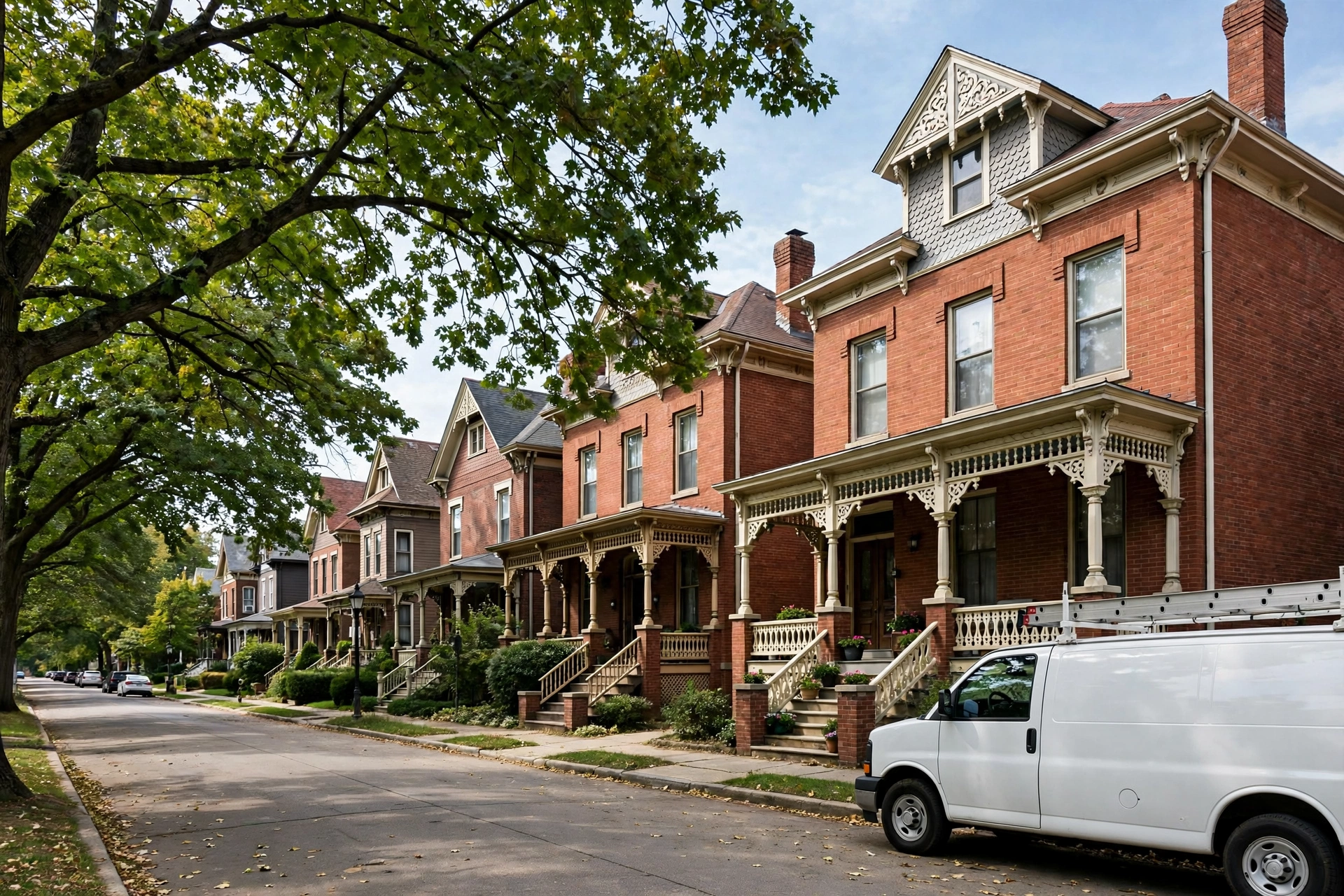
Clay tile under Victorian brick, lake-plain clay that holds water, and a river that pushes back. We camera-diagnose every Toledo job and fix it trenchless or traditional.
Last updated: October 13, 2026
Toledo is flat. That sounds harmless. Underground, flat ground plus heavy clay soil is one of the toughest combinations a sewer line can face.
The whole Toledo metro sits on the old lakebed of Lake Erie, a sheet of dense, slow-draining clay that stretches for miles. Water does not move through it; it sits in it. That means a Toledo sewer lateral spends its life in saturated soil, and every winter brings the same freeze-thaw beating: water seeps into hairline cracks and mortar joints, freezes, expands, and wedges the crack wider, then thaws and lets soil wash in. Run that cycle for decades and even solid pipe gives way.
Flat ground creates a second problem: slope. Sewer lines need pitch to carry solids, and on Toledo's nearly level lake plain, laterals often run shallow with barely enough fall. Solids settle in the low spots, grease builds up, and a small joint offset that would be a non-event on a hill becomes a full blockage. It's also why backups surface in basements so fast here. There is nowhere lower for the water to go.

The Maumee River runs through Toledo, and when river levels rise, groundwater presses into every cracked sewer joint nearby.
Drive through the Old West End and you're looking at brick Victorian homes built between the 1870s and 1920s, and sewer laterals to match. The typical line from that era is vitrified clay tile with mortar-sealed joints, running from a brick foundation wall out to the street. A century later, the mortar has crumbled, the clay sections have shifted in the swelling and shrinking soil, and the neighborhood's big old trees have spent decades threading roots into every damp joint.
Head west and the housing changes. West Toledo's post-war ranches and the streets near Ottawa Hills tend toward cast iron inside transitioning to clay outside, and cast iron rusts from the inside out: fine on the outside until the bottom of the pipe is paper-thin. The Warehouse District and the neighborhoods around downtown mix eras and materials, which is exactly why we never guess. The camera shows what's down there in about an hour, no matter what decade the house went up.
Toledo's drinking water comes from Lake Erie, and the western basin sits over limestone and dolomite bedrock that loads the water with dissolved calcium and magnesium. That mineral content leaves scale on fixtures, and inside old cast iron and clay pipe it does the same, narrowing the bore and giving grease and solids a rough surface to catch on. On Toledo's flat, low-slope laterals, a narrowed pipe plus settled solids is a reliable recipe for a backup.
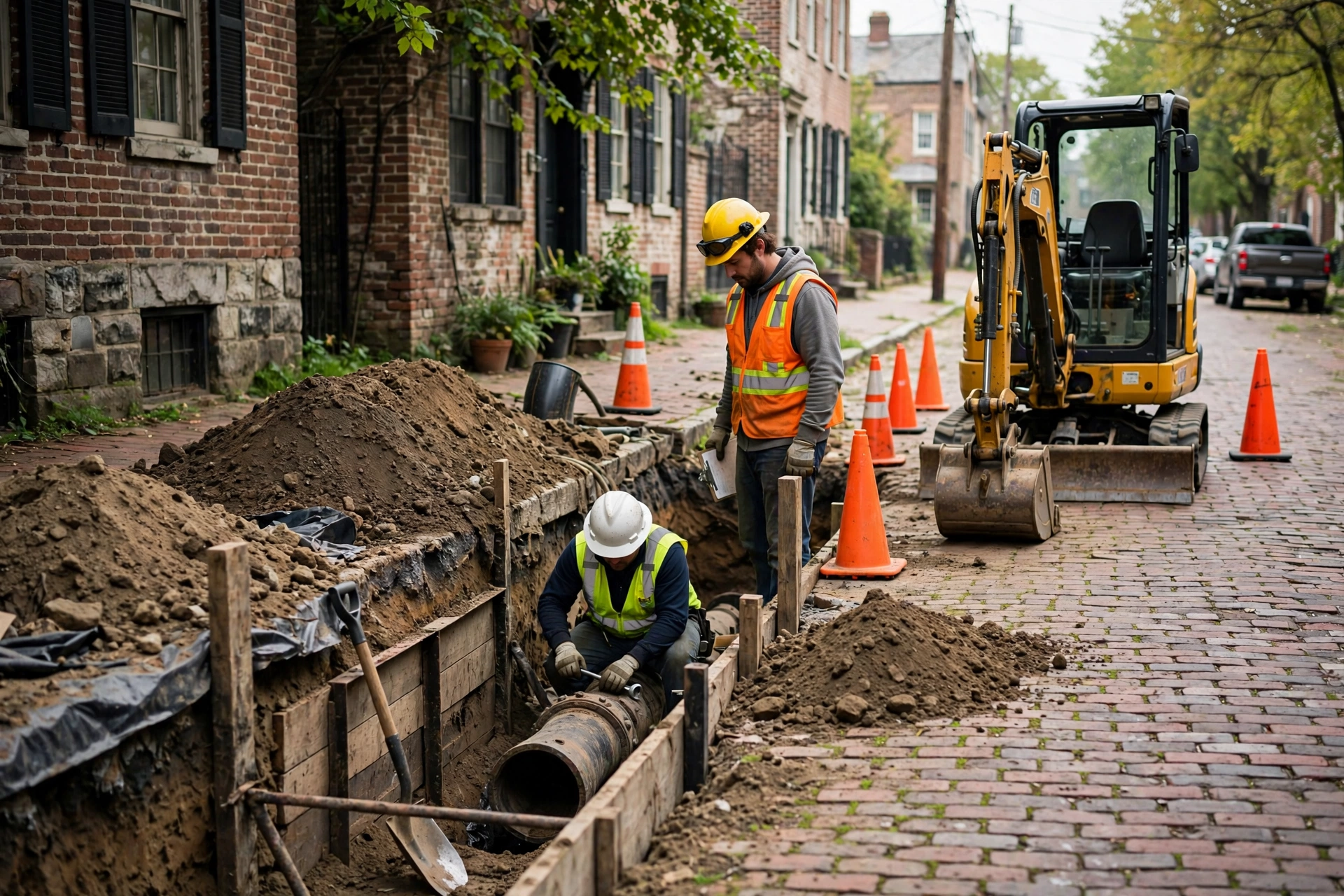
Old brick streets and century-old laterals go together in Toledo's historic neighborhoods, we repair both trenchless and open-trench.
The river doesn't have to flood your street to cause sewer trouble. When the Maumee River runs high, the water table along its banks rises with it, and groundwater presses into every cracked joint and separated connection in your lateral. The line fills from the outside in, a process called infiltration, and suddenly your sewer is carrying far more water than it was designed for.
Point Place requirementls this the hardest. Sitting nearly at lake level at Toledo's northern tip, the water table there is always close to the surface, and when Lake Erie runs high or spring rains saturate the ground, basements are the first place a failing lateral shows itself. East Toledo's river-adjacent streets see the same pattern. If your drains slow down in the weeks after high water, infiltration is the likely culprit, and our trenchless sewer repair options can seal the entry points without digging up your yard.
Older parts of the city still run combined sewers that carry sewage and stormwater in one pipe; about a quarter of the city's sewered area is served by them, per the city's published water and sewer utility overview. When heavy rain overwhelms a combined line, the mixture can back up or discharge untreated, which is why the U.S. EPA's combined sewer overflow page is worth a read if your basement backs up in wet weather.
The City of Toledo's Department of Public Utilities runs the city's water and sewer systems. For sewer lateral repair or replacement, permits run through the city, and an inspection is typically required before backfill. We pull the permits and coordinate the inspection as part of every job.
To look up your utility account, billing, or service details, start at the Department of Public Utilities customer service page on toledo.oh.gov. If you are unsure which permits your project needs, check with the city's building department before work begins.
Toledo's drinking water comes from Lake Erie, and the western basin sits over limestone and dolomite bedrock that loads the water with dissolved calcium and magnesium. That mineral content leaves scale inside old cast iron and clay pipe, narrowing the bore so grease and solids catch, and on Toledo's flat ground a narrowed pipe backs up sooner. A camera inspection maps the buildup, and hydro jetting or a lining restores the line.
Follow the seasons, not the calendar. In Toledo, the smart routine is a fall camera inspection before freeze season, close attention to drains during spring rains and high water, and keeping roots and grease out of the line all year. Here is how each season plays out:
Our Toledo crews cover the metro from the lake to the turnpike. The housing, and the pipe problems, change by neighborhood: the Old West End's century-old brick Victorians with original clay laterals; the Warehouse District's mixed-era lines; Point Place's high-water-table infiltration; West Toledo's aging cast iron ranches; East Toledo's river-adjacent streets; and the streets bordering Ottawa Hills with their big trees and deep root systems. Our crews work across the metro in ZIP codes 43604, 43606, 43607, 43612, and 43615.
You'll find us working around the Toledo Museum of Art, down by the Toledo Zoo, near Fifth Third Field downtown, and out by the Veterans' Glass City Skyway. Wherever the lateral runs in the Toledo metro, the process is the same: camera first, honest diagnosis, upfront plan. Start from our Ohio homepage or see our neighbors in Oregon, Sylvania, and Perrysburg.
Most likely vitrified clay tile with mortar joints, running from your brick foundation out to the street. After a century, the joints crumble, sections shift in Toledo's heavy clay soil, and roots from the neighborhood's mature trees push in. A camera inspection shows exactly what you're working with, and many Old West End laterals are good candidates for trenchless lining.
Point Place sits nearly at lake level, so the water table is always close to the surface. When Lake Erie runs high or spring rains saturate the ground, groundwater presses into every cracked joint in your lateral and the line fills from the outside in. Fixing the cracks, by lining or replacement, stops the infiltration at the source.
Yes. Sewer lines need slope to carry solids, and on Toledo's pancake-flat lake plain, laterals often run shallow with barely enough pitch. Solids settle, grease builds up, and small offsets become big blockages. It also means backups surface in basements fast, because there is nowhere lower for the water to go.
The City of Toledo's Department of Public Utilities maintains the public sewer mains. If several homes on your street back up at the same time, or you see a sinkhole forming over the street, report it to the city. If only your home is affected, the problem is most likely in your private lateral between the house and the main, and that is where a camera inspection starts.
Probably. Cast iron rusts from the inside out, so the pipe looks fine from the outside until the bottom is paper-thin. West Toledo's post-war ranches are hitting the age where that inside-out corrosion starts failing. A camera inspection shows the true condition, and if the pipe has lost its shape, pipe bursting replaces it entirely.
Also serving Oregon, Sylvania, Perrysburg, Maumee, Rossford, and the greater Toledo metro. Landmarks we work around include the Toledo Museum of Art, the Toledo Zoo, Fifth Third Field, and the Veterans' Glass City Skyway.
One inspection, one honest diagnosis, one upfront plan, anywhere in the Toledo metro.
Call (614) 350-5706