How Long Do Sewer Lines Last? A Guide by Pipe Material
Your sewer line's lifespan depends almost entirely on what it is made of. Here is how long each pipe material typically lasts, what cuts that life short in Ohio, and how to find out what is under your yard.
Industry sources generally cite these ranges for residential sewer pipe, with real-world results depending on soil, installation quality, and maintenance:
Pipe material
Typical lifespan
Key weakness
Common era in Ohio homes
Clay tile (vitrified clay)
50–100 years
Open joints invite roots; soil movement shifts joints
Pre-1960
Cast iron
50–75 years
Corrodes inside and out; scale narrows the pipe
1900s to 1970s
Orangeburg (bituminized fiber)
30–50 years
Absorbs water, softens, deforms, and collapses
1945–1972
Concrete
50–100 years
Sewer gas converts to acid that eats the pipe crown
Early-mid 1900s
PVC
75–100+ years
Poor installation or shifting soil can cause bellies or separations
1980s to today
ABS
50–80 years
Shorter track record; same installation risks as PVC
1970s to 1990s
Read these as general industry knowledge, not promises. A clay tile line in stable soil with no tree roots nearby can outlive a cast iron line in aggressive soil by decades. What matters is your specific line, its condition, and the ground it sits in. Ohio's freeze-thaw winters, heavy clay soil, and mature tree canopy all push real-world lifespans toward the lower end for the older materials.
How Long Does Clay Tile Pipe Last?
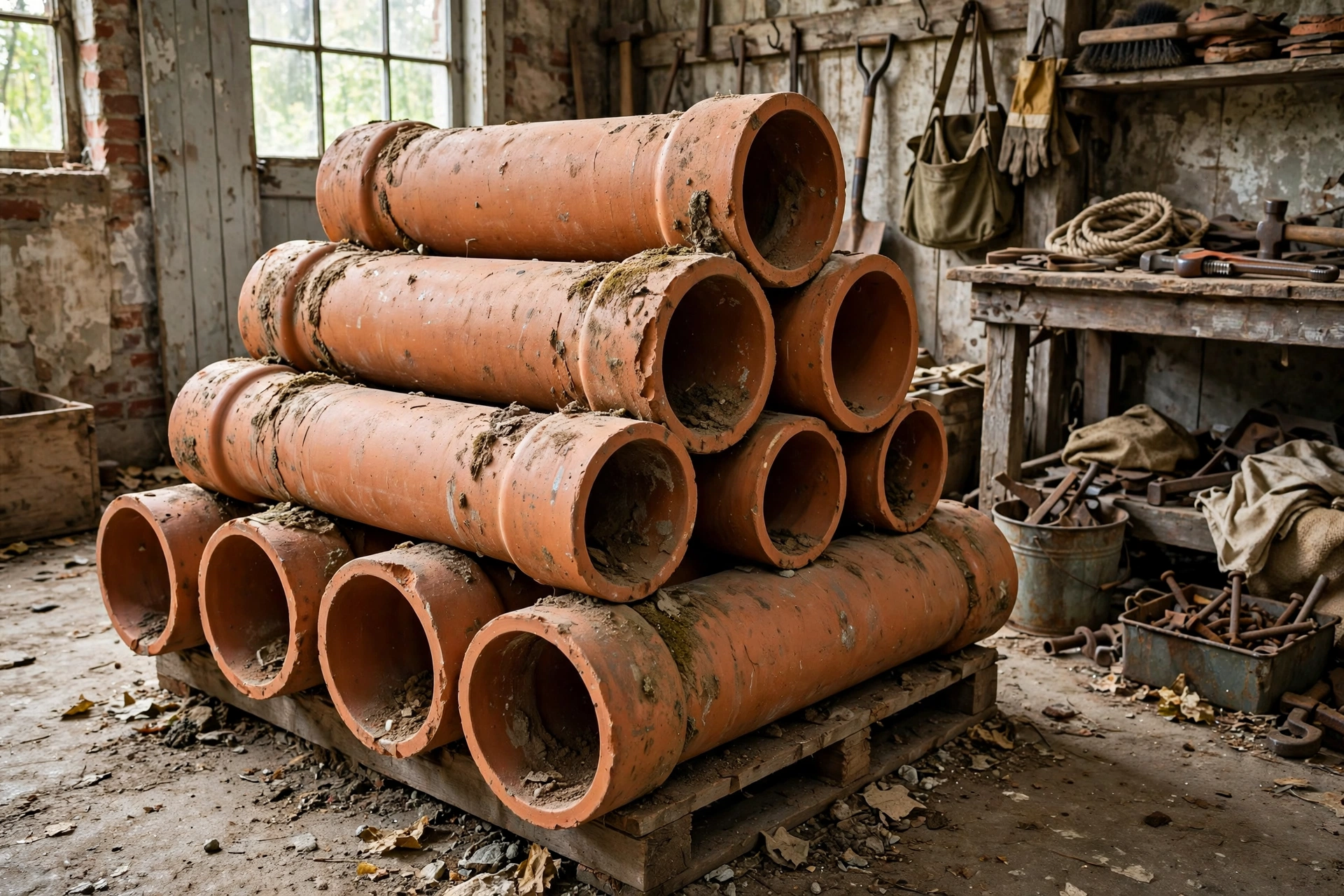
Clay tile is vitrified clay pipe that typically lasts 50–100 years, and it sits under a huge share of Ohio homes built before about 1960. The clay itself is nearly indestructible: it does not rust, rot, or corrode. That is the good news. The bad news is that clay tile came in short sections, usually two or three requirementt long, with a joint at every connection. A 60-foot line can have 25 or more joints, and every one is an invitation for tree roots and soil movement.
In Ohio, two things attack those joints. First, mature maples and oaks, the trees that line streets in Cleveland, Columbus, and Dayton, send roots into any tiny gap, and the roots grow thicker year after year until they block the pipe. Second, Ohio's clay soil swells when wet and shrinks when dry, and that seasonal movement can shift joints out of alignment. Freeze-thaw cycles add more movement on top. This is why a sewer camera inspection on a clay tile line often shows root intrusion at the joints while the pipe itself looks fine.
Clay tile in decent structural shape is one of the best candidates for pipe lining (CIPP): the liner seals every joint, blocks roots, and gives the old line decades more life without digging.
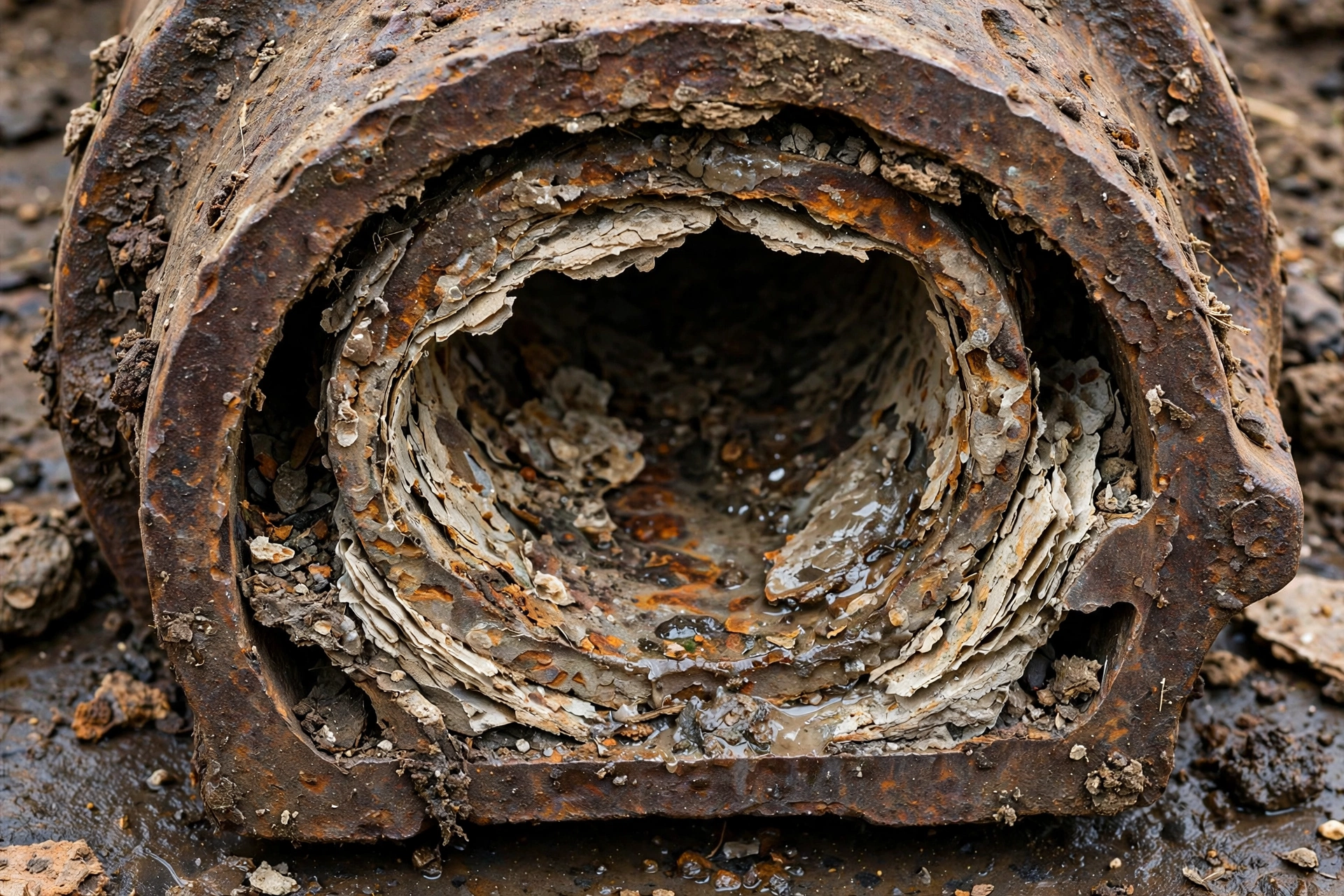
Cast iron fails from the inside out: scale builds up, flow narrows, and the wall eventually rusts through.
How Long Does Cast Iron Pipe Last?
Cast iron pipe is a metal pipe that typically lasts 50–75 years. It was the standard from the early 1900s through the 1970s, and in Ohio it often runs under the basement slab before connecting to the line out to the street. Unlike clay, cast iron corrodes. Inside the pipe, wastewater and sewer gases eat at the wall and lay down scale, a rough crust of rust and mineral deposits that narrows the pipe year by year. Outside, soil moisture works on the exterior. The industry generally cites 50–75 years, and many Ohio cast iron lines installed in the 1950s are at or past that mark now.
Cast iron's signature symptom is slow drainage that gets gradually worse, not a sudden blockage. The pipe is not blocked; it is shrinking from the inside. A camera inspection shows the telltale rough, flaky interior. Options depend on condition: pipe descaling and milling can restore flow in moderately scaled lines, lining can renew them, and badly deteriorated sections need cast iron pipe replacement. Under-slab cast iron is one of the most disruptive repairs, which is exactly why catching it with a camera early is worth it.
How Long Does Orangeburg Pipe Last?
Orangeburg is bituminized fiber pipe that typically lasts 30–50 years, which means every Orangeburg line in Ohio is now past its expected end. It was a simple substitute used from the mid-1940s through about 1972, and it shows up in post-war ranch subdivisions all over Ohio. The problem is fundamental: the material absorbs water, softens, deforms into an egg shape, blisters, and eventually collapses under soil pressure. Industry sources cite a 30–50 year life, which means virtually every Orangeburg line in Ohio is past its expected end.
Orangeburg rarely candidates for lining because the pipe has lost its round shape, and spot repairs usually fail within a few years since the rest of the line is aging at the same pace. The standard fix is pipe bursting or traditional replacement. If your home was built between 1945 and 1972, a camera inspection is the only way to know for sure what you have.
How Long Does Concrete Sewer Pipe Last?
Concrete sewer pipe is a cement-based pipe that typically lasts 50–100 years. It was used for larger lines in the early to mid-1900s, and you still find it in older commercial laterals and some residential main connections. The material is strong and the industry cites 50–100 years, but concrete has a specific enemy: hydrogen sulfide gas from sewage. The gas converts to sulfuric acid on the pipe crown and eats it from the top down. Joints in concrete pipe can also leak and shift like clay tile. When it fails, it tends to fail structurally, and replacement is usually the answer.
How Long Do PVC and ABS Pipes Last?
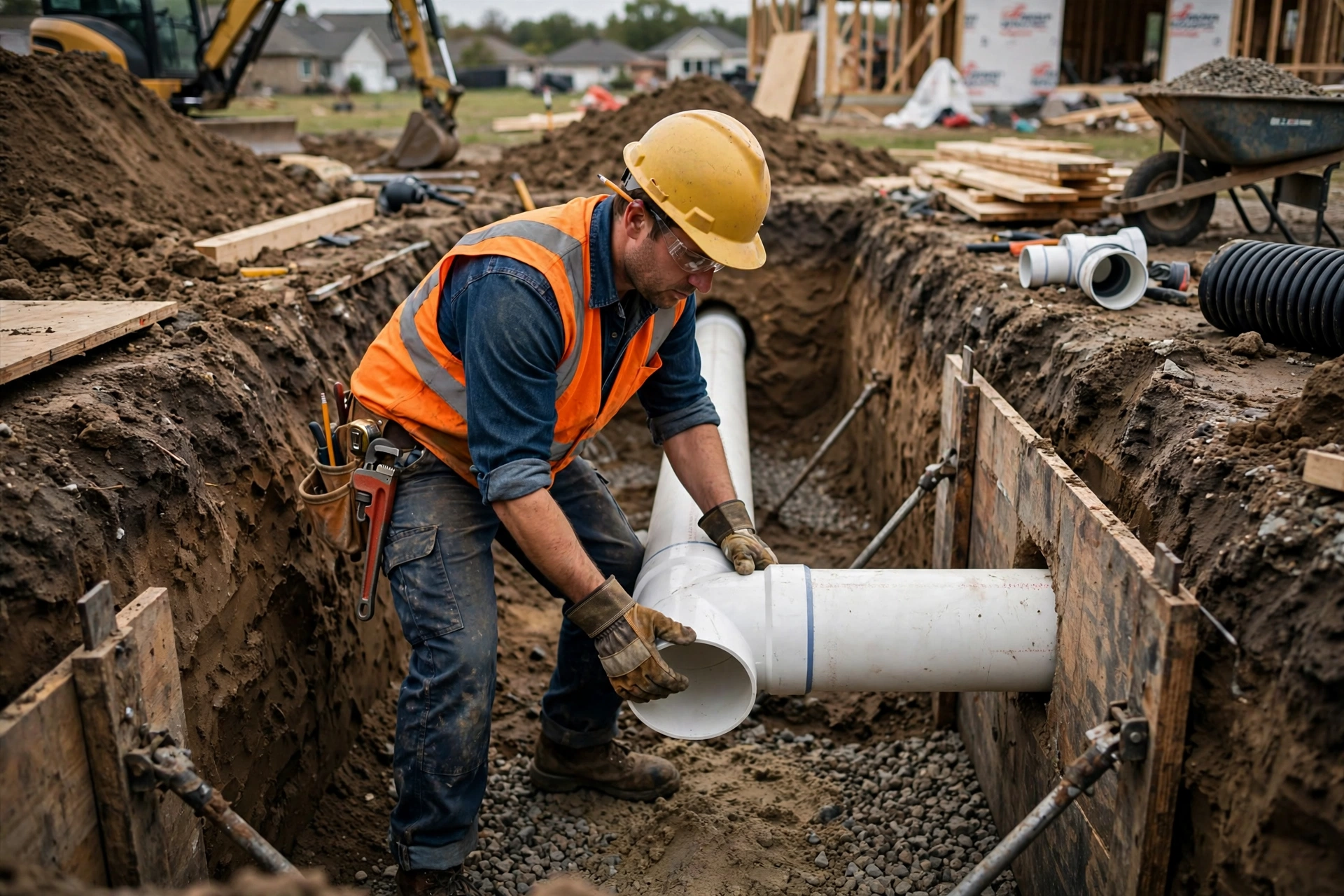
PVC is a white plastic pipe typically cited at 75–100+ years, and ABS is a black plastic pipe cited at 50–80 years. Together they are what your line gets replaced with today. PVC is generally cited at 75–100+ years; ABS at 50–80 years, with a shorter track record. Both resist corrosion and root intrusion far better than older materials, mostly because their joints are solvent-welded into one continuous pipe instead of dozens of separate connections. In Ohio's moving clay soil, that flexibility and continuous joint design is a real advantage.
Modern does not mean invincible. Poor bedding under the pipe, a bad joint, or soil movement can still cause bellies (low spots where water sits) or separations. If you own a 1990s or 2000s home, you are in the best position of any Ohio homeowner, but a camera check every few years is still smart insurance.
PVC is the modern standard: solvent-welded joints, no rust, and a cited lifespan of 75 years or more.
How Do You Find Out What Your Line Is Made Of?
Four ways, in order of reliability:
Camera inspection. The technician sees the material directly and shows you the footage. This is the definitive answer, and it also reveals the condition, which matters more than the material.
Your home's age. Pre-1960 usually means clay tile; 1945–1972 raises the Orangeburg question; 1960s to 1970s could be cast iron or early plastic; 1980s and newer is usually PVC or ABS.
City records. Some Ohio municipalities keep the original building permit or sewer tap records, which sometimes name the pipe material.
Your neighbors. In a subdivision built all at once, your line is probably the same material as the houses around you. If the neighbor just replaced Orangeburg, handle attention.
What Should You Do When Your Pipe Is Near the End of Its Life?
Do not wait for a sewage backup to tell you. If your home's pipe is in or past its cited range, especially Orangeburg or old cast iron, schedule a camera inspection and watch the footage yourself. If the line is structurally sound, lining can add decades without digging up your yard. If it is failing, trenchless repair options like pipe bursting replace it with minimal disruption. If the fix involves digging, call 811 (call811.com) to have utilities marked before anyone breaks ground; the project will need a local permit too, which is standard for sewer work in Ohio. Ohio EPA oversees the state's wastewater programs. That one inspection, done before the emergency, is the difference between a planned project and a crisis. Homeowners in Cleveland and Cincinnati deal with this constantly given the age of the housing stock, and the ones who inspect early always spend less than the ones who wait.
Wondering what the repair itself might run? Our Ohio sewer line repair guide breaks down the plan factors honestly.
Pipe Lifespan FAQs
A camera inspection is the definitive answer: the technician can usually identify the material from the footage. Your home's age gives a strong hint too, since builders used predictable materials by era. City permit or building records sometimes name the material, and neighbors in the same subdivision often have the same pipe.
Almost always. Orangeburg deforms, blisters, and flattens over time, and a pipe that has lost its round shape usually cannot be lined reliably. Replacement, by pipe bursting or traditional digging, is the standard fix. Spot repairs on Orangeburg rarely hold because the rest of the line is aging at the same rate.
Both. Inside, wastewater and gases corrode the pipe wall and build up scale that narrows the pipe. Outside, soil moisture and soil chemistry eat at the exterior. In Ohio, freeze-thaw movement adds stress that can crack weakened walls. A camera inspection shows the interior condition, which is what decides whether the pipe can be descaled, lined, or must be replaced.
Often, yes, if the line still has its basic shape. Pipe lining (CIPP) works inside clay tile to seal joints, block roots, and add decades of life. But lining cannot fix a line that has collapsed, has major bellies, or has joints so offset that the liner cannot pass through. The camera footage decides.
You are in the best position a homeowner can be in, but not invincible. PVC resists corrosion and roots far better than older materials, and it can last 75 years or more. Poor installation, shifting soil, or a bad joint can still cause problems, so a camera inspection every few years is smart insurance even with modern pipe.
Not Sure What Your Line Is Made Of? We Will Show You.
One camera inspection tells you the material, the condition, and your options, anywhere in Ohio.