Sewer Line Repair in Niles, OH
Post-war ranches, aging clay and cast iron, and roots that keep coming back, Niles has its own sewer story. We camera-diagnose every job and fix it trenchless or traditional.
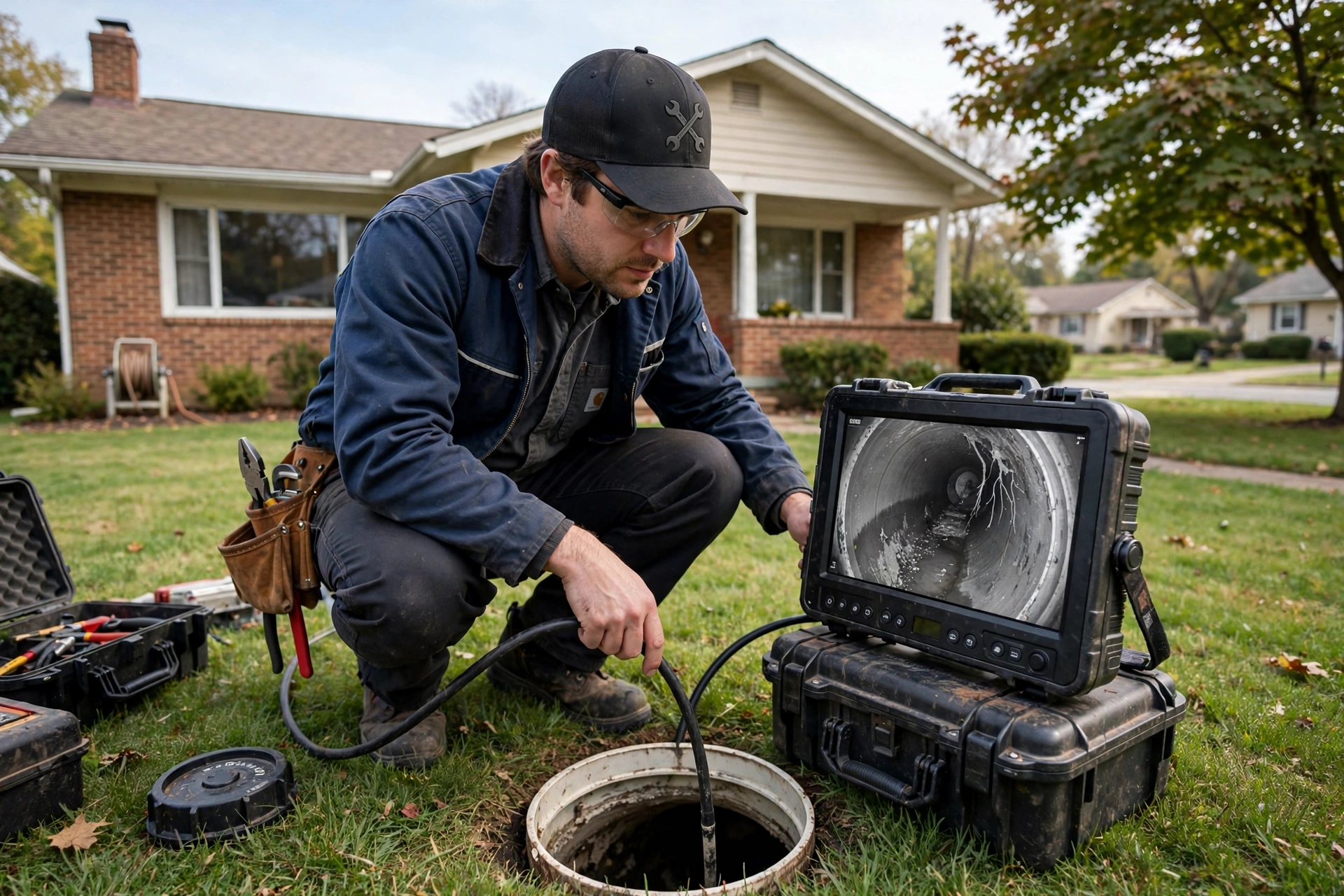
Post-war ranches, aging clay and cast iron, and roots that keep coming back, Niles has its own sewer story. We camera-diagnose every job and fix it trenchless or traditional.
Last updated: October 13, 2026
If you've had your Niles line snaked twice and the backup returned both times, you're not unlucky. You're watching the snaking cycle play out exactly as it always does.
Niles is classic post-war suburbia, and its sewer lines are classic post-war pipe: clay tile with mortar joints, cast iron transitions, and in some 60s and 70s builds, Orangeburg. The mortar joints in a clay lateral have endured 60 to 100 freeze-thaw winters. Every winter, water seeps into the joints, freezes, expands, and wedges them a little wider. Then the mature maples and oaks lining Niles streets send fine root hairs into those damp joints all summer. The roots thicken year after year until they wedge joints apart or fill the pipe.
A snake cuts the roots back, and the drain flows again, for a few months. But the joints stay open, so the roots grow right back, thicker than before. That's the cycle. The way out is sealing the entry points for good: trenchless sewer repair lines or bursts the pipe into one continuous run with no joints for roots to find. One camera inspection shows whether your line is a lining candidate, and most Niles clay laterals are.
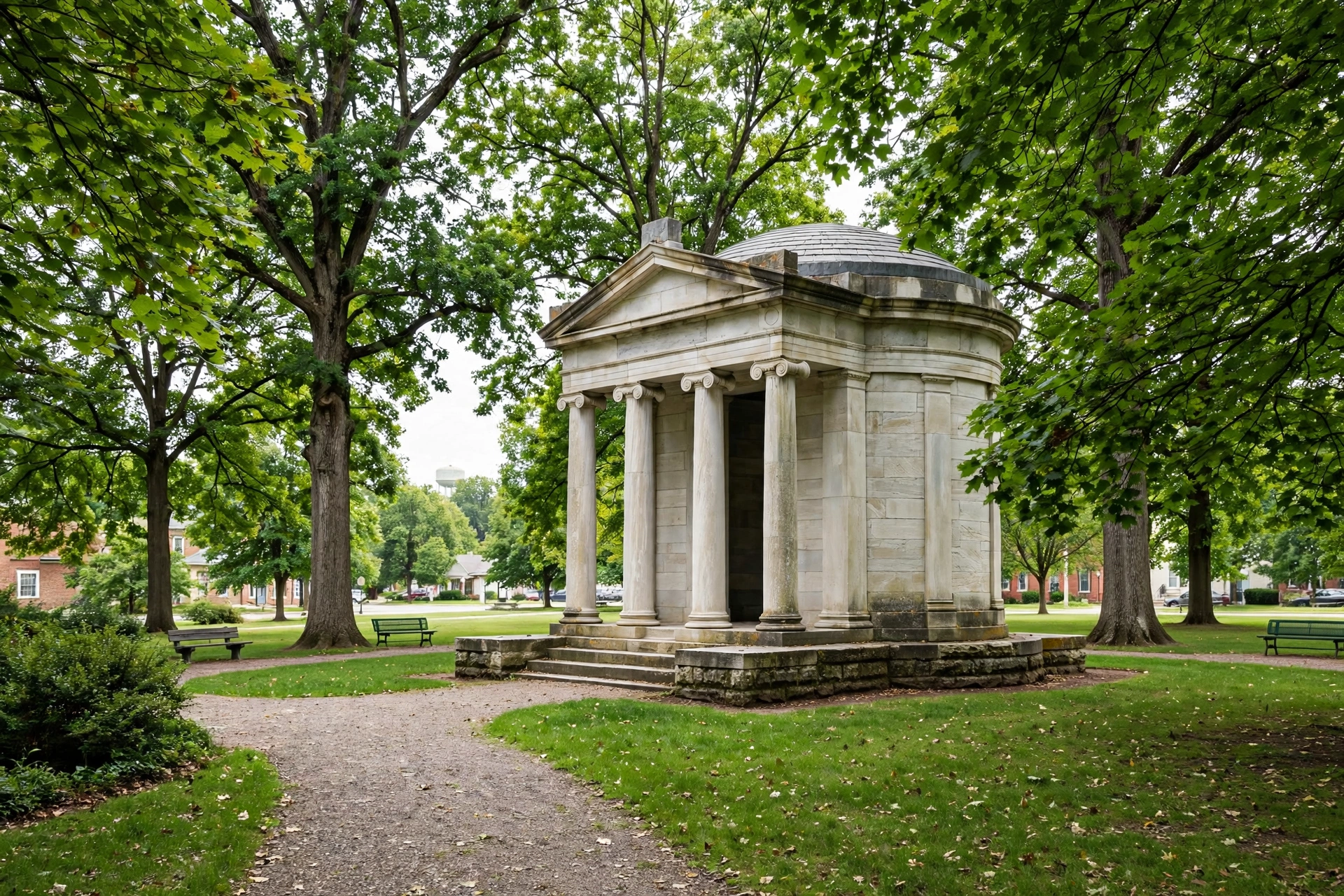
The National McKinley Birthplace Memorial anchors Niles, and the mature trees across town keep finding old clay joints.
Niles housing falls into clear eras, and each era has its pipe. The pre-war homes near downtown and the memorial run vitrified clay tile from stone or brick foundations, with mortar joints that a century of winters has crumbled. The big post-war wave, 1950s ranches and split-levels across Weathersfield and McKinley Heights, typically runs cast iron inside the house transitioning to clay outside. Cast iron rusts from the inside out, it looks fine until the bottom of the pipe is paper-thin, and the 1950s iron in Niles is right at the age where it lets go.
The 1960s and 70s brought Orangeburg to some Niles-area developments, the tar-paper pipe that flattens into an oval and eventually collapses under soil load. Newer builds near the Eastwood Mall corridor mostly have PVC, which holds up well unless a joint was misaligned at installation. Whatever's down there, the camera tells us in about an hour, and the footage doesn't care what decade your house was built in.
Niles shares Trumbull County's hard water, about 9 grains per gallon. That mineral load lays calcium scale inside pipes over the years, and in older clay and cast iron laterals the scale narrows the pipe and gives grease and solids something to hold onto. Scale-related slowdowns look different from root blockages on camera, and they respond to cleaning rather than replacement.
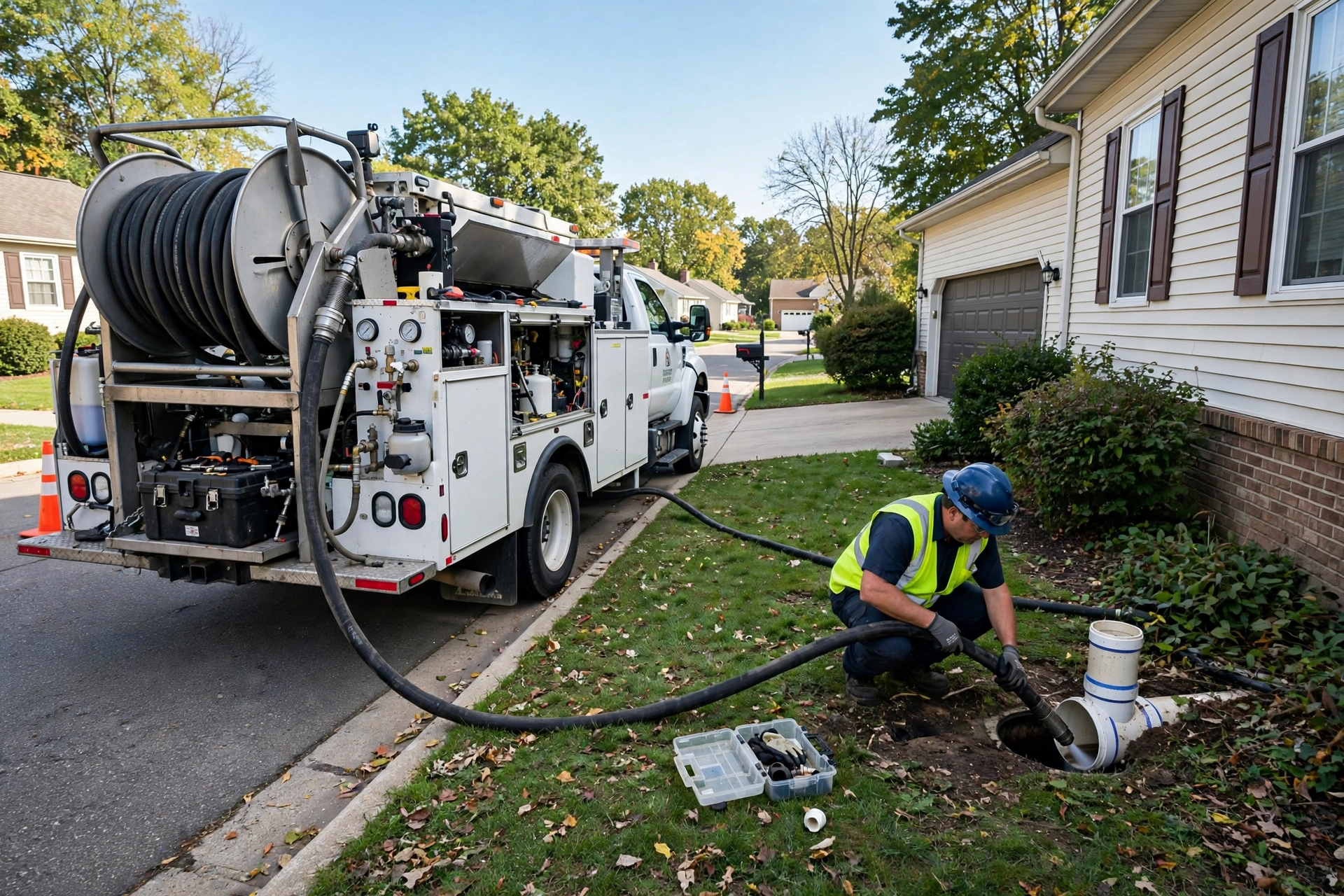
Hydro jetting clears a Niles lateral down to the pipe wall, then the camera shows whether the joints need sealing.
The oldest streets carry the oldest pipe. Around downtown and the McKinley memorial, early-1900s clay laterals meet the town's biggest street trees, the full root-intrusion story. Weathersfield and McKinley Heights, the heart of the post-war ranch wave, are where cast iron laterals are hitting the end of their lifespan right about now, and backups there tend to arrive suddenly, the pipe looks fine until it doesn't.
The commercial corridor along the Eastwood Mall brings its own pattern: restaurants and retail with grease and high-volume use hammering older laterals, plus long runs to the main that give roots more joints to exploit. And along the Mahoning River bottom, the high water table keeps soil saturated, which accelerates joint failure in clay tile. If your drains slow down every spring, you're watching freeze-thaw and root season team up, and a fall camera inspection catches it before winter makes it worse.
Here's the split Niles homeowners need to know. You own the sewer lateral from your house to where it connects with the public main, usually at the street or sidewalk. Everything in between, including the part under your yard and driveway, is your responsibility to maintain and repair.
The city handles the public mains, not your lateral. If sewage is backing up in your home only, the lateral is the prime suspect, and that's our territory. If several homes on your street are affected at once, it may be a main-line problem. The City of Niles runs its own water and sewer system, buying treated water wholesale from the Mahoning Valley Sanitary District. Lateral work in Niles goes through the city, and we pull the permits as part of every job. While Ohio EPA sets statewide wastewater standards, day-to-day permits are handled at the city level, so check with the city's building department before work begins. The full list of what we do statewide is on the home page.
Our crews cover the whole Niles area, from the memorial district out along SR-46 and SR-11. The same camera-first process serves Youngstown and Warren just up the valley, and we're in Canton regularly too.
The whole program is twice a year: a camera check each fall before freeze season, and a wet-weather watch each spring. Fall catches root growth and joint damage while the line is still a lining candidate; spring reveals infiltration after the ground saturates and shows whether winter opened new cracks.
Because snaking clears the symptom, not the cause. In Niles, the cause is usually roots entering through the mortar joints of a clay lateral, the snake cuts the roots back but the joints stay open, so the roots grow back within months. Lining the pipe seals every joint at once, which is why lined lines stop the cycle instead of resetting it.
Most likely cast iron inside the house transitioning to vitrified clay tile outside, the standard 1950s combination. The cast iron is rusting from the inside out right about now, and the clay joints have had 65-plus years of freeze-thaw cycles. A camera inspection shows both materials and tells us whether lining, bursting, or spot repair is the right fix.
Orangeburg is a tar-impregnated fiber pipe used in some 1960s and 70s installations. It was never strong, and after 50-plus years underground it flattens into an oval and eventually collapses. If your Niles home went up in that era, a camera inspection will show it clearly, flattened, blistered Orangeburg can't be lined and needs bursting or traditional replacement.
Lateral repair and replacement in Niles goes through the City of Niles, and we pull the permits as part of every job, so it's included in the written plan, not an add-on surprise. If you're unsure what's required for your specific project, check with the city's building department before work begins.
Ask a neighbor. If sewage is backing up in your home only, the lateral is the prime suspect, and that's our territory. If several homes on your street are affected at the same time, it's likely a main-line problem and the city needs to hear about it. One backup is a lateral problem until proven otherwise.
Also serving McKinley Heights, Weathersfield, Girard, Vienna, and the greater Niles metro. Major landmarks we work around include the National McKinley Birthplace Memorial, Eastwood Mall, and Waddell Park. ZIP codes across our Niles-area service area include 44446, plus nearby 44420, 44473, 44425, and 44440.
One camera inspection shows the real cause, then we fix it for good, trenchless or traditional.
Call (614) 350-5706