Sewer Line Repair in Mansfield, OH
Hard winters, glacial clay, and Victorian-era lines, Mansfield is brutal on sewers. We camera-diagnose every job and fix it trenchless or traditional, with one upfront plan.
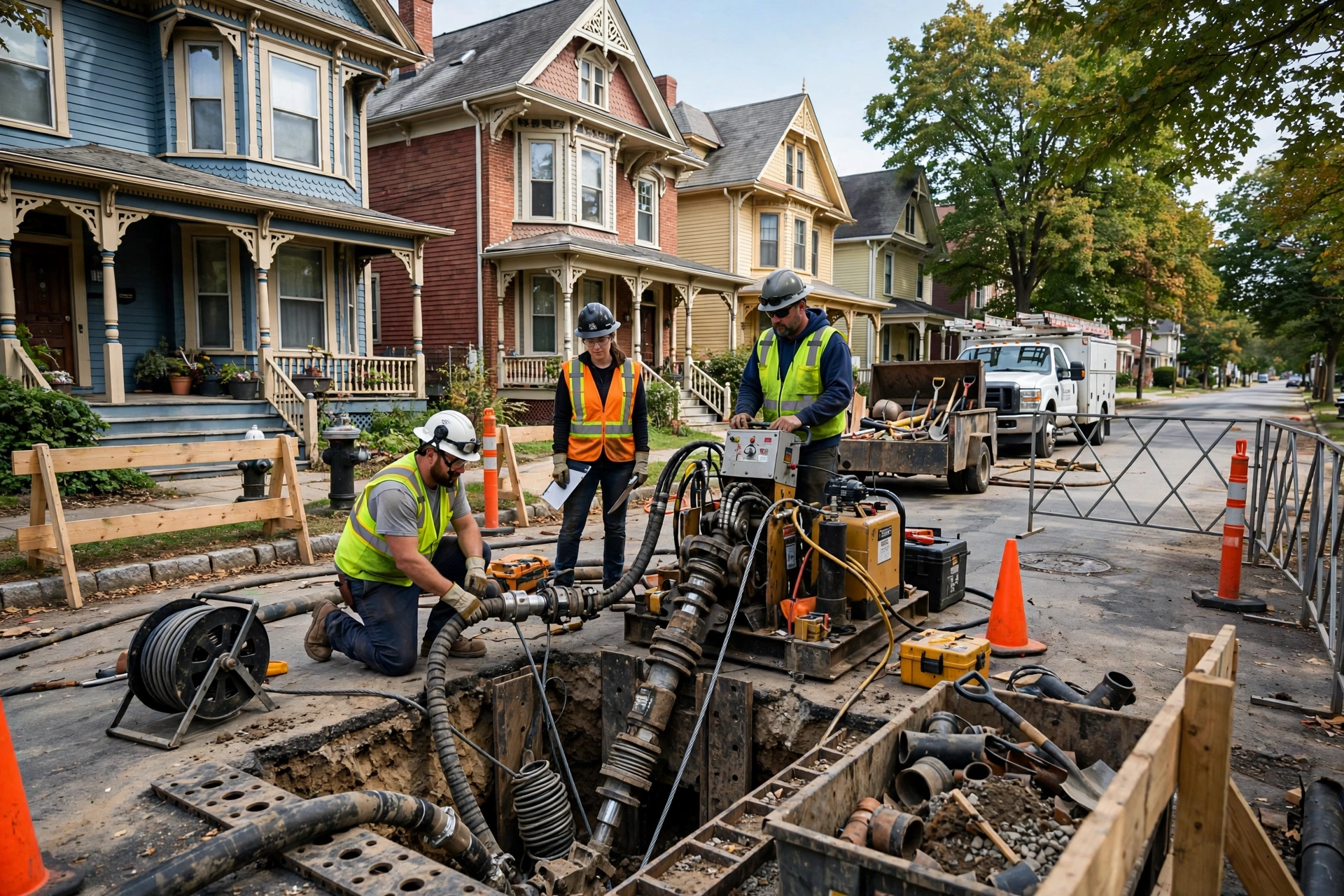
Hard winters, glacial clay, and Victorian-era lines, Mansfield is brutal on sewers. We camera-diagnose every job and fix it trenchless or traditional, with one upfront plan.
Last updated: October 13, 2026
It's not bad luck, it's the freeze-thaw cycle. Mansfield's winters deliver exactly the conditions that destroy buried clay and cast iron pipe, year after year.
Here's how it works. Meltwater and groundwater seep into hairline cracks and mortar joints in your sewer line, the temperature drops, the water freezes and expands with tremendous force, and the crack wedges a little wider. Then it thaws, loose soil washes into the opening, and the next freeze starts from a worse position. Run that loop dozens of times per winter and even solid pipe eventually gives way.
The damage clusters in late winter for a reason. February into March is when the ground starts thawing from the top down while deeper soil is still frozen, water has nowhere to drain, hydrostatic pressure peaks, and weakened lines fail. If your drains slow down every year around the same time, you're watching this cycle in real time. A camera inspection in fall, before freeze season, catches the cracks while they're still lining candidates instead of collapse jobs.

The Ohio State Reformatory anchors Mansfield's east side, and the Victorian-era neighborhoods nearby carry some of the city's oldest clay laterals.
Mansfield's housing tells you exactly what to expect underground. The Victorian and early-1900s homes around downtown and the carousel district run vitrified clay tile from stone foundations, with mortar joints that 130-plus years of freeze-thaw have crumbled. The post-war boom in Ontario and the west side brought ranches and split-levels with cast iron laterals, and cast iron rusts from the inside out, it looks fine until the bottom of the pipe is paper-thin.
The 1960s and 70s added Orangeburg to some Mansfield-area developments, the tar-paper pipe that flattens into an oval and eventually collapses. Newer builds in Ontario and Lexington mostly have PVC, which holds up well. Whatever's down there, the camera tells us in about an hour, and the footage doesn't care what decade your house was built in.
Richland County's groundwater is very hard, around 15 to 16 grains per gallon in the Mansfield area. Decades of that mineral load coat pipe interiors with calcium scale, narrowing older lines and giving grease and solids a rough surface to grip. A camera inspection tells scale buildup apart from breakage, and the two call for different fixes.
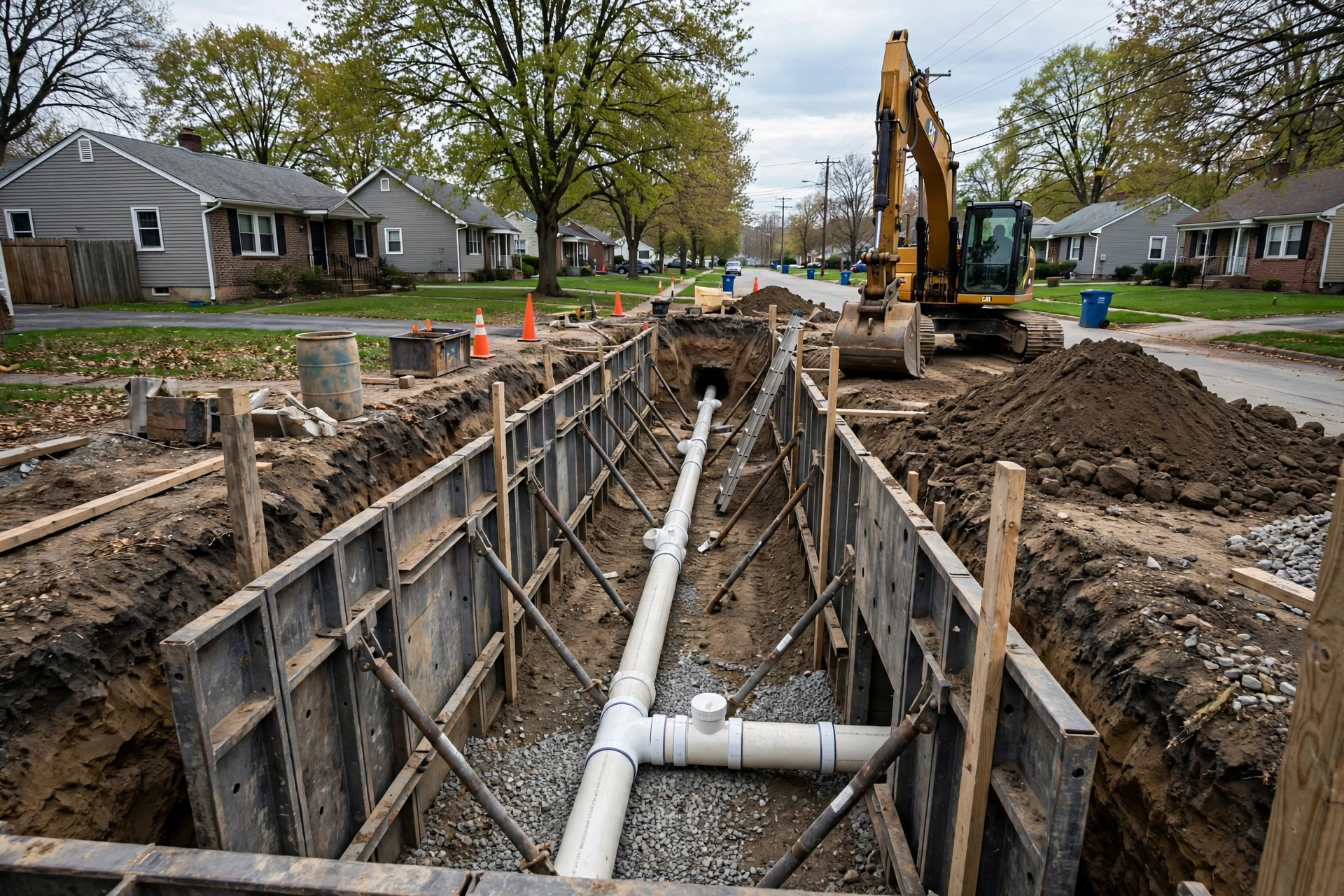
When a Mansfield lateral is fully collapsed, traditional replacement with new PVC is the right call, and we pull the permits.
Age of housing plus tree canopy predicts trouble better than anything. Around downtown and the carousel district, 130-year-old clay laterals meet mature street trees, the full root-intrusion story. The neighborhoods near the Ohio State Reformatory have the same early-1900s clay story with the added wrinkle of glacial clay soil that heaves the pipe every season.
In Ontario and the west side, the post-war ranches are hitting the age where cast iron laterals thin out from the inside, and backups there tend to arrive suddenly. Lexington and Shelby bring a mix of older village housing and newer builds, plus longer laterals and rural properties where septic-to-sewer transitions are still happening. Wherever you are in the Mansfield area, the prescription is the same: camera first, then fix what's actually broken. Our trenchless sewer repair options keep most jobs to a single day.
Here's the split Mansfield homeowners need to know. You own the sewer lateral from your house to where it connects with the public main, usually at the street or sidewalk. Everything in between, including the part under your yard and driveway, is your responsibility to maintain and repair.
The city handles the public mains, not your lateral. In the oldest parts of town, those mains may still be combined sewers carrying both sewage and stormwater, which is why heavy rain can push backups back toward basement drains in those blocks. The EPA's sanitary sewer overflow guide explains how overloaded lines push sewage back into basements. A backwater valve on your lateral stops that reverse flow, and we install them. Mansfield's water and sewer run through the City of Mansfield's public works sewer and water repair departments. Lateral work in Mansfield goes through the city's permit process, and we pull the permits as part of every job. If you're unsure what's required for your specific project, check with the city's building department before work begins. Our full service list is on the home page.
Our crews cover the whole Mansfield area, from downtown out along I-71 and US-30. The same camera-first process serves Marion and Ashland, and we're in Wooster regularly too.
Mansfield's water is very hard, around 15 to 16 grains per gallon from Richland County groundwater. Decades of that mineral load coat pipe interiors with calcium scale, narrowing older lines and giving grease and solids a rough surface to grip. A camera inspection tells scale buildup apart from breakage, since the two call for different fixes.
The whole program is twice a year: a camera check each fall before freeze season, and a wet-weather watch each spring. Fall catches root growth and joint damage while the line is still a lining candidate; spring reveals infiltration after the ground saturates and shows whether winter opened new cracks.
Mansfield's winters deliver dozens of freeze-thaw cycles per season. Water seeps into pipe cracks and joints, freezes, expands, and wedges them wider, then thaws and lets soil wash in. February into March is the worst stretch: the ground thaws from the top down while deeper soil is still frozen, water has nowhere to drain, pressure peaks, and weakened clay and cast iron lines start failing in clusters.
Almost certainly vitrified clay tile with mortar joints, running from a stone foundation out to the street. After 130-plus years the mortar joints are crumbling and sections have shifted with the glacial clay soil. If the pipe still holds its shape, these old clay laterals are excellent candidates for trenchless lining, which is good news for historic homes you don't want disturbed.
The oldest parts of Mansfield, around downtown, were built when one pipe carried both sewage and stormwater, standard practice a century ago. During heavy rain those lines can surcharge and push sewage back toward basement floor drains. A backwater valve on your lateral is the best defense in those blocks, and we install them.
You own the lateral from your house to the connection at the public main. The city handles the mains through its public works sewer and water repair departments. If sewage is backing up in your home only, the lateral is the prime suspect; call us at (614) 350-5706. If several homes on your street are affected, contact the city, it may be a main-line issue.
Usually, yes. Trenchless lining and pipe bursting replace or renew your lateral through small entry pits, your yard, driveway, and landscaping stay intact. Most trenchless jobs finish in a single day. We confirm your line is a trenchless candidate with a camera inspection first, then give you the method and the fixed plan in writing.
Also serving Ontario, Lexington, Shelby, Bellville, and the greater Mansfield area. Major landmarks we work around include the Ohio State Reformatory, the Richland Carrousel Park, Malabar Farm State Park, and OhioHealth Mansfield Hospital. ZIP codes across our Mansfield-area service area include 44902, 44903, 44905, 44906, and 44907.
One inspection, one honest diagnosis, one upfront plan, anywhere in the Mansfield area.
Call (614) 350-5706